E-2/C-2 Program jumps on the AIRSpeed bus
Hawkeye 2
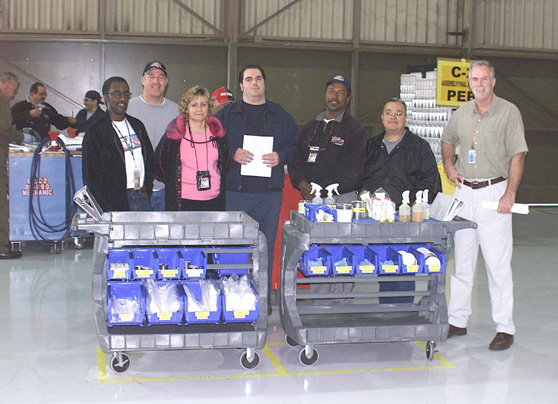
An E-2 Hawkeye team shows us the commodities and hazardous materials carts inside a cell in a hangar. From left: Sammie Williams, Daniel Morin, Denise Brent, Kevin Carrasco, Lloyd Baker, Mark Archuleta, and Conor Goulding. Joe Feliciano
Hawkeye 3
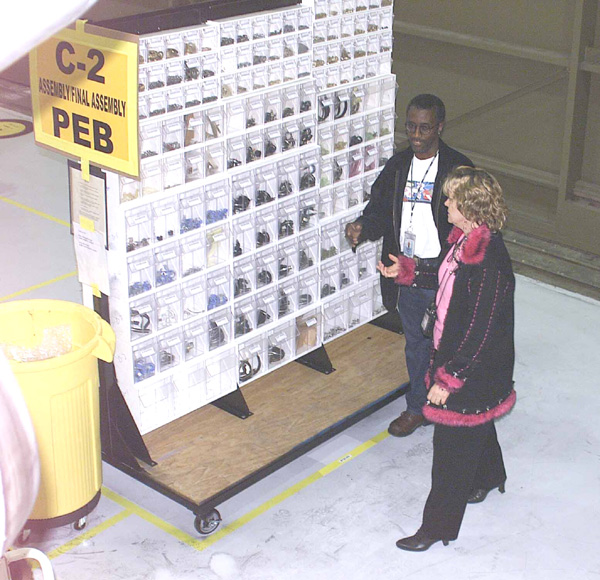
Sammie Williams and Denise Brent examine pre-expended bins (PEBs) that are in each cell. Joe Feliciano
E-2/C-2 Program: a passenger on the AIRSpeed bus
By Bill Bartkus
NAVAIR Depot North Island
CORONADO, Calif. – Another program at NAVAIR Depot North Island here hopped on the AIRSpeed bus and is flying towards faster, cheaper, and better methods of accomplishing business and helping the warfighter to accomplish the Navy’s mission. The E-2C Hawkeye and the C-2A Greyhound Program is the latest to get aboard the AIRSpeed bus.
“We needed to reduce turnaround time on Planned Maintenance Interval on the E-2 Hawkeye and the C-2 Greyhound, and we’re using AIRSpeed tools to pursue our goal,” said team champion Conor Goulding, whose job it is to coordinate efforts so the team may reach its goal. Brian Delaney is the team lead.
Goulding said that the team is employing AIRSpeed tools “by identifying bottlenecks and constraints to eliminate waste, plus reduce WIP (work in process) in the hangar.” Everyone on Goulding’s team has been trained in AIRSpeed and judging from the looks inside the hangar, the E-2 and C-2 teams are flying in the right direction.
In the hangar, there is a place for everything and everything is in its place. Colored tape on the floor indicates where everything goes right down to brooms and trash cans. Nothing is out of its place unless it’s being used.
The team uses value stream mapping, an AIRSpeed tool. Goulding said that artisans and experts sit down in a room and map out a process to work on the aircraft. “In this manner, we identify the work flow, the work that needs to be done to progress the airplane. Then we isolate the waste and the constraints,” he said. This methodology helps the Depot to reduce cycle time, which reduces turnaround time. “This process ultimately pleases customers and the artisans working the product,” Goulding stated.
“What we’re doing is common sense, not rocket science,” said core team member Lloyd Baker. “Artisans have been doing this level of work for years, but the AIRSpeed program places our level of work on an even higher priority. Turnaround time is even faster now, and that’s the way it should be.”
Goulding mentioned that every team develops a standard operating procedure. “Every invent starts with quality assurance, Engineering, and FISC (Fleet and Industrial Supply Center) to insure that the Depot doesn’t have backsliding, the unwanted event of things going back to the way they were before AIRSpeed,” Goulding said. “The SOPs (standard operating procedures) will ensure that this does not happen,” he said.
Every cell on the hangar floor will have a SOP.
Goulding stated that artisans work with the AIRSpeed team to identify everything that is required to work the aircraft in each particular phase such as tooling, hazardous material, commodities, PEB (Pre Expended Bin), and IPB’s (Illustrated Parts Breakdown). “Knowing this will help us to decrease our turnaround time by using Point of Use methodology,” he said. Everything will be kept within the cell so the artisan won’t have to go far just to get a tool or a part. Everything will be within reach.”
Denise Brent said that artisans are coming to see her with their ideas on accomplishing the job faster. “Engineers are calling me with ideas, but I have to tell them that we aren’t at that particular stage yet. But, I note the suggestion and use it when the time comes,” she said. “I also get ideas from artisans almost daily and this shows to me that there is a lot of enthusiasm towards AIRSpeed and creating a better workplace.”
Aircraft mechanic crew leader Daniel Morin said that the whole point of AIRSpeed to him is to empower the worker to tell supervisors what is happening. He used an analogy of a doctor helping a patient. “When a doctor needs an item to help a patient, he doesn’t leave the patient; rather, he instructs a nurse to bring him the item. The workers are the doctors, and the aircraft is the patient. If a worker needs an item for the aircraft, it’s there in the cell; the worker isn’t waiting in a line for a item wasting taxpayer dollars,” he said. “We’re improving the work process while providing a quality product for the warfighter.”
Beyond cellular development and Point of Use employment, Goulding stated the E-2 and C-2 AIRSpeed team has launched into a visual kitting process and Examination and Evaluation material disposition on the floor, at the aircraft during disassembly. “The goal is to know the material condition of the aircraft and have the material visually kitted for the assembly phase at the completion of the disassembly phase,” he said.
He noted that Depot leadership is behind their efforts. “The commanding officer, the AIRSpeed Deployment Office, Product Management, and competencies are providing us with the support and assistance we need,” Goulding said firmly. “We are empowered to make the necessary changes to make AIRSpeed a reality for the E-2 and C-2 product line and ultimately the warfighter.”
Sammie Williams said that the Depot’s quality of work cannot be questioned. “AIRSpeed gives us the ability to compete with anyone anywhere on turnaround time. AIRSpeed reduces our turnaround time,” he said emphatically. “We’re untouchable!”
NAVAIR provides cost-wise readiness and dominant maritime combat power to make a great Navy and Marine Corps team better.