Disestablishment Ceremony for Naval Test Parachute Team
Released by Naval Air Warfare Center Weapons Division China Lake Public Affairs Office--
by Steve Boster
For 61 years, members of the Naval Test Parachute Team were ready and willing to be first out the door, risking their lives testing new parachute and escape systems. On June 1, that long tradition ended when the team was disestablished at China Lake.
Colonel Mark Bamberger, Commanding Officer, Military Operations, Research and Engineering Department, praised the Sailors who formed the team, saying it wasn’t so much the training or even the skills that made a difference. “Their key asset is their heart.” He added that their commitment and their willingness to strap on a new parachute system to ensure it worked when a pilot needed it in an emergency made a real difference to many pilots who survived emergency ejections and bailouts.
Retired Air Force Colonel Joseph Kittinger, who made his first parachute jump with the Navy team in 1955 as a young fighter pilot, was the guest speaker. Kittinger’s first jump began with a 10-second free fall. In 1960, while serving with the Air Force’s Escape Section of the Aeromedical Laboratory, he flew a balloon to 102,800 feet, and then stepped out of the gondola into the black of space. This time his free fall set records, taking him nearly five minutes to reach 17,500 feet before his parachute opened. During his free fall, he reached speeds of more than 600 miles per hour, still a record for unpowered human flight. Following three combat tours in Vietnam and 11 months as a POW, Kittinger went on to set many ballooning records, including becoming the first person to fly a balloon solo across the Atlantic Ocean.
Kittinger noted this was a sad day because of the decommissioning, but that the test parachutists should be proud of their legacy. The 339 men and women who served on the team made more that 67,000 jumps during 61 years and have a great tradition of success.
“The Navy and the country are indebted to you for your accomplishments, “ Kittinger said of the Test Team. “You have a great tradition and in the words of one of your pioneer jumpers, you are immortal, bulletproof and invisible.”
Former NAWCWD Commander RADM Dave Venlet sent a message congratulating the team on their history of success and noting that he was proud to have jumped with the best during his tenure at China Lake. “Do not sorrow for the sunset of a team, “ Venlet advised, “but tell your honorable stories of bravery long into this night; and carry your noble memories of comrades, your daring work, in your hearts forever. I will never forget you. Thank you for your inspiration to me, and all who knew you. Carry on, shipmates! Well done!”
The team was established at Lakehurst, N.J. in 1944, moved to El Centro, Calif. in 1946, then moved to China Lake in 1979. Among the systems tested by the team were the Navy’s first ram-air parachute; the P-3 thin pack, the advanced ram-air system, the modified reserve parachute system, the E-2C personnel survival ensemble and NASA’s space shuttle crew escape system. They also worked in testing NASA’s Pathfinder parachute used to land on Mars. In addition, they trained personnel from many commands and all services in basic parachute skills. Thirty-five former test parachutists from all branches of the U. S. Armed Forces are currently deceased.
While June 1 marked the disestablishment of the Naval Test Parachute team, which is the result of workload and budget decisions, it does not mark the end of the team’s legacy or the future of parachute testing. Civilian and military personnel, men and women of the Human Systems Department at NAWCWD and qualified parachutists throughout the Fleet continue to work with these systems, and new systems as they evolve, to ensure the future safety of parachute systems.
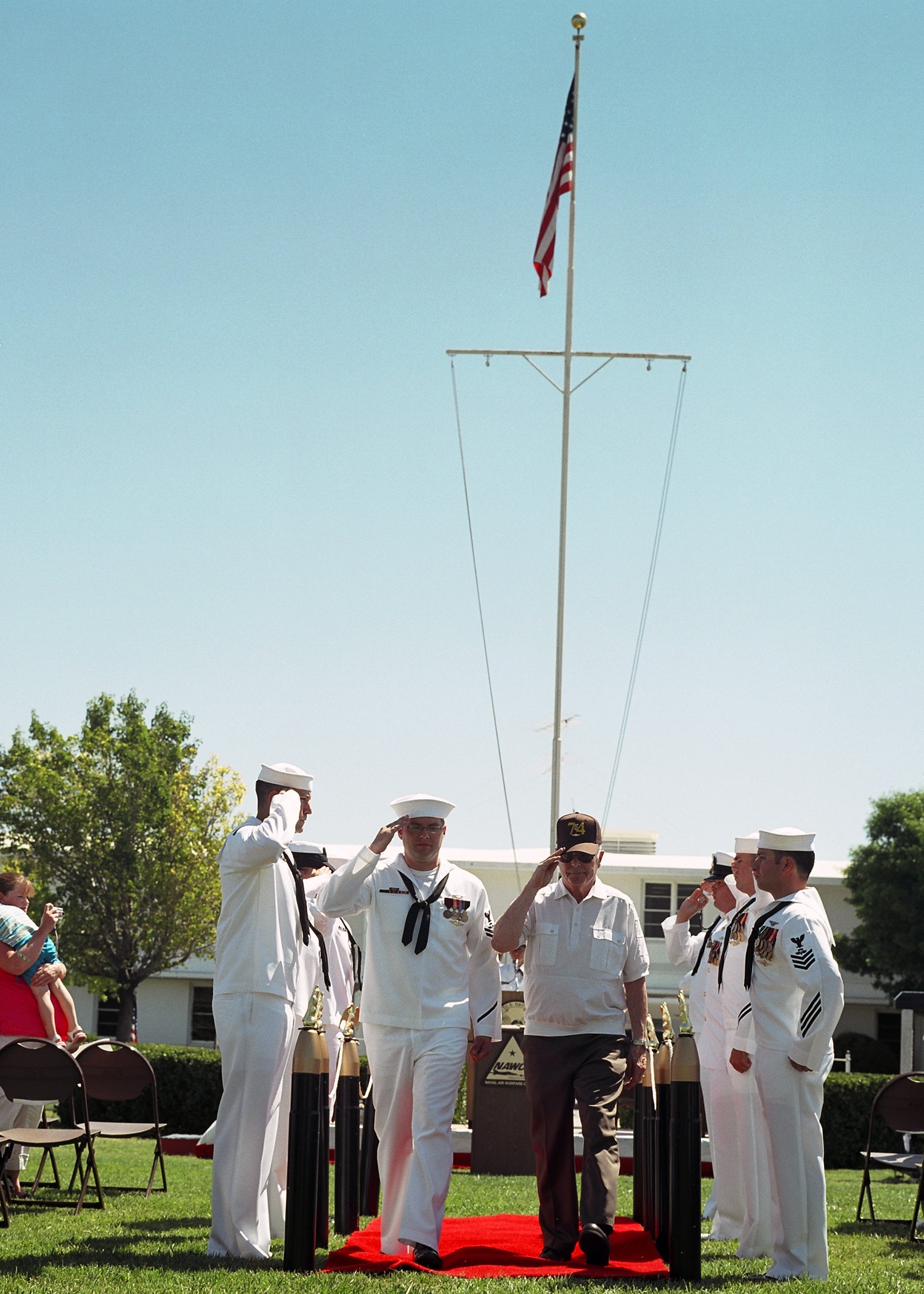
LCDR Barbara Lewis, Officer in Charge of the Test Parachute Branch, concluded the event by setting two traditions in motion. “At the end of each day, when the duty officer retired or at the end of each log book, there would be a signature and a notation of “No Further Entries”, Lewis said. “Additionally, the Navy honors the sacrifice, courage and steadfast devotion to duty by the current crew and those from the past by having the oldest and youngest present take part in a ceremony.”
To close the book on the team and 61 years of accomplishment, the oldest test parachutist, retired Master Chief Hal Picard and the youngest, PR2 Mark Cusimano made the final entries to the team’s log and the team marched into the history books.
####
Cutline: Junior and senior test parachutists PR2 Mark Cusimano and retired Master Chief Hal Picard are piped ashore as part of the disestablishment ceremony of the Naval Test Parachute Team.