
C-2A given back to fleet in record time
C-2A Workers
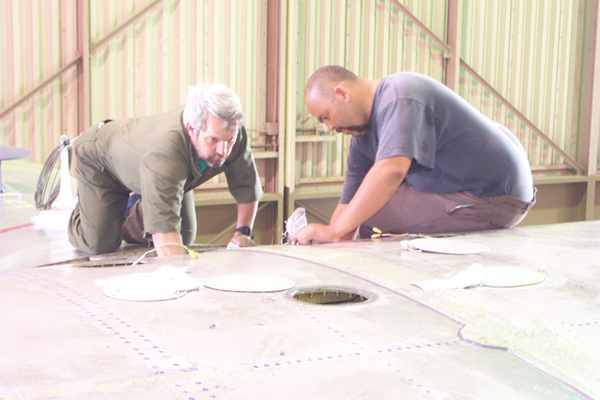
Robert Richardson (left) and Juan Gonzalez work on a C-2A center wing leading edge. Bill Bartkus
C-2A given back to fleet in record time
By Bill Bartkus
NAVAIR Depot North Island
NAS NORTH ISLAND – Webster’s Dictionary defines greyhound as a sleek swift breed of dog.
To the Navy, Greyhound is an aircraft that is used to fly people and precious cargo to carrier strike groups at sea.
To artisans and engineers with the E-2/C-2 Program at NAVAIR Depot North Island, Greyhound is a product that can be safely delivered back to the fleet in 287 days after going through a Service Life Extension Program (SLEP) using the AIRSpeed concept of Lean.
The C-2A is the only means to fly people and cargo to carriers at sea, and the Navy does not have a suitable type aircraft to replace the aging Greyhound. Several years ago, the Navy decided to extend the Greyhound’s lifespan by 20,000 flight hours through SLEP. The program has been ongoing at the Depot for several years.
“We try to return aircraft to the fleet in as little time as possible,” said Brian Delaney, E-2/C-2 deputy program manager. “In order to achieve our goal, we implemented AIRSpeed techniques, and we started in the SLEP cell.”
Delaney said that the program uses point of use tooling and technical data. “By doing this, we decreased flow time,” he said.
AIRSpeed techniques cut the time down in two cells that decreased the time when the aircraft went to the Test Line. According to Delaney, “this gave Test Line personnel a fighting chance to meet critical dates.”
“Rather than produce an aircraft in an average of 372 days, we completed one in 287 days,” he said.
“This is a first for the Depot and a remarkable achievement,” said Capt. Tim Trainer, Depot commanding officer. “Everyone who had a hand in returning this C-2 back to the fleet in record time, should be proud of this accomplishment. I salute them all.”
“Our efforts paid off in several different ways, and the AIRSpeed tactics that we took worked to our advantage,” said Ben Duysings, program planner.
Probably the biggest problem that keeps an aircraft from leaving the Depot and going back to the fleet is getting material on time. “One of the AIRSpeed concepts that we implemented was identifying the materials that we needed to work on this aircraft as early as possible during the disassembly stage,” Duysings said. “This goes a long way in getting an aircraft on time or under time. This was a big factor in completing this aircraft sooner,” he said.
Sheet metal supervisor Louis Sena said that his team took care of all of the metal discrepancies on the Greyhound. “Having the SLEP team on hand added that much needed expertise in getting the plane done faster,” he said.
Delaney mentioned that having a second shift played a big role in getting the aircraft back into the hands of the fleet faster.
“The artisans were instrumental in getting the job done faster. “Getting the cells put together under AIRSpeed and implementing the processes helped,” said Delaney. “Get the ideas from the artisans and put the processes in place.”
Duysings said, “This was definitely an empowerment for the artisans and brought them into the AIRSpeed picture. It gave them a sense of product ownership.”
Delaney mentioned that the artisans at first were apprehensive towards the evolution of the AIRSpeed process. “They had a ‘let’s watch and see what happens’ attitude,” he said. “When they saw that the teeter totter was going to move in the other direction, they quickly jumped on board.”
Sena said that artisans are free to write down their ideas and post them on a board. “This gives them a voice in the AIRSpeed process. And some of them have given us some great ideas,” he said.
Delaney rates each cell from A to F, and rating cards look like those seen inside restaurant windows. “The card tells the artisans if their cell is functioning smoothly and whether or not it complies with the 6S Lean process under AIRSpeed. If their cell isn’t rated A, artisans know what they need to do to get it in A shape,” he said.
Delaney’s rating card concept is similar to the five Ps of managerial skills: Proper planning prevents poor performance.