
Fleet introduction team provides input to early MMA planning
By Renee Hatcher
MMA Public Affairs
To make sure NAVAIR’s Multi-Mission Maritime Aircraft (MMA) Program Office does not forget who its customer is as it leads the way in replacing the Navy’s rapidly aging fleet of P-3C Orions, it stays in constant contact with those who will ultimately operate the Navy’s next generation sub hunter – the warfighter.
The MMA Fleet Introduction Team (FIT) makes communication between NAVAIR and the fleet possible. Cmdr. Andy McCartin assumed responsibilities as the MMA FIT project officer in August 2004 and said he is proud to contribute to the successful acquisition of MMA.
“We are the bridge between the fleet and the MMA program office,” McCartin said. “These planes are being designed for the warfighter so it only makes sense to have the end user involved early in the acquisition process.”
Currently, the FIT consists of 10 technically qualified fleet personnel and civilian experts whose purpose is to provide continuity, liaison, training, guidance and related support to commands that are directly involved with the MMA acquisition.
“We recently hosted the first of several major strategy sessions with the fleet – the MMA Fleet Working Group,” said Capt. Steve Eastburg, NAVAIR’s Maritime Surveillance Aircraft Program Manager. “We’re not doing this in a vacuum. We’re working closely with the FIT to provide a state-of-the-art total weapon solution for the future of the Navy's maritime patrol and reconnaissance force.”
Although the FIT works directly for Commander, Patrol and Reconnaissance Group in Norfolk, Va., it is made up of personnel from the P-3 fleet replacement squadron and is stationed in Jacksonville, Fla. Its primary responsibility will morph over time from an advisor/consultant function to more of a training role as the acquisition of MMA progresses. The FIT will eventually manage all fleet introduction issues and will coordinate all training required for those transitioning from the P-3C to MMA.
“We are the single point of contact for all fleet input to the MMA program office,” McCartin said. “But, we are not the sole source of information. We solicit input from all working levels including deck plate Sailors, pilots and naval flight officers. We are in an enviable situation. Our prime contractor, Boeing, solicits our input, our program office promotes our participation and the Fleet either contributes or validates our contribution.”
The FIT provides a necessary conduit of information between the fleet and the MMA program office. McCartin said he and his team communicate regularly with NAVAIR – sometimes daily but at least two to three times a week.
“The FIT gives the Navy-Boeing Integrated Test Team a current operator’s perspective as we go forward in the development of MMA,” said Cmdr. Joe Rixey, MMA Integrated Product Team lead. “Hearing the voice and seeing the face of the fleet helps keep us all focused on our fleet customer. We work directly with the FIT to tightly manage “requirements creep”. This is paramount for a program during its early development and design phase like MMA.”
PHOTO CAPTION
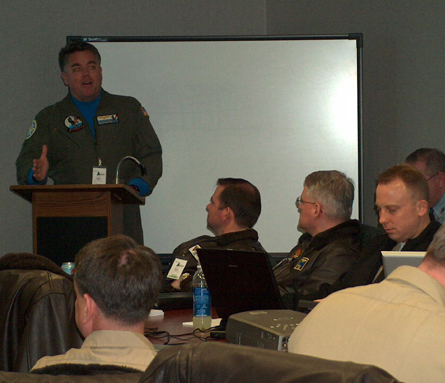
Cmdr. Andy McCartin, talks about how the Fleet Introduction Team is contributing to the successful acquisition of the Multi-Mission Maritime Aircraft during the MMA Working Group hosted by NAVAIR’s Maritime Surveillance Aircraft Program Office Feb. 8-9 in California, Md.