PATRIOT Radar Range Finder Team Recognized for Acquisition Innovation
Released by Naval Air Warfare Center Weapons Division Public Affairs Office--
by Monte Frisbee, ATAC
Naval Sea Systems Command (NAVSEA) Program Executive Officer for Submarines, RDML J.D. Butler, honored the Naval Air Warfare Center Weapons Division (NAVAIR Weapons Division)-led PATRIOT radar range finder development team by nominating it for the prestigious David Packard Excellence in Acquisition Award.
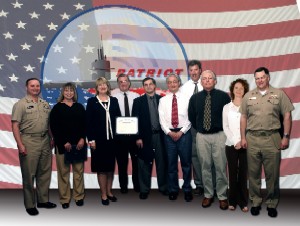
As a nominee, the team received the Defense Certificate of Recognition for Acquisition Innovation, presented by CAPT David Portner, NAVSEA Program Office PMS 435 and RDML Mark Skinner, Commander of NAVAIR Weapons Division.
This is an unusual combination of acquisition innovation at the Weapons Division, combining technical work from both the Weapons Division and the Naval Undersea Warfare Center (NUWC) at Newport, Rhode Island.
This project is an example of how two large government laboratories achieve a common goal. They created an environment that nurtured the development and demonstration of a miniature, collision-avoidance and situation-awareness radar system usable by the entire attack submarine fleet.
The need for this radar was realized after a Los Angeles class submarine collided with the Japanese fisheries research ship, the Ehime Maru, off the island of Oahu in February, 2001.
The Chief of Naval Operations and Commander, Submarines, Pacific (COMSUBPAC) determined that an existing proposal from the Weapons Division could help avoid a repeat incident by developing a smaller, mast-mounted radar.
A team was formed with representatives from Government Laboratories, Canadian-based Amphitech International, WaveBand Corporation and Sperry Marine. They developed the radar and conducted an at-sea demonstration, all within 13 months.
Requirements demanded the new radar fit atop the submarine mast in a space no larger than a two-pound coffee can, without extra wiring or disrupting existing parts.
The radar performed as designed, receiving rave reviews from crews familiar with its capabilities. This breakthrough brings precise situational awareness performance to the submarine, a benefit never before enjoyed by a submerged platform.
Excellent coordination between the procurement and scientific communities allowed the short schedule to achieve this success.
Team requirements for both government and commercial members were realized in a single Statement of Work, clearly outlining each team member’s responsibility. This was essential, as no “prime integrator” was used.
Contractors on the team set up a task-sharing arrangement to troubleshoot problems as they occurred. Throughout the project, contractors put competition aside and openly shared ideas.
The team’s management felt that this short schedule needed complete openness among all the government laboratories, sponsors, and vendors. For this effort, Alpha Acquisition was authorized to provide the open communications needed between the government and all the contractors. All participants were introduced at a kickoff meeting at the NUWC laboratory.
The new radar, now in high-rate production, is providing a unique ability to each fleet attack submarine. Spiral engineering techniques are being used to improve the first design, while Phase B of the radar enters development at the Weapons Division.
######
Photo cutline:
RDML Mark Skinner (right), NAVAIR Weapons Division Commander, and CAPT David Portner (left), NAVSEA Program Manager, recognized the achievement of the PATRIOT radar range finder development team on 28 April 2005. Team members are (left to right): Debbie Winfield, Diane Foucher, Monte Frisbee, Robert Bernier, Phuc Nguyen, Terry Kenyon, Mike Anderson, Colette Nalley.