
Dr. Bill Webster Retires From China Lake After 34 Years of Service
Released by Naval Air Warfare Center Weapons Division, China Lake Public Affairs Office--
by Steve Boster
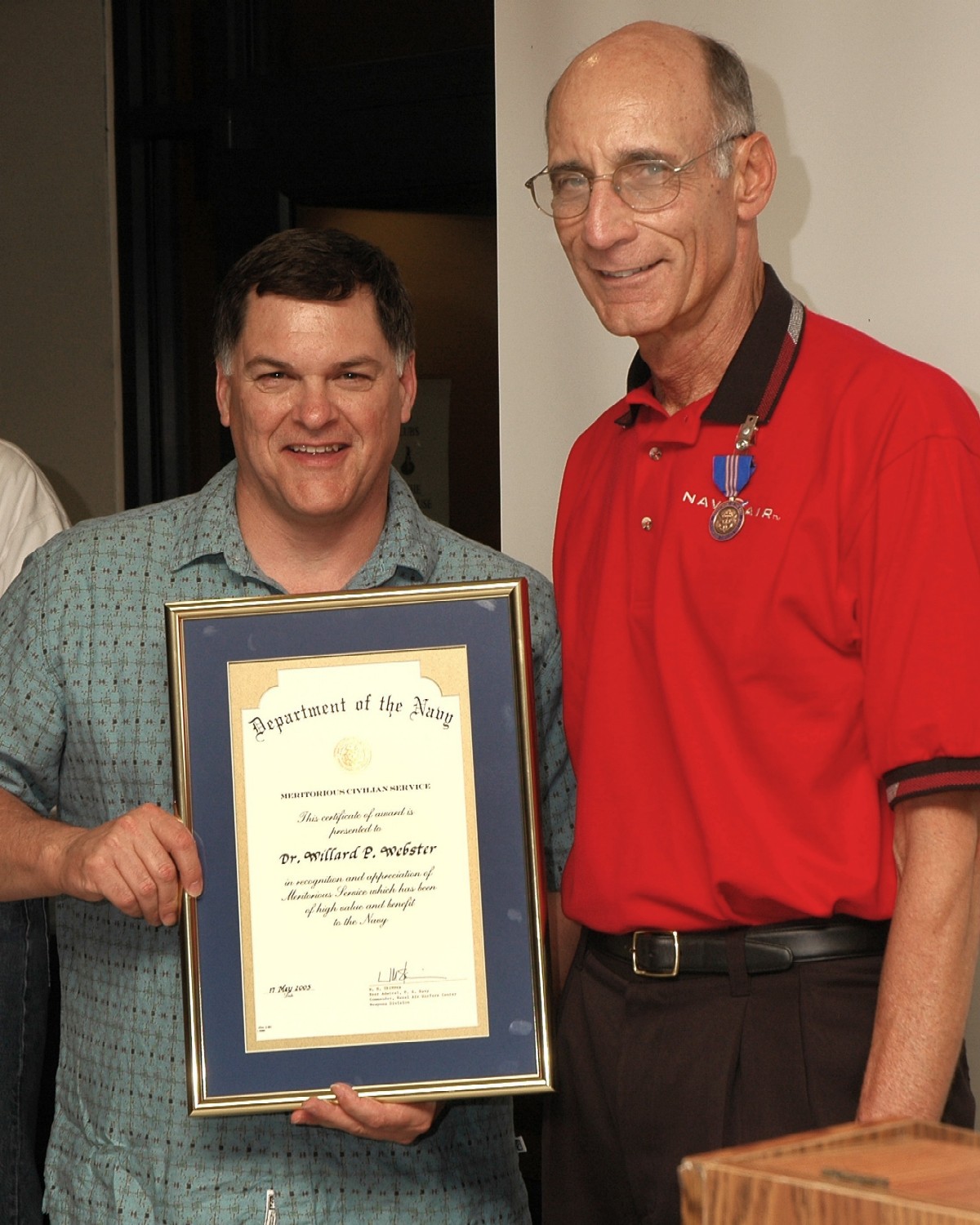
Years of exceptional accomplishments in the areas of technology management and technology transfer brought the Navy Meritorious Civilian Service Award to Dr. Willard (Bill) Webster at his recent retirement from the Naval Air Warfare Center Weapons Division (NAWCWD).
In a fitting end to 34 years of service to the Navy, Webster received the prestigious award from Rear Admiral Mark Skinner, Weapons Division Commander. This honor, the highest award the commander can authorize, recognizes Webster’s unique talents as an engineer, manager, and innovator.
Starting with the Fuze Department in 1971, Webster soon demonstrated special skills in microelectronics. Among his accomplishments in that field was the design of microcircuits in the Sidewinder missile – circuits so well designed that they are still in use today. He also pioneered the Weapons Division’s participation in very high speed integrated circuits by custom designing silicon integrated circuits and gate arrays.
Moving into more managerial roles, Webster became associate head of the Targeting Division in the Aircraft Weapons Integration Department, supervising development of aircraft tactical fire control radar, laser, and infrared systems hardware, and signal processing technology.
This led to his work as Technology Manager for the Office of Naval Technology (now Office of Naval Research) Fire Control Technology Block Program. He then assumed responsibility for all missile fuze and sensor technology efforts in the Fuze and Sensors Department. These programs developed significant advances in the technology for missile guidance, control, and fuze systems: concurrent engineering seekers, guidance integrated fuzing, and neural networks for missiles.
In the past 11 years Webster’s focus has been the Technology Transfer Office, where he played a vital role in facilitating the transition of appropriate military technology to the private sector. The transfer of technology between the government and industry makes better use of scarce resources, with advantages for both sides.
Under his leadership the Cooperative Research and Development Agreement (CRADA) process brought dozens of industry partners to the Weapons Division seeking to share technological advances. More than 125 such agreements between the Navy and private industry now exist, resulting in a cost avoidance to the Navy of more than $50 million.
Webster’s exceptional leadership and technical skills in the area of technology transfer initiatives brought frequent recognition to the Weapons Division from the Navy, the private sector, and academia.
A 1999 recipient of the Michelson Laboratory Award for technical excellence, Webster’s 34 years at China Lake as a consummate professional earned him the respect of peers, subordinates, and superiors. This final award recognizes his exemplary dedication to excellence, which benefits both the warfighter and the taxpayer.
######
PHOTO CUTLINE: Rear Admiral Mark Skinner (left) presents the Navy Meritorious Civilian Service Award to Dr. Willard (Bill) Webster at Webster’s recent retirement party.