NAVAIR Depot engineers teach rocket science to kids
Rocket cuts
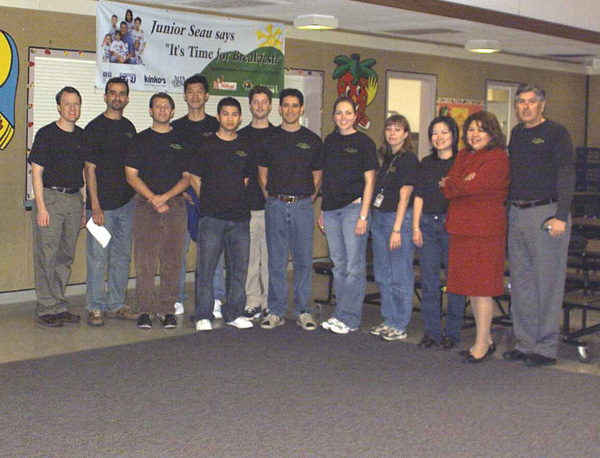
Interns
Paul Johnson (far left) and Sandi Wong McKellips (second from right) and former Depot engineer Mike Cruz (far right) with engineering interns Lahib Romaya, Kevin McCoy, Kent Yen, Dennis Tagulao, Brian Johnson, Amado Aviles, Laurie Gris, Lisa Faul, and Jing Ruan.
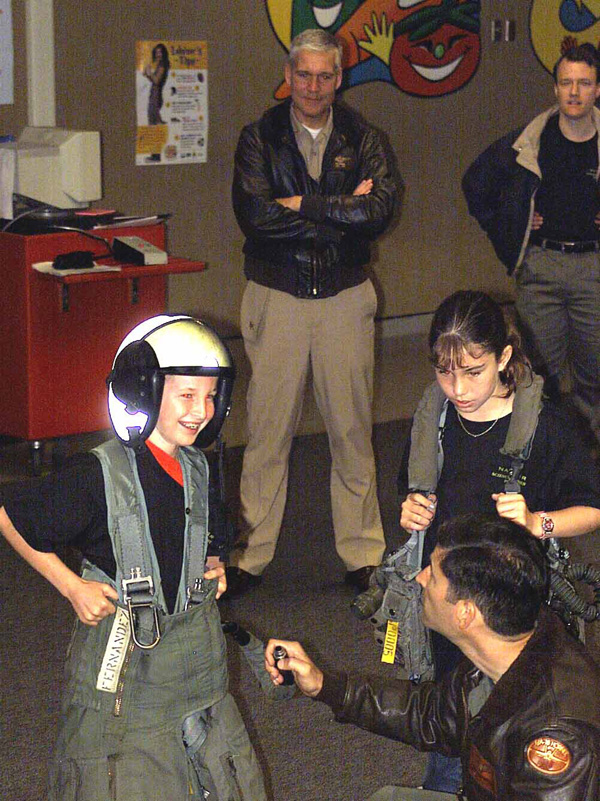
Flight suits
Lt. Cmdr. John Fernandez helps two students get into flight hear as Capt. Tim Trainer and Paul Johnson watch.
Making them
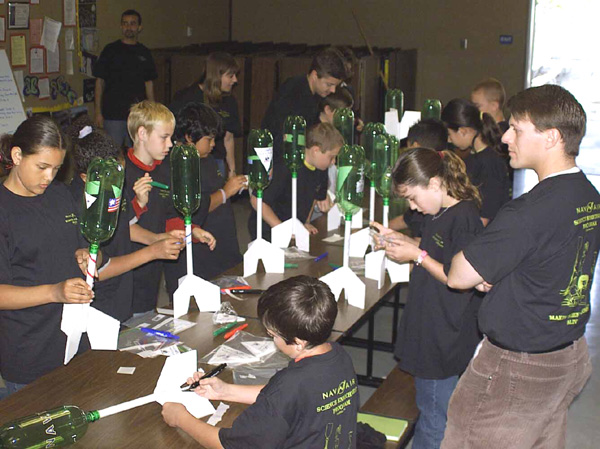
Engineer intern Kevin McCoy watches the students build their rockets.
Compete
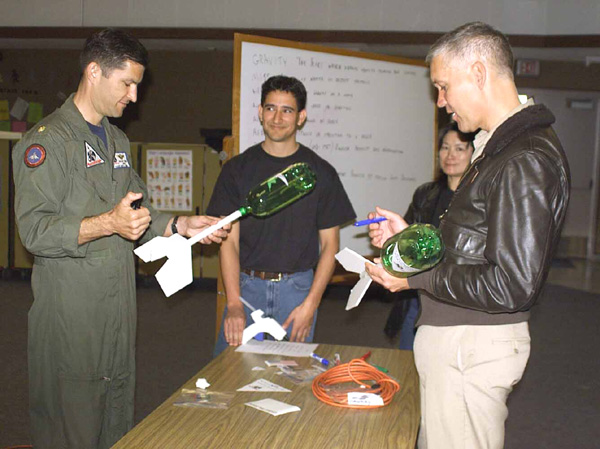
Lt. Cmdr. John Hernandez (left) and Capt. Tim Trainer build their rockets under the watchful eyes of engineering interns Amado Aviles and Jing Ruan.
Skyward
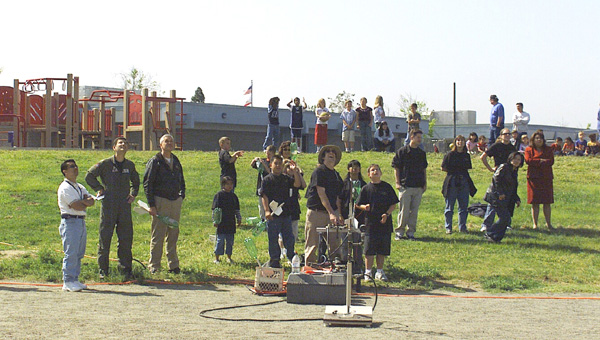
Students and teachers spend some time on the “launch pad”.
NADEP 01
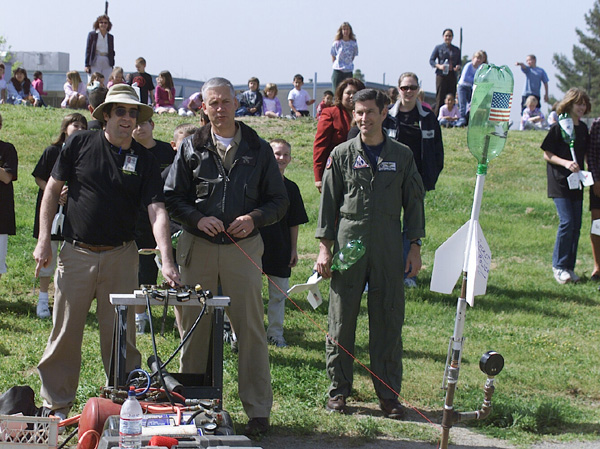
Engineer Chip Slack (in hat) helps Capt. Tim Trainer launch NADEP 01 while Lt. Cmdr. John Fernandez waits his turn.
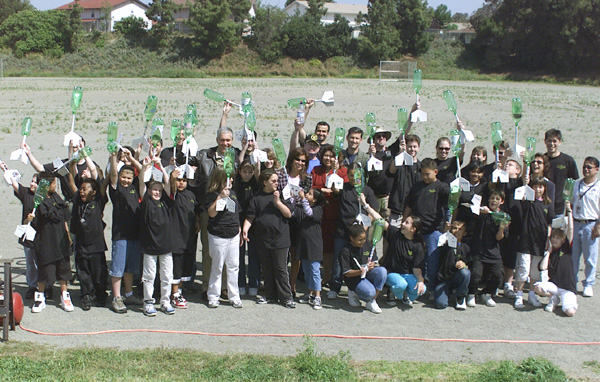
Group
All the “kids” show us their rockets.
NAVAIR Depot engineers teach science to young minds
By Bill Bartkus
Photos by Joe Feliciano
CORONADO, CALIF. – It doesn’t take a rocket scientist to teach rocket science to fifth graders; it takes ingenuity and understanding the mind of youngsters. And, it takes patience.
Inquiring minds want to know everything. That’s why kids ask two of the toughest questions to answer: how and why.
Engineers and engineering interns from NAVAIR Depot North Island here have been answering these two questions for the past 14 years. They volunteer their time and talent with the Partners in Education program.
Lead by materials engineer Sandi Wong McKellips (4.9.7), the volunteers visit Hancock Elementary School, in the Tierrasanta Navy housing area, 12 times a year to tutor a small class of specially selected fifth graders. The program – dubbed the NAVAIR Science Enrichment Program – is a hit with the kids.
“We make science come alive,” McKellips said. “The program is so popular, that teachers pre-select the children to be in the class.” She noted that there is a waiting list for the class.
McKellips said that the class meets after regular school hours. “When kids volunteer to stay after school to learn, it’s a given that they are really interested in what we have to teach them.”
Capt. Tim Trainer, Depot commanding officer, and Lt. Cmdr. John Fernandez, were on hand for this visit along with Depot engineers and engineering interns.
Trainer, a helicopter pilot, told the kids that they are lucky to have after school activities like science projects. He explained how he finished grade school and college and went on to become an engineer and later a naval aviator. “I encourage all of you to take math and science classes through college. These classes will help you to become better students and help you get good jobs as adults,” he said. “The engineers are providing you with a wealth of information, so I encourage to learn as much as you can.”
Fernandez, a F/A-18 pilot, pulled a pop quiz on student. He tried to stump the class by asking questions on the Hornet. “What color is it? How many engines does a Hornet have? How many tails? How fast can it travel?” he asked. As hands were held high, the youngsters correctly answered his questions as fast as he asked them.
When Fernandez asked the students what they plan to become as adults, he received a variety of answers from joining the Navy, to becoming a Blue Angel, to a major league baseball pitcher, to being a Marine, to a politician. One girl hopes to become an obstetrician, “because I like babies, and I would always have a job,” she said.
Several students jumped at the opportunity to try on flight gear that Fernandez brought to the class. He explained each item and its use.
After the fun stuff, it was time to get down to some serious classroom work. McKellips, Trainer, Fernandez, and engineer Paul Johnson listened and watched the interns explain the theory of flight to the class. One by one, each of the interns played a specific role in the theory of rocket science. Then it was time for the kids to build their rockets.
“This is a very cool class,” said Savannah 11, who hopes to become an obstetrician.
“I like the teachers; they’re so disciplined,” said Troy, 11.
“I like this class,” said Khidiasian, 11, who named his rocket Taco.
Using two-liter plastic bottles, the youngsters – young and old alike – decorated their “rockets” with decals and stickers. The interns told the “kids” to name their rockets. Trainer aptly named his “NADEP 01”.
After all was said and done, it was time to put the rockets to the test. A flight test!
Everyone went outside on the dirt field where Johnson, Ellis (Chip) Slack, Donald (Doc) Holliday, and former Depot engineer Mike Cruz were waiting at the compressors. One by one, the students – Trainer and Fernandez included – had their rockets placed on the “launch pad”. As the 640-member student body and their teachers watched and counted backwards from ten, the whiz kids pulled the string at the appropriate moment to propel their rocket upward.
A private “air show” of sorts.
Several interns stayed on the field and retrieved them when they came back to Earth.
Students and teachers shouted ooh and aah as they watched the rockets soar overhead. Several students sent their rockets up more than once.
Another successful science project completed.
“This was a cool day. I like this class,” said Dylan, 10.
As their reward for being intelligent and motivated students, the class will tour the Depot in June.
NAVAIR provides cost-wise readiness and dominant maritime combat power to make a great Navy and Marine Corps team better.