NAVAIR engineers help students build robot
Cutline
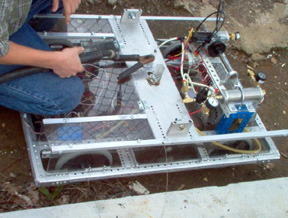
Tobor receives a few minor adjustments from a student before the competition. Courtesy photo
Bionic Battalion calls in secret weapon; team uses Depot engineers for assistance, mentoring, success
By Bill Bartkus
NAVAIR Depot North Island
CORONADO, Calif. – The 23-person robotics class at Granite Hills High School (El Cajon, Calif.) has dubbed itself the Bionic Battalion.
The class is a true team effort combining the high school with the East County Regional Occupational Program (ROP) and NAVAIR Depot North Island engineers. Gary Jibben is the class instructor for East County ROP.
NAVAIR Depot North Island engineers Schlotte and Frank Snook are the engineers for ROP this year. Both men are active members of the Professional Engineers and Scientists Organization (PESO), an engineering fraternity that offers a friendly atmosphere for the free exchange of ideas and knowledge.
The class is one of nine in San Diego County, which will compete in the U.S. For Inspiration and Recognition of Science and Technology (U.S. FIRST) nationwide robotics competition. The event is the brainchild of Dean Kamen, famous for his invention of the Segway human transporter.
“This class is very unique because of the complexity of the subject, robotics, and the limitations imposed by ROP,” said Schlotte. “ROP regulations require that anyone over age 16 can enroll in the class without any prior prerequisites, and it must teach skills that the individual can use to help obtain or improve their current job skills.”
Snook said that U.S. FIRST imposes the limitations regarding using high school students and the robotics competition. “The competition is a final exam of sorts,” he said.
The engineers said that the rules of competition change every year. “The rules specify the maximum weight of the robot, maximum size, limitations on parts used, and imposition of obstacles and tasks that must be overcome by the robot,” stated Schlotte. “Every competition has a short autonomous period followed by a free drive portion,” noted Snook.
Schlotte said that there is a great deal involved in building the robot alone. “There are mechanical skills required for machining and assembly of the frame and drivetrain. These components are manufactured from aluminum, steel, and plastics to meet the stringent weight and strength requirements,” he said.
The robot, dubbed Tobor, runs off of a 12-volt DC battery with small motors to make it move so students need to know electrical skills.
The last required element is programming the robot so it can overcome the required obstacles. Said Snook, “There are several sub-skills that can be taught as well such as computer aided drafting (CAD), web page design, and computer animation.”
U.S. FIRST provides the basic mechanical components of the robot and the control system that needs to be programmed. Autodesk provides software for CAD and 3-D modeling. Microsoft provides Visual Studio.Net for everything else.
“In the past, Gary and Depot engineers have been successful in teaching this in a six-week period, but this year was different,” noted Schlotte. “We started out this year teaching critical engineering skills such as “thinking outside the box” through an exercise named accomplish the mission.”
During this exercise, students were encouraged to think of new ways to do common tasks and eliminate traditional right answers. “Then the class worked on team building with exercises designed for teams of two, then three, then four, finally culminating in an exercise called “divide and conquer” where the team was divided in half and asked to accomplish the mission,” said Snook.
“Divide and conquer” requires two teams to solve the same problem, then the teams come together to share their results and formulate a third resolution by combining elements of the two solutions. The engineers agree that the third solution should be the best idea possible, build team cohesion, and build an understanding of the problem.
This is the third year that Depot engineers and ROP have teamed up. “The prior two years were rushed, but we managed to finish above mid-field in the competitions,” said Schlotte. “In years to come, we hope to expand the program to a four-year program, where calculus, physics, CAD, team building, and more are all taught in classes prior to the cap stone class, which will be building the robot.”
Said Snook, “This program would make Granite Hills High School part of the national “Project Lead the Way” movement, which is a project designed to put pre-engineering classes in the high school classroom.”
The Bionic Battalion went to its first regional competition in Phoenix, March 9 to 13, and placed fourth overall and won the Rookie All-star Award. “This is a tremendous accomplishment considering the robot broke down and caught fire during the quarterfinals and could not proceed,” Schlotte said.
As a minimum, 12 teams went to the semi-finals and six to the finals. “This in itself proves that our six-week “basic training” paid off, but there is more,” Schlotte added.
During the six-week period, the team built no less than five different lifting “arms” for the robot. Snook noted that the team pulled an all nighter in one of the team vice-president’s garage, designing and fabricating an arm to lift tetrahedrons.
The purposes of the FIRST robotics program is to get kids excited about math and science and to show them how to apply these subjects that they learn in a classroom environment to the real world setting. “The program also gets them to understand why they learn these subjects and how they help to better mankind,” Schlotte stated.
At the second regional competition in Las Vegas, Nev., Bionic Battalion placed first and also won the Rookie Team Inspiration Team of the Year Award, first place webpage design. The team also won the right to compete in the nationals in Atlanta this spring.
Editor’s note: Snook has been published in Maintenance Technology Magazine and NASA Tech Briefs. He also has a software patent with the U.S. Air Force. Schlotte is a NAVAIR Associate Fellow and a member of Tau Beta Pi engineering honor society.