NAVAIR bids farewell to Tomcat program
By Chuck Wagner
Public Affairs for
PEO Tactical Aircraft
As the ceremony concluded, those in attendance – whether wearing uniform or business dress – took long moments to study the aircraft.
If the world’s most recognized fighter could show emotions, it surely would appear proud, battle-scarred and somewhat resigned at the moment.
NAVAIR’s program which supported procurement, research, development, test and evaluation for the F-14 Tomcat closed shop April 27 in the Hazelrigg Hangar on Naval Air Station Patuxent River, Md. after nearly three decades of providing the Fleet with what many people in and out of flight suits consider the best fighter aircraft ever made.
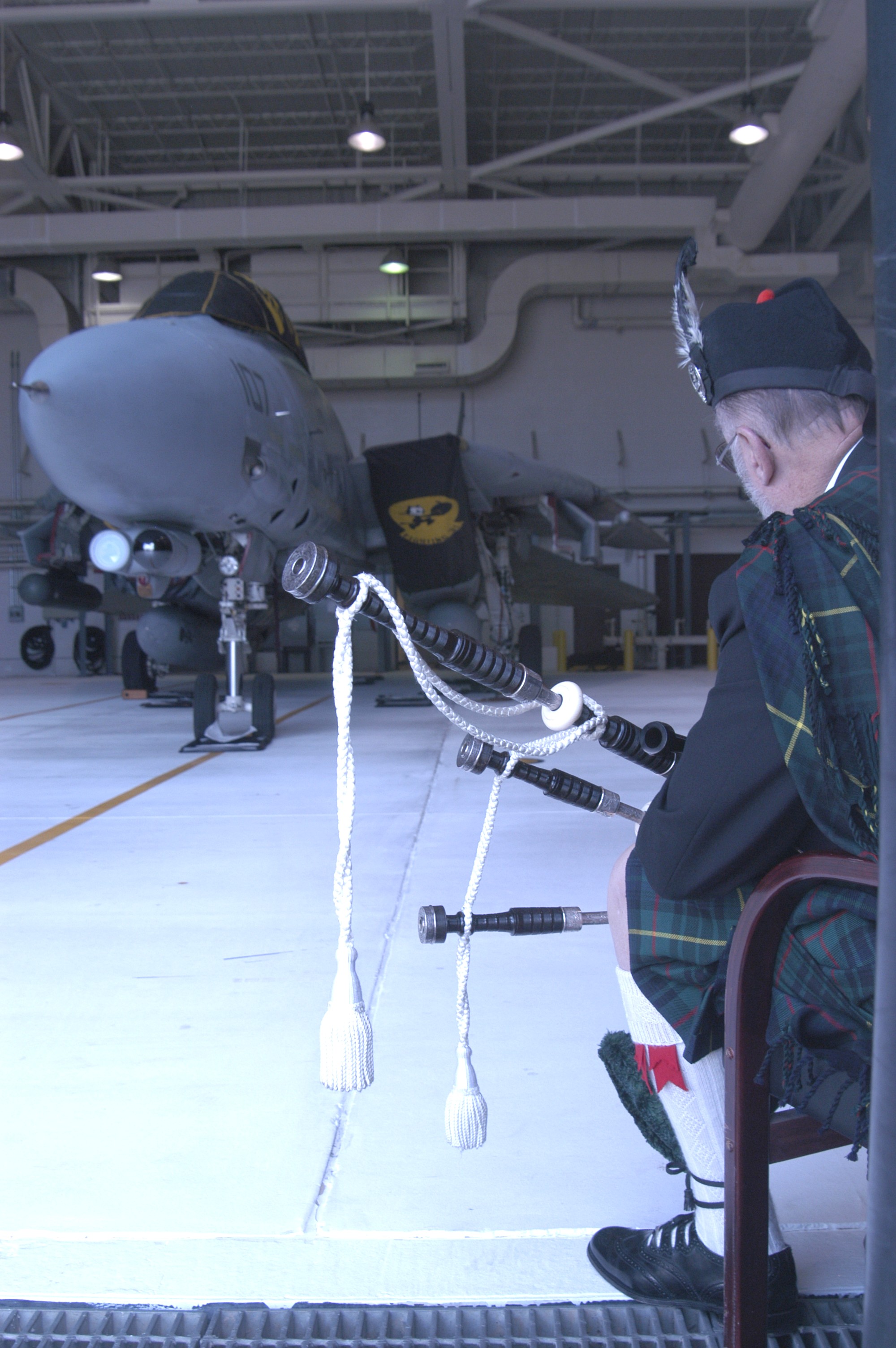
Rear Adm. David J. Venlet, program executive officer for tactical aircraft, spoke to several hundred people assembled in the hangar for the program’s disestablishment. A Tomcat from VF-31 flown in that morning stood imposingly to one side.
“The Tomcat is going out at the top of her game,” said Venlet, who served as an F-14 aviator and now oversees six tactical aircraft programs, including PMA 241, the program closing shop that day.
Venlet more than once directed the audience’s attention to the aircraft nearby, “When you reflect on the Tomcat, know the real story is about people.”
One of those people is Cynthia Nelson, who served as a program analyst with PMA 241. “It’s been a part of my life for 23 years. I’m sad to see it end. You have to just move on. But I’m going to retire, so maybe I’m not moving on,” said Nelson. There were, in fact, few care-free expressions in the hangar. Many in attendance had followed the Tomcat’s bumpy ride across several decades, as trendier fighter aircraft designs came and went.
“Let your memories also be tied to the defense of freedom,” added Venlet, who earned a Distinguished Flying Cross as a Radar Intercept Officer, a “back-seater” in the Tomcat.
“I’ve got no mixed emotions. I’m pretty sad,” said Lt. Cmdr. Bryan Roberts, who flew the F-14 to the event. “It’s a beautiful aircraft, and it’s amazing to fly. It’s the best aircraft I’ve ever flown.”
Extending an arm up to the Tomcat, he added, “I am now flying the F-14D - what the Tomcat was always meant to be.”
The ceremony also marked a change of command for the Tomcat’s final program manager, Chris Frayser, who will now work with the E-2/C-2 program at NAVAIR. Previous program managers were in attendance.
Frayser thanked all those who worked with the program over the years. Supporting the Tomcat is a “culture, a way of life,” he said. “They do it because they love the aircraft.”
The F-14D Tomcats which returned in March from duty in the Persian Gulf are the realization of a concept that began at NAVAIR in 1968. Outlasting most aircraft programs, the Tomcat’s longevity depended on the aircraft’s transformation from a single-mission, air-to-air fighter developed to intercept fast Soviet bombers to a combat-proven, precision strike/attack aircraft and digital reconnaissance platform that has dazzled the Fleet while serving in the Persian Gulf. A total of 712 F-14s were built; 633 went to the U.S. Navy, 79 to Iran.
The grand finale for the F-14’s transformation has been the aircraft’s performance in Allied Force and Operations Enduring Freedom and Iraqi Freedom. In 2003, Operation Iraqi Freedom saw the simultaneous deployment of all three existing F-14D squadrons, and saw the F-14D’s first release of a Joint Direct Attack Munition in a combat environment. In 2005, the aircraft was for the first time cleared to drop the 500-pound JDAM, the weapon of choice for bombing missions in Iraq. Late in 2005, the Tomcat also became the first Navy platform to be equipped with ROVER compatibility, which allowed transmission of real-time streaming video to troops on the ground. The project went from concept to capability in seven weeks.
Frayser noted the team implemented over 1,400 engineering change proposals for the F-14.
“We fought for the Fleet, so the Fleet could fight,” Frayser said.
Born out of the Cold War, the Tomcat was a national symbol as much as a weapon. It became an icon in popular culture with the 1986 motion picture “Top Gun” and later regular appearances on the television series “JAG.” Its sweeping wings and muscle-plane design are recognized around the globe.
“For someone who grew up watching ‘Top Gun,’ it was amazing to get to climb into the aircraft. I’m sad to see it go, but I’m glad I got to fly it all the way to the end,” said Lt. Eric McMullen, who would be a back-seater in the Tomcat later that day as it returned to Naval Air Station Oceana,Va., the last of a unique breed.
_____________________________________________________________________
CUTLINE
(photo by Chuck Wagner)
During a disestablishment ceremony for the F-14 Tomcat program office, bagpipe player Dick Blair sits solemnly in front of a Tomcat from VF-31 before performing for a crowd of several hundred in a Naval Air Station Patuxent River hangar April 27.