
With Navy help, Finns crafting first-of-its-kind Hornet
By Chuck Wagner
Navy Public Affairs
Program Executive Office for Tactical Aircraft
One of the oldest air forces in the world is undertaking a first in aviation history.
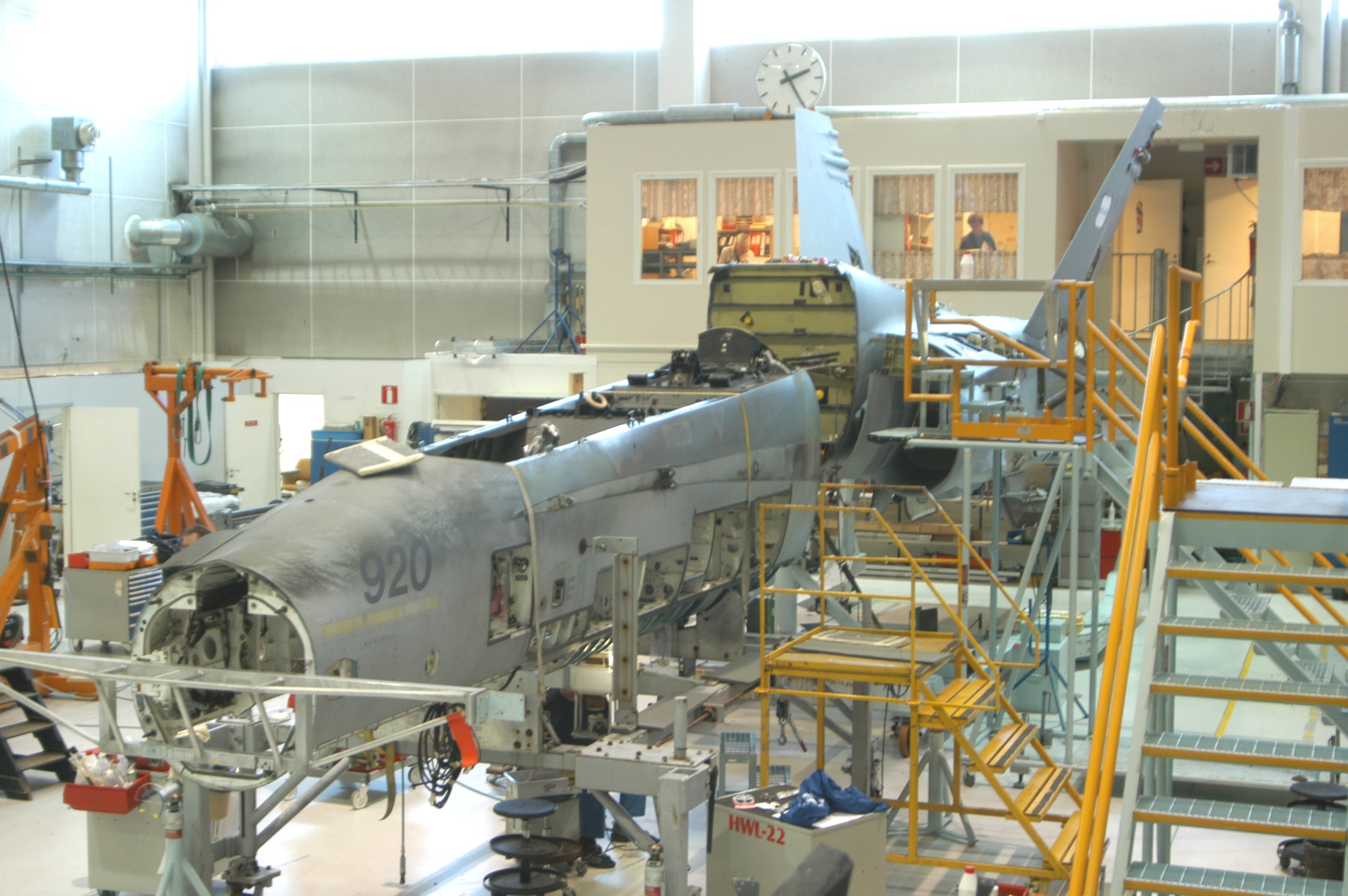
With an engineering feat that will create the world’s only aircraft of its kind, the Finnish Air Force is constructing its newest two-seater F-18D Hornet by combining sections from a C-model and an earlier-generation B-model Hornet.
The U.S. Navy and the Hornet’s original manufacturer, Boeing, are helping the Finns construct what project team members affectionately refer to as the “Frankenplane,” or more officially HN-413. The F/A-18 is the Navy’s premier multi-mission fighter attack aircraft. Boeing sold Hornets to Finland in 1992 with delivery between 1995-2000.
Finnish aerospace company Patria is completing the project at a remote snow-covered hangar complex in Halli, Finland. Airframe sections from two aircraft will be melded together next year after completion of necessary structural modifications to the forward fuselage. Patria engineers will then install the onboard systems. The aircraft is expected to reach structural completion at the end of 2007.
“It is an experiment. The result will be something very unusual,” said Senior Lt. Petri J. Korhonen, with the Air Force’s F-18 Systems Engineering. There was some anxiety about the project’s feasibility until the sections were brought together, “When we first matched the planes up, they fit perfectly.”
The project’s €15.1 million ($18.5 million) price tag is less than half of the aircraft’s original price – an important accomplishment for a nation that spent the entire annual defense budgets for a year and a half to upgrade its air fleet from MIG 21 and SAAB 35 Drakens.
The project has an aggressive two-year schedule. In order to expedite procurement of necessary parts, the Navy’s Hornet program - PMA-265 at Patuxent River Naval Air Station, Md. – working with the Navy International Programs Office, established a blanket order foreign military sales case, which allows them to purchase a broad spectrum of services for the Finns. As an interested partner, PMA-265 subject matter experts are joining the FiAF, Boeing and Patria engineers in June for a coordination meeting in Halli.
“We’ll be with the Finns all the way to help them to a successful conclusion,” said William McDonald, PMA 265’s Finland foreign military sales program manager.
FiAF lost a C-model Hornet in a November 2001 mid-air collision. The second Hornet involved in the mishap (HN-413) landed, but with severe damage to the airframe and engines. At the time, the aircraft had less than 500 flight hours.
A FiAF-Patria team evaluated the salvaged aircraft in 2003, and forwarded options for repair - or demolition - to government officials the next year.
In late 2005, FiAF leaders accepted a plan to convert the aircraft into a D-model using spare parts and fuselage section from an older B-model aircraft purchased from the Canadian air force. Canada is one of seven nations across the globe that flies the Hornet. Canada had mothballed the aircraft during downsizing of its inventory several years earlier. The FiAF owns just seven two-seater Hornet variants used for training pilots to fly the remaining inventory of 55 single-seater F-18Cs.
Canada’s B-model aircraft, like the newer D-model, is a two-seater. The project is grafting the cockpit section of the B-model onto the tail end, or center-aft fuselage, of the refurbished C-model Hornet to make a two-seater. With systems upgrades, the aircraft becomes a later-generation F-18D.
Because of substantial rebuilds on major structural parts that are stress points, the project aircraft should have a life expectancy at least as long as the FiAF’s current F-18D models. After completion, the aircraft will undergo immediate systems improvements under a mid-life upgrade underway with the help of the U.S. Navy.
The Finns want to keep their Hornet fleet operational until 2030. Capabilities offered by Link 16, Advanced Tactical Forward Looking Infra-Red, advanced tactical radios, next generation radar warning receiver systems, and advanced mission computers in the mid-life upgrade will make the Finnish Hornet the most advanced F/A-18C/D aircraft in the world.
“Aircraft maintenance and operations are tailored to the Finnish environment. For instance, the carrier tailhook is used for roadway landings, with the arresting cable slung between movable arresting brakes,” said Korhonen. The Finnish Air Force utilizes the Hornet’s carrier suitability to defensively scatter the fleet across the country’s vast natural landscape.
Retired Lt. Gen. Matti Tapani Ahola, Finland's Deputy Minister of Defense, called the F-18 program "the most successful in the entire Finland Defense Ministry” during a March 25 ceremony recognizing the Navy’s Hornet program office team at Patuxent River Naval Air Station, Md.
Korhonen suggests such success is only possible with an aircraft like the Hornet, which has a proven and consistent design concept and benefits from a global partnership of Hornet-flying nations.
“The Hornet community has something very rare. This shows us the commitment of the partners,” he said. The partnership was proven by Canada’s willingness to provide an aircraft, and the willingness of the U.S. Navy and Boeing to aid with the project.
“This is the single most important cooperative program the Finnish and U.S. militaries have together. It is a serious, long-term commitment and a great example of diplomacy by military,” said Col. Robert Byrd, defense and air attaché at the U.S. embassy in Helsinki.
McDonald said the embassy has been very supportive of the effort. Byrd and his staff have served several times to ensure the Navy and Boeing could support the Finnish project without bureaucratic hurdles. “Colonel Byrd and his staff are integral team members in our efforts to support the Finnish Air Force,” McDonald said.
“This is a great opportunity for all us to step up and help out a good friend of the U.S. Our role is minimal, as the FiAF has complete faith in Patria Aviation, FiAF’s trusted agent that actually built the C-models from kits shipped over from Boeing back in the 90s,” said McDonald. “Boeing has provided engineers to Patria in support of an on-going mid-life upgrade and has engineers back in St. Louis defining the necessary structural pieces for the HN-413. The Navy is simply helping connect these dots any way we can.”
_________________________________________________________________________________
(photo by Chuck Wagner)
Cutline: The HN-413 or “Frankenplane” is a Finnish Air Force F-18D aircraft Patria Aviation engineers are creating from sections of B- and C- model Hornet aircraft at its facility in Halli, Finland.