
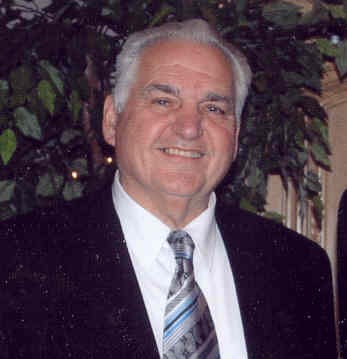
“MR. CATAPULT” retires after 54½ years – only to return as a Highly Qualified Expert
by Patricia Odoardo, NAES Lakehurst Public Affairs
While it has come as a shock to many at NAVAIR Lakehurst and the Navy, George DiBiase has retired as the head of NAVAIR Code 4.8. Having been at the senior level of the Aircraft Launch and Recovery (ALRE) department for over a decade, and having guided the current systems to where they are today, one would think that DiBiase would, perhaps, retire. But that is not his way. As he stepped away as NAVAIR 4.8 and retired on April 1, he returned on April 3 as a Highly Qualified Expert (HQE), a position he was appointed to by the Secretary of the Navy. Until now, there has only been one other HQE appointed in the history of the Navy.
In his five plus decades with the Navy, DiBiase worked in various areas at the Naval Air Engineering Center realizing early that to increase his value he would have to complete his formal education. As a designer and technician by day, he spent eight years attending Drexel University at night, completing his degree in Mechanical Engineering. This is the classic story of an entry-level employee climbing his way to the top. As a result of his hard work and dedication, the name DiBiase will forever by synonymous with Navy Lakehurst and Naval Aviation.
As the engineer responsible for the creation and development of the low-pressure steam catapult used to launch aircraft from carriers, he is internationally recognized as the world’s expert on steam catapults. Rarely a day has passed that DiBiase has not consulted with universities, foreign governments, Defense think tank organizations, such as the Center for Naval Analysis, the National Science Board, and Naval Intelligence Activities.
When asked about his career highlights, DiBiase selected his being awarded the Ordre National De Merite for his help designing the French Carrier Porte-Avions Nucleara Charles de Gaulle. This award, which is the highest honor the President of France can confer on a civilian, is tantamount to elevating DiBiase to knighthood. He has performed similar consulting efforts for the British and Brazilian Governments. Next, DiBiase selected his meeting with President George W. Bush. President Bush became the first sitting President to be trapped aboard a carrier using an arresting cable. This occurred on the USS Abraham Lincoln (CVN 72) while steaming back from the IRAQ war. The White House planned a ceremony to commemorate the President’s “trap” on the Lincoln and invited “Mr. ALRE” to provide technical overview about the historical landing. While there, DiBiase gave the President a plaque with a piece of the actual cable used to stop the President’s aircraft. Another highlight for DiBiase was filming the History Channel’s “Guts N Bolts” television documentary. Filmed aboard the USS Enterprise, Dibiase appeared in the show and provided his expert knowledge on the history of take off and landing systems on aircraft carriers.
“Retirement is going to be an adjustment,” said DiBiase. “Giving up what you have done for so many years will not be easy, but coming back on a part-time basis as an expert in the areas of launch and recovery will allow me to continue to contribute to our great Navy mission.” His nomination for the HQE position by NAVAIR was approved by SECNAV because of the need to effectively transfer George’s specialized knowledge and skills through example and training. This is essential for the continued safe operations of the current aircraft launch and recovery systems and toward the successful development of the new Electromagnetic Launch and Recovery System of the future.
As the nationally recognized expert in ALRE and Support Equipment (SE), DiBiase is the senior technical agent for ALRE and SE and will continue to provide guidance in evaluating the existing systems performance and he will oversee the initiation and planning for new approaches and technology developments to overcome operational deficiencies.
Looking forward to his new position, DiBiase stated “my future goals include finding a better, new arresting gear, a novel solution on how to stop airplanes in the future, and to continue to be a member on the Carrier Readiness Team (CRT).” DiBiase looks forward to improving the life of each and every sailor. The CRT goal is to improve readiness on aircraft carriers and reduce the cost of operations. In order to achieve these goals, they are developing metrics to measure costs. As part of this team, DiBiase stood-up the ALRE Readiness Team and implemented “Boots on the Deck.” Boots on the Deck brings Flag officers and SES’s to the carrier to talk to the Sailors and find out first hand what is causing the problems they incur with their jobs.
George, we bid you a traditional Fair Winds and Following Seas, and welcome you back into the fleet!