Will it fly?
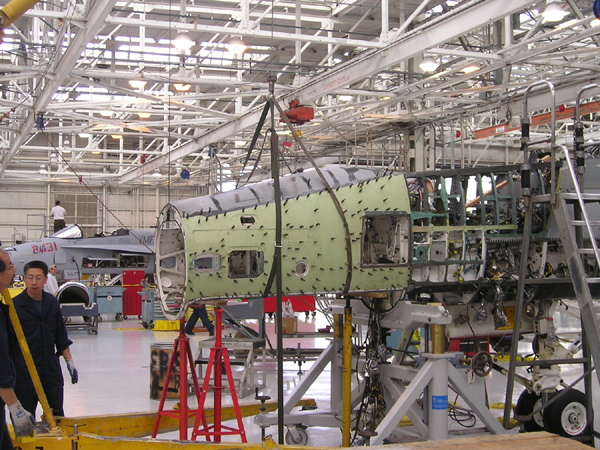
Pic 1
The extent of interior structural damage to the nose.
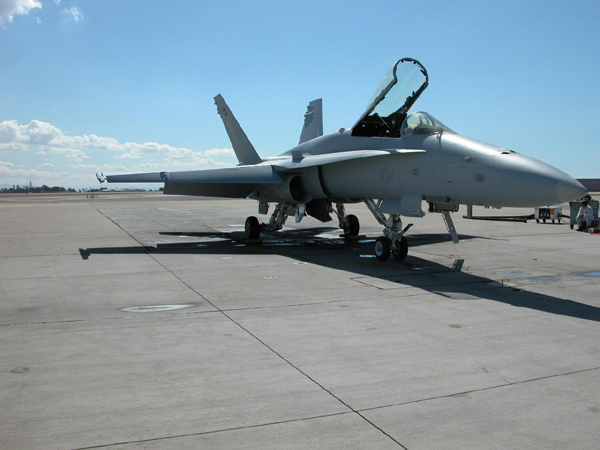
Pic 2
The extent of teardown that was required to identify and replace the damaged parts.
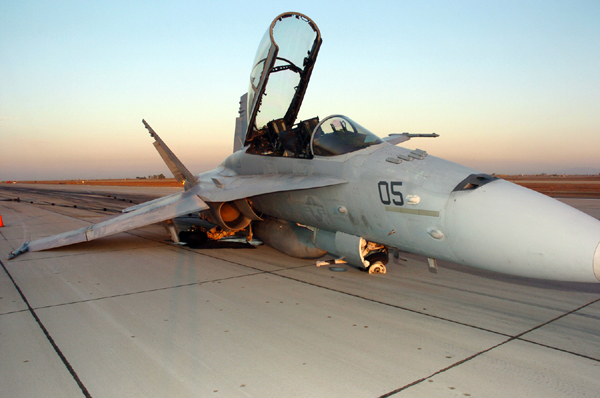
Pic 3
RX-46 in final paint and ready to fly home.
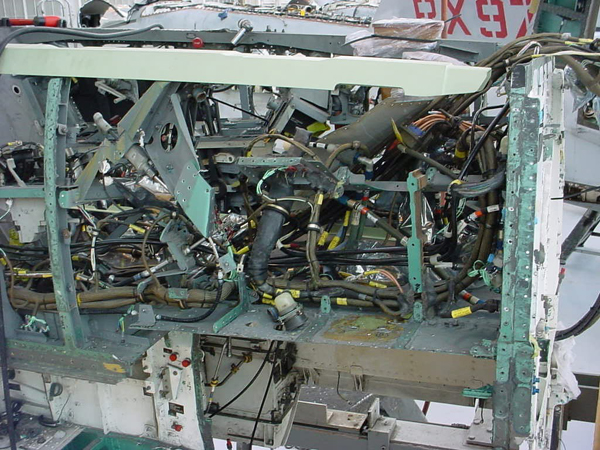
Pic 4
Here comes RY 27.
“WHAD’YA THINK? CAN YA FIX IT?”
CDR John Mawhinney
Chief Test Pilot
NAVAIR Depot North Island
NAS NORTH ISLAND – The F/A-18 Program recently bid farewell to RX-46, an aircraft that has been with NAVAIR Depot North Island here for a very, very long time. Its memory will continue to be a source of pride and satisfaction for the unparalleled perseverance, professionalism, experience, knowledge and craftsmanship of the North Island Team.
RX-46 is a special rework aircraft that came to the Depot in pieces after it suffered significant damage aboard an aircraft carrier in 1999. Jet exhaust from another aircraft pushed RX-46 across the flight deck and it collided with an F-14 Tomcat, causing the nose of the aircraft to be displaced or “bent” about five inches to the left. At the time, RX-46 was a fairly young aircraft in the fleet, and to this day has only about 3,000 total flight hours.
Over the seven years that it was at North Island, some 27,000 labor hours, $2.8 million in material, and approximately 3,700 engineering hours were expended to bring the jet back to life.
In 1999, Commander Naval Air Force, U.S. Pacific Fleet (now Commander Naval Air Force) asked the Depot, “Can ya fix it?” The Depot’s initial response, “No way, sir!”
At first glance, the damage didn’t seem to be that bad, but the engineers and the evaluators knew better.
To displace the nose by five inches meant that there was significant underlying damage and much of the forward fuselage would have to be replaced. AIRPAC really wanted that aircraft back, so with no spare F/A-18 forward fuselages hanging around, the Depot’s F/A-18 Program was forced to rebuild the damaged fuselage with North Island locally manufactured parts. Teardown was required to identify and ultimately replace the myriad of damaged parts. The scope of the final assembly phase alone was enormous but Michael Bennett, the assembly crew leader, did an outstanding job of coordinating the diverse and unique assembly requirements for this aircraft on a daily basis.
Personally, I didn’t believe that I would be around to see RX-46 fly, but I was proven wrong and ironically it turned out that I was the first one to fly it.
The obvious question for me of Derrick Pettit, an FST engineer, was, “How do I know its straight?” The answer was that a laser alignment tool was utilized to ensure that the aircraft was straight and in fact RX-46 was true to within 0.007 inches of perfectly straight. This actually compares well with undamaged fleet aircraft that can measure out to 0.250 inches.
Still not convinced, I was expecting that the aircraft, if it got airborne, would not fly straight. Just like a repaired car fresh from a collision shop, for some unknown reason it just can’t be the same as it was before. Once again I was proven wrong in that it is the straightest aircraft I have ever flown. From 80 knots out through Mach 1.6, RX-46 flies straight as an arrow and its overall performance has been nothing short of phenomenal.
As a local rule, all center barrel and special rework aircraft require a minimum of three flights to verify proper operation, and it usually takes that many flights or more to work out all the bugs. But with RX-46, the first flight after seven years was nearly flawless. Everything worked as it should, including mission systems such as the air-to-air radar. In fact, the performance was so good that LCDR John “Gomez” Fernandez reported that RX-46 can super-cruise, meaning that it can travel at supersonic airspeeds without the use of afterburner. This level of performance is not often seen in older aircraft, and it is a testament to the quality of repair that the F/A-18 Program team was able to achieve.
Marine Fighter Attack Squadron 332 in Beaufort, S.C., will be receiving an aircraft that performs better than new and will require very little grooming to get it up to Full Mission Capable (FMC) combat status in a short time.
Although it took seven years, CNAF got back a full up warfighting asset at a bargain price. In the process, the F/A-18 Program has learned a lot about repairing this type of extensive damage and the next go-around shouldn’t be so bad. Just in time too, because here comes RY-27.