
Weapons Division Team Wins Commander's Award
Released by Naval Air Warfare Center Weapons Division, China Lake, California Public Affairs Office
By Steve Boster
A Naval Air Warfare Center Weapons Division (NAWCWD), China Lake and Point Mugu team of employees is demonstrating the feasibility of an innovative Distributed Ground-Sensor-Grid Threat Detection System (DGTDS). DGTDS will help protect aircraft utilizing military airfields from surface-to-air missiles. The efforts of this group, led by Mallory Boyd, head of the Information Warfare Systems Division, recently resulted in Commander’s Award recognition for Boyd, Richard Busse, Dave Reade, Dr. Rod Ditzler, Aaron Clement, Lori Clodt, Annette DeMay, John Knecht, Dale Robison, Mark Miliano, Jason Allen and Dr. Dave Serena. A separate Team Award was given to another 24 individuals for their contributions to the project.
Early this year, the DGTDS team successfully demonstrated the system’s capabilities in a series of live-fire demonstrations for visiting officials representing the Office of Under Secretary of Defense, Department of Homeland Security, Naval Research Laboratory, Army Research Laboratory, Air Force Research Laboratory, Naval Air Systems Command (NAVAIR), members of the Joint Staff, and industry representatives from Raytheon and General Dynamics.
The concept of using a ground-based system to protect transport aircraft leased by the military to deliver troops and supplies to military airfields evolved from discussions that began in 2002. Boyd said that Mike Barrett and Richard Busse proposed making use of the Weapons Division’s in-house knowledge of missile countermeasure techniques and advanced sensors expertise to solve the problem. The difficulty was that, at the time, no requirement for such a system existed.
Nonetheless, Boyd, Barrett and Busse set about exploring the possibilities and briefing senior officials throughout Washington. With the unsuccessful but dramatic missile attack on an Israeli airliner in Kenya in 2002, interest in Washington picked up.
Tasked to focus on protecting non-tactical, large body aircraft in military use, the Weapons Division team was given 90 days to conduct a study on the most feasible means of accomplishing that goal.
The results of this study indicated that the solution set was bounded by two extremes: install a robust detection and countermeasure system on every aircraft, or use a ground-based system to protect the airfield, thereby protecting all aircraft operating at that airport. Combinations of ground- and air-based capabilities were also considered. The Weapons Division team estimated a significant cost savings with the ground-based approach, provided one could be developed.
The choice, however, wasn’t strictly based on numbers of systems. The team also considered such factors as reliability. If an aircraft-based system were chosen, the components would have to be rugged enough to withstand a hostile flight environment. A ground-based system also faced environmental challenges, but not as extreme as those encountered in flight.
Protecting the aircraft, whether via an air- or a ground-based system, is actually a two-part challenge. The first is to detect a missile launch within time and distance parameters to allow for successful countermeasure deployment. The second part, to be developed by industry partners, involves the actual countermeasures.
To meet the first part of the challenge, the Weapons Division team had three goals. First, to ensure the system was sensitive and robust enough that it would never miss a missile launch within its effective range. Second, the false alarm rate had to be extremely low. Third, the system had to meet the first two goals within an extremely short timeframe. This dictated an automated solution -- human intervention is simply not possible with these three constraints. And failing at any of the goals would deem the system unacceptable. Boyd admitted that these goals are normally mutually exclusive; however, the patent-pending design allows for their optimization.
This signal processing challenge takes advantage of a collaborative sensor arrangement. The current experimental system is a two-node unit, which Boyd states could be replicated to cover a larger footprint. The sensors look for the unique signatures of surface-to-air missiles. These unique properties allow the DGTDS to eliminate background interference from other aircraft and other non-threats (such as vehicles) in the area.
The DGTDS effort proved to be a task opportunity for several Engineer & Scientist Development Program (ESDP) newcomers. Nine of the team award recipients began their work on the project as ESDP participants. Boyd noted that senior technologists were paired with the ESDPs to enhance the mutual learning experience. This mentoring opportunity is vital for transfer of knowledge. For example, Dr. Rod Ditzler, a NAVAIR Fellow, worked closely with ESDP Jason Allen in algorithm development and analysis. Another ESDP, Mark Miliano, developed special skills with the advanced software and hardware packages. Boyd also praised Dave Reade’s technical leadership. He noted that Reade’s efforts paid off with a system that has exceeded all the performance metrics established at the outset.
Thanks to the innovation and dedication of the DGTDS team, large aircraft supporting military operations in the near future may fly into uncertain or hostile environments more safely. In addition, several other applications utilizing the technology developed during this effort have been identified. At some point, Boyd thinks there might be applications beyond Department of Defense, provided industry continues research and development of improved systems.
PHOTO CAPTION ######
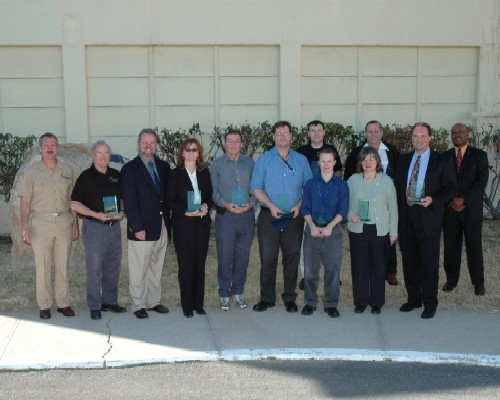
COMMANDER’S AWARD – Captain Dan Lee (left), acting NAWCWD Commander and Dr. Ron Smiley (right), head of the Avionics Department, presented the Commander’s Award to the DGTDS team. Receiving the award were (from left to right)
Dale Robison, Mallory Boyd, Lori Clodt, John Knecht, Dr. Dave Serena, Mark Miliano, Jason Allen, Annette DeMay, Dave Reade and Richard Busse. Awardees not pictured are Aaron Clement and Dr. Rod Ditzler. U.S. Navy photo