Small tool makes big change for H-53 repair
By Rocco DeFilippis
Necessity has always been the mother of all invention. With a need to provide nonstop support of the highest quality, Naval Air (NAVAIR) Depot Cherry Point, N.C., personnel are continually providing innovations that benefit the Fleet.
When reports of cracked fittings on the number six bearing support fittings, a part that connects the number six driveshaft bearing to the tail rotor of the aircraft, came in from forward deployed units, a group of Cherry Point artisans and engineers designed and created a new tool that will save M/CH-53E Marines and Sailors around the globe countless maintenance hours.
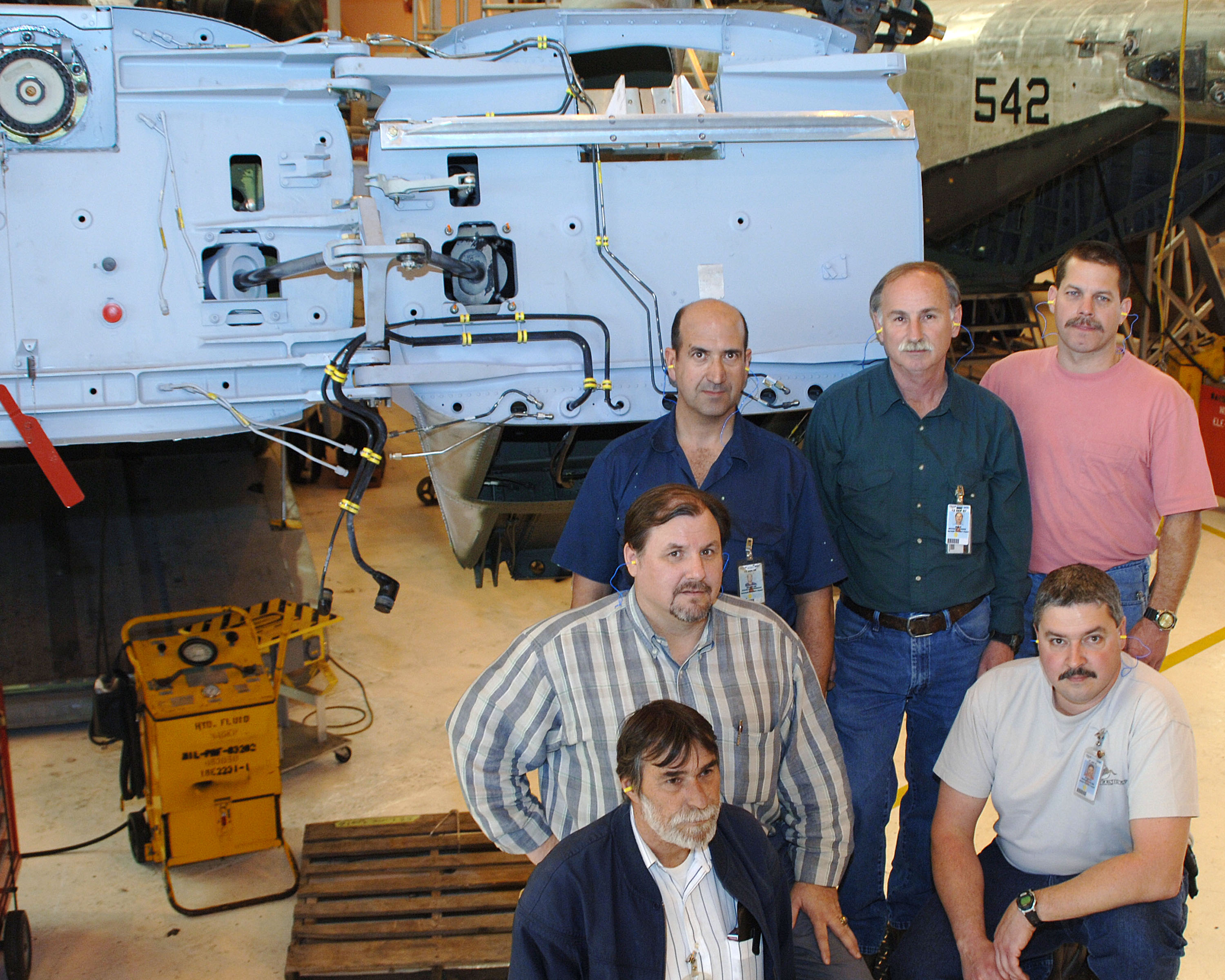
A group of machinists, sheet-metal workers and engineering personnel teamed together to devise a new fixture that allows the cracked fittings to be replaced without having to perform in-depth maintenance procedures. With the new fixture, the fix can be done while the pylon, or tail segment, of the aircraft remains on the helicopter.
“The old method was very labor intensive and required a large, heavy fixture to complete,” said Ed Solomon, H-53 production support engineer. “The new fixture is small, lightweight and the repair can be conducted anywhere in the world.”
“The old fix was just not practical because of its size and weight,” said Keith Linton, one of the machinists responsible for the fabrication of the new fixture. “We needed something that was easily transportable so that the units in the field could keep their assets on hand.”
Logistically, artisan repair team members can carry this new fixture with them as part of their normal luggage, whereas the original method required a C-130 or tractor-trailer to transport a tail-pylon stand, pylon-swing fixture, pylon sling and support equipment to the repair site.
Solomon said the old procedure required many parts of the aircraft to be disassembled in order to change the cracked fittings, a process that took more than 40 maintenance hours.
“We have reduced the time necessary to complete this repair from more than 40 hours to less than eight,” said Rodney Helms, machinist leader. “It saves a squadron time, not only in maintenance man-hours, but also reduces the number of quality assurance checks from more than a dozen to around two.”
“Instead of doing a temporary fix that would need to be replaced when each aircraft cycled through the depot, this tool gives a depot field team the capability to completely repair the problem the first time,” said Maj. Warren Bair, H-53 program officer.
The new tool and repair process has been validated and approved by the engineering department, and a local engineering specification, or standard operating procedure, is in the works.
“We saw a way to simplify a complex problem,” Linton said. “Our job is to support the Fleet, this is just another way we can do that.”
-30-
CUTLINE:
The artisans and engineers who designed the new tool stand near an H-53 with the fixture in place. The new fixture allows for the pylon to remain on the aircraft during the bearing support repair. From top to bottom, left to right: Charles Andreucci, Mike Jones, Keith Linton, Ed Solomon, Rodney Helms, and Stanley Walker. (Photo by Dykie Whitfield)