
ADVANCED WEAPONS LAB INTEGRATED PRODUCT TEAM HONORED with RAYTHEON SIX SIGMA CHAIRMAN'S AWARD
Released by the Naval Air Warfare Center Weapons Division China Lake Public Affairs Office--
By Desiree Jones
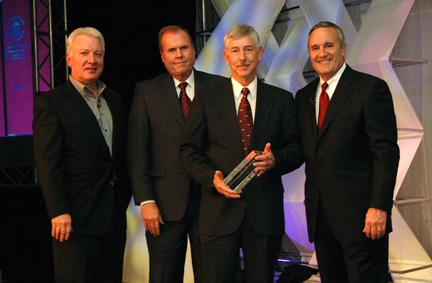
NAVAIR’s F/A-18 & EA-18G Advanced Weapons Laboratory (AWL) Integrated Product Team (IPT) received the Raytheon Six Sigma™ Chairman’s Award from Chief Executive Officer Bill Swanson. AWL’s IPT lead Barry Douglas accepted the award during an October ceremony in Washington, D.C.
This prestigious award is presented to Raytheon customers who embrace the company’s continuous improvement culture using their version of Six Sigma, R6S.
The AWL team was honored for seeking improvements to a process attached to Raytheon’s support of the APG-73 radar, one of Raytheon’s all-weather, multi-mode search-and-track sensors for the F/A-18.
The radar performs both air-to-air and air-to-surface missions and is an upgrade of the combat-proven APG-65 system, providing higher throughputs, greater memory capacity, improved reliability and easier maintenance without an increase in size or weight. The APG-73 also produces high-resolution radar ground maps and performs precision strike missions with improved weapon designation accuracy.
Seeking to reduce frustration caused by communication gaps, and to obtain higher quality products, Douglas asked Raytheon to propose an improved process. “In my mind, we weren’t maximizing our effort, timing, or profitability for the fleet. My desire was for Raytheon to understand what makes us tick, what is important, and how to help satisfy fleet needs.”
According to Raytheon, the AWL was not always satisfied with Raytheon’s final products related to the radar. In some instances, products were not fully tested. Conflicts with other existing work often caused schedule delays.
Raytheon went to work on a solution. Software engineer project team lead Martin Chao said the core problem was that neither Raytheon nor the AWL had a clear understanding of each other’s constraints, capabilities, resources, and priorities.
“We needed this project outcome to be an improved program plan based on a clear understanding of what is desired. We knew that would lead to better performance in meeting the customer’s needs, which would result in maximum award fees,” said Rich Herman, Raytheon’s APG-65 and 73 radar program manager.
The award fees Herman refers to are those that are built into industry contracts, rewarding high quality and fast delivery to customers.
To improve customer satisfaction and earn higher award fees, Raytheon was challenged with reducing the number of software bugs and performance problems associated with the radar operational flight programs and delivering to the Navy on schedule.
The R6S team worked the process with Raytheon Black Belt Alan Gilchrist. The team shared knowledge through periodic status meetings where Douglas provided F/A-18 program updates to the Raytheon IPT and prioritized performance concerns. The team then developed action plans to address those concerns. They used R6S and NAVAIR AIRSpeed tools to open communication between affected software engineers, system engineers, integration-and-test groups and accounts-receivable groups.
“These infrastructure changes resulted in Raytheon’s ability to reduce OFP integration-and-test cycle time by 20 percent,” Chao said. “NAVAIR’s AWL was impressed by Raytheon’s dedication to high quality software development and mission assurance. Barry Douglas was pleased with our commitment to customer satisfaction and so impressed with the results of the R6S process that he is now an unabashed advocate for the use of R6S throughout all future business activity with Raytheon.”
According to Douglas, the AWL’s stated goal is to improve and provide higher quality products for the Navy, the Marine Corps, and foreign military sales fleets at reduced cost and schedule. Upon recognition of the stated goals, he expects an increase in Raytheon award fee as a result of the R6S projects.
“Rather than have to do the rework, we get it right the first time,” Douglas said. “If the government is paying maximum award fee, that’s because the government is real happy. And the fleet is the ultimate winner.”
-End-
Photo caption: (Left to right) Don Ronchi, Raytheon Six Sigma director; Jon Jones, president, Raytheon Space and Airborne Systems; Barry Douglas, NAVAIR F/A-18 and EA-18G AWL IPT lead; and Bill Swanson, Raytheon chairman and chief executive officer gather at the presentation ceremony in Washington, D.C.