
Engineers plan ahead to prevent downtime
Circuit breaker cut
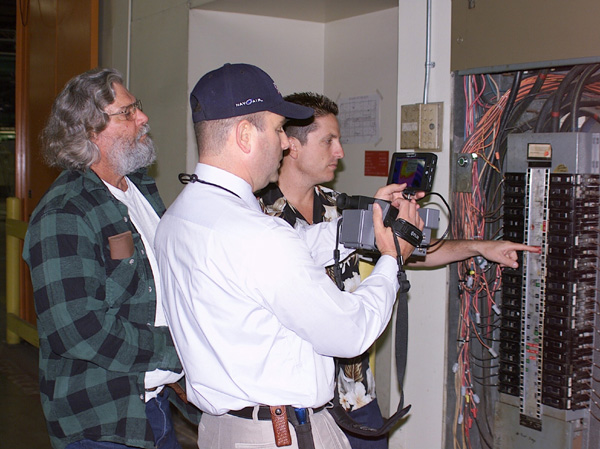
David Gaipa points to a problematic circuit breaker as Frank Snook uses an infrared camera to display heat the circuit breaker generates. Behind them is maintenance work leader Ken Moen. Joe Feliciano
Engineers planning ahead to prevent downtime
By Bill Bartkus
NAVAIR Depot North Island
NAS NORTH ISLAND – NAVAIR Depot North Island here is 100 percent committed to supporting the war fighter. However, unexpected and unplanned downtimes can disrupt the flow of getting parts and aircraft back to the fleet. Downtimes are costly and bad for business.
Last month an engineer with a trained eye, Frank Snook – coupled with an infrared camera – averted a possible catastrophe in the plant. The engineer operating the camera saw that a circuit breaker on a panel in the manufacturing building was hotter than the rest and had it immediately replaced. Had it not been replaced, the circuit breaker could have started a fire.
“Failure Code Analysis showed repetitive power issues in the building. Using the infrared camera, we performed heat scans on power panels,” said Frank Snook, a Depot electronics engineer in the Industrial Production Support Department.
“The camera spotted a circuit breaker that was hotter than the others; we replaced it on the spot and rechecked the heat level and the results were satisfactory,” said Snook, “We also repaired bad insulation crimps; it’s when you have metal to insulation contact, not metal to metal.”
To nip problems in the bud, the Facilities competency established engineering trouble calls (ETC) that give support maintenance and shop personnel faster response times. “This gives them time to submit a Rapid Reply Request (3R) or a request for services while we are working the problem,” said David Gaipa, a Depot electronics engineer in the Plant Technical Support Office and Equipment Availability Team lead.
“Facilities has established an Equipment Availability Team, which spawned from an AIRSpeed event, whose goal it is to reduce equipment downtime and increase the meantime between failures,” said Plant Technical Services Manager Tony Santos.
“We want to increase the meantime between failures and decrease the meantime to repair. Everyone plays a part, not only engineering and maintenance, but FISC (Fleet and Industrial Supply Center) as well,” said Snook. “FISC plays a role because if we don’t get the parts on time it impacts our meantime to repair.”
The infrared camera plays a critical role in helping Facilities discover potential problems before they erupt into something major.
“In the case of the electrical panel in the manufacturing building, the camera displayed that a circuit breaker was 4 degrees hotter than the rest. We removed this particular circuit breaker and discovered that it was damaged,” Snook said. “We found the problem before there was a trouble call.”
Gaipa said, “The infrared camera is just one of the tools that the team uses to detect problems before they cause plant equipment to go down. We also have vibration analyzers and laser alignment equipment that we use on machinery to check for different problems that are developing.”
Snook and maintenance foreman Roger Mikulec work as “point of use engineering” where engineers and maintenance work together. The team plans to walk around the plant every Friday and use the camera in other areas.
For the last year, the Equipment Availability Team failure code data on production shop equipment and used this information to find repetitive failures. “Roger’s personnel tell me why the machine fails. Production calls in a trouble call, but maintenance tells me why the machine failed and codes it,” Snook said. “Then I look for repeat problems and find a solution to eliminate them.”
Snook examined the failure codes over the last year. “By analyzing them I discovered that the manufacturing building was No. 1 for power problems. In order to find and diagnose power problems, one of the best tools to use is the infrared camera,” he said. “We place the camera in the hands of maintenance and walk around and check for glitches before they become problematic.”
Mikulec mentioned that it is better to have the engineer crew with maintenance when they operate the camera. “The experts are there alongside us,” he said.
Snook said that he goes around with the team and shows them what to look for. “We need to locate the problems,” he said.
The team will also look at three other buildings in the Depot.
Snook said that the team located the circuit breaker problem in the manufacturing building within one hour.
The team has other tools to search for problems. As an example, Snook said that the new TESTEK bench had noise in the gearbox. “We formed a team and ran all the technology tools on the bench that we have: vibration analyzer, infrared camera, scope meter, and laser alignment. We captured wave forms coming from the drive controller going to the motor where the pulses were missing.”
Snook said he contacted the factory and explained that there was a problem. “The factory sent a technician who changed the drive parameters in the computer, and the problem we had since February went away because (with our technical tools) we proved that the mistake was a factory flaw,” Snook said.
Santos said that the technician changed the parameters based on the recommendations by depot engineers. “The technician hesitated, but he changed the parameters nevertheless, and it turned out that this was the problem,” said Santos.
Gaipa said that the TESTEK flaw problem also affected 59 other systems Navywide. “Now the company will go back and fix the other 59 based on our findings,” Santos said.
Snook mentioned that the team wants to put Production on notice to plan downtimes. “Shop foremen don’t know when we are coming around to test equipment because a computer generates a preventive maintenance card. Most preventive maintenance requires a machine to be down, and technicians need the machine for a certain period of time,” Snook said.
The predictive maintenance tools used on the machines require that the machines be operative. “We need to plan the downtime with the customer,” Snook said. “We need to coordinate with the customer during operation to give us time to make predictive maintenance measures.”
Production will need to plan maintenance on their scoreboard items, the most critical pieces of equipment in their area. “It’s similar to scheduling an appointment for a TV cable company to come into your home to make repairs,” Snook said.
“This system will minimize any impact on production time,” said Santos.
“Overall, the goal is to improve the reliability of critical equipment in the plant. This will help production provide the war fighter with what they need as quickly as possible,” said Gaipa.
“Performing failure code analysis will allow us to find solutions to eliminate repetitive failures. Performing predictive maintenance using the new tools will find problems before they have the chance to cause major equipment downtime,” he said.
- 30 -