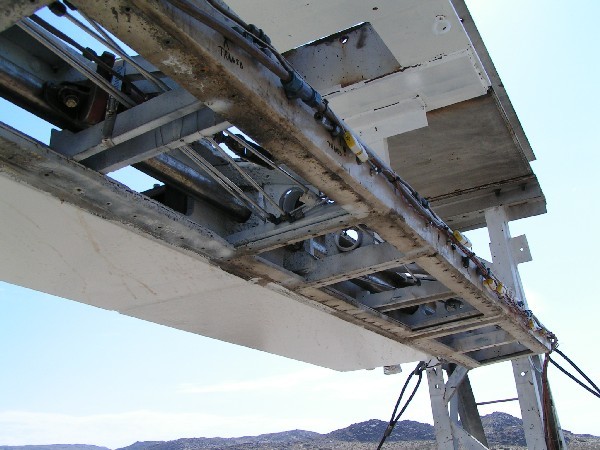
This test article was designed and built by engineers at the Weapons Survivability Laboratory in China Lake, Calif. to simulate the leading edge of a P-8A Multi-mission Maritime Aircraft wing for fire suppression testing at the Naval Air Warfare Center Weapons Division in China Lake, Calif. (U.S. Navy photo)
P-8A blazes the acquisition trail with live-fire testing
Though early in its System Development and Demonstration phase, the P8-A Multi-mission Maritime Aircraft Program continues to set the standard for acquisition programs, this time in maybe one of the most critical areas - survivability.
“Fire is a major contributor to catastrophic failure of aircraft,” said Silvia Seng, P-8A live fire test lead with the Weapons Survivability Laboratory (WSL) at Naval Air Warfare Center Weapons Division in China Lake, Calif. “We are doing developmental live-fire testing early enough in this program so that the results can have a positive influence on the actual design of the aircraft.”
A team of engineers from Patuxent River, China Lake and Boeing worked together on the P-8A program to execute the approved Live-Fire Test and Evaluation (LFT&E) Strategy. This strategy is focused on vulnerability reduction and survivability enhancement while fulfilling congressionally mandated LFT&E requirements. LFT&E testing began in April and will conclude in 2012, prior to the P-8A entering full-rate production.
“The primary goal of the P-8A program is to provide the Maritime Patrol Aircraft fleet commander an aircraft that is continually effective and suitable for its intended missions in maritime and littoral environments,” said Dave Legg, P-8A Survivability lead in NAVAIR’s Maritime Surveillance Aircraft Program Office (PMA-290). “Vulnerability reduction and survivability enhancement are part of that goal.”
Preliminary fire suppression testing for P-8A began at the WSL in April. The results remain classified, but based on data from those preliminary tests Boeing is working with several vendors to develop an effective fire-suppression system. Development and verification testing of the system began in August and will continue through 2009. Full-scale live-fire testing is slated for 2011 using a P-8A static test aircraft.
Using data and information provided by their Boeing teammates, engineers at China Lake design the required test articles using Computer-Aided Design. That design is then brought to reality a few hundred yards away at the machine shop on-site. Seng then oversees the set-up of the test on one of the six test pads at the WSL, and the execution of the tests from a fire control room.
Testing began Aug. 16 on a fabricated leading edge of a P-8A wing. The simulated wing was hung on a test stand in front of a High-Velocity Airflow System that can simulate in-flight conditions up to 690 mph. This particular test event called for 19 shots to be fired at the wing leading edge dry bay. A dry bay is an area in the aircraft adjacent to an area where fuel is located, or one that contains hydraulic lines or reservoirs. Test results will be classified.
Seng will provide Boeing the raw data collected from the tests within two weeks. Boeing is then responsible for analyzing and reporting the results to P-8A program management and incorporating design features as appropriate.
Assessments by the Navy/Boeing team of advanced technologies and systems will be an ongoing effort to meet emerging requirements with effective solutions. The next fire-suppression test for the P-8A program will be on the trailing edge of a fabricated wing and is scheduled for September at the WSL.
“We have assembled a great team that is working closely together to ensure the safest and most effective warfighting solution for the future,” said Cmdr. Mike Moran, NAVAIR’s P-8A department head. “The P-8A will deliver a broad array of technologies for protecting the aircraft and its crew in order to maximize the likelihood of mission completion.”
The P-8A MMA is the Navy’s replacement platform for the P-3C Orion, securing the Navy’s future in long-range maritime patrol. Built on a modified Boeing 737-800ERX, P-8A will bring together a highly reliable airframe and high-bypass turbo fan jet engine with a fully connected, state-of-the-art open mission systems architecture. This approach, coupled with a combined set of low risk non-developmental and next-generation sensors, will dramatically improve Anti-Submarine Warfare, Anti-Surface Warfare, and Intelligence, Surveillance, and Reconnaissance capabilities well into the 21st century. P-8A MMA will use state-of-the-art simulation and training systems and implement innovative performance based logistics concepts. The platform will provide more combat capability with a smaller force and less infrastructure than the venerable P-3C. Successful execution of SDD is critical toward getting the first operational aircraft squadron forward deployed in 2013. Full operational capability is slated for 2019.
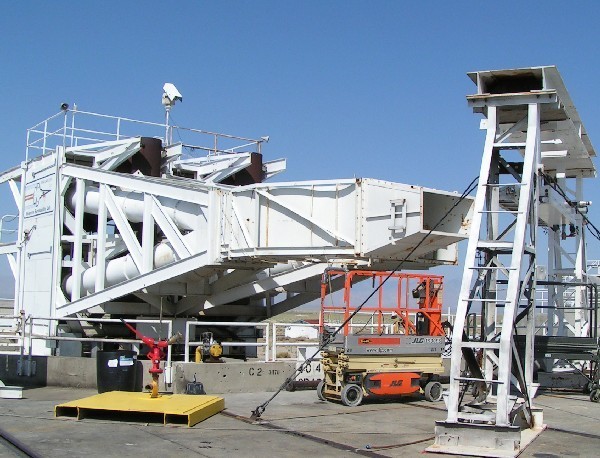
The four-engine High-Velocity Airflow System (HIVAS) can simulate localized in-flight conditions up to 690 mph. The fabricated leading edge of a P-8A wing hangs in front of HIVAS in preparation for fire suppression testing at the Naval Air Warfare Center Weapons Division in China Lake, Calif. (U.S. Navy photo)
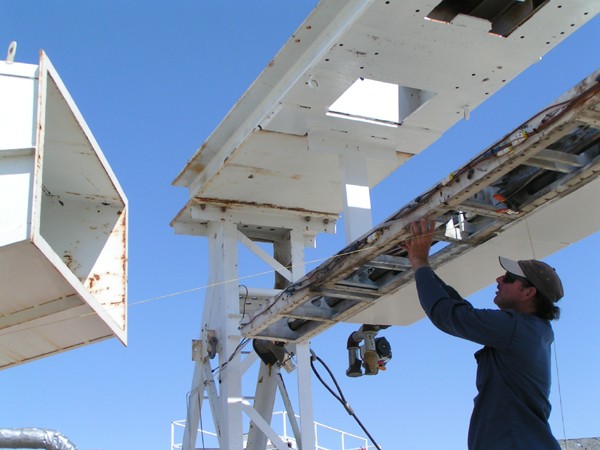
Dan Connell, WSL test crew lead, calculates the precise angle that accurately reflects the P-8A’s swept wings for an upcoming fire suppression test at the Naval Air Warfare Center Weapons Division in China Lake, Calif. (U.S. Navy photo)