SMALLER SEAFIGHTER RESPONSE TEAM TESTS FIRE FIGHTING AND SAFETY SKILLS DURING REALISTIC DECK FIRE SIMULATION
Released by Naval Air Warfare Center Weapons Division, China Lake Public Affairs Office --
By Susan Read
Thirteen Navy and Coast Guard crew members from the new SeaFighter (FSF-1) based in San Diego and a host of technical and military personnel from various Navy commands spent the earliest part of three days in August -- very warm days in California’s high desert -- to conduct flight deck fire tests designed to evaluate reduced team manning concepts for aviation fire fighting aboard FSF-1 and LCS-1 class ships.
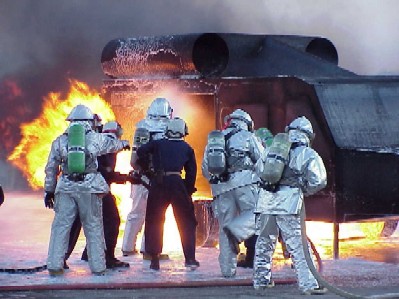
The tests were conducted at the Naval Air Warfare Center Weapons Division (NAWCWD) China Lake, California on the Fire Test Facility known as the “Mini Deck” and sponsored by the Office of Naval Research and W-1819 Program. A helicopter fire simulator and equipment was set up to create as realistic a setting as possible, in which crew members were to respond to the ignition of JP-8 fuel as though it were the emergency response of a helicopter crash on the flight deck.
In addition to the eleven Sailors, Coast Guard and their Commanding Officer, Lieutenant Commander Brandon Bryan, test participants included NAWCWD Fire Sciences Office of the Weapons and Energetics Division, with support from the Fire Division, Fuel Farm and Safety Offices of the Naval Air Weapons Station (NAWS). Observers included Captain John W. Riley III, commander of the Regional Support Organization in San Diego, and Commander Michael Sasscer from the Afloat Training Group, Pacific (ATGPAC).
SeaFighter’s CO had praise for the NAWCWD support at China Lake. “The facility has been fantastic,” Bryan said, “And I think it’s safe to say the tests have been successful so far.” He explained that the basis for testing like this is to optimize manning to make the crew’s jobs easier. Technologists and test crews are able to hone in more efficiently and make additional suggestions that one or the other might not otherwise have considered.
Captain Riley was impressed with the testing coordination effort. It was key to demonstrating the concept of operations that focuses on keeping optimally manned ships and their Sailors safe. “There is no sacrifice to safety,” Riley said. “SeaFighter will allow technological advancements to be incorporated in future ships.” Commander Sasscer added, “There’s success in the realism and the proof of concept.”
Three of the SeaFighter crew who responded to the repetition of the test fuel fires were BMC Donald Murray, GSM1 Daniel Ayers and QM1 Casey Neal Hamilton. Each man represents not only the military occupational specialty that his rate designates, none of which is firefighting, but also a variety of other significant roles aboard the SeaFighter . Their job during the response tests was as firefighter alongside three teammates, with the five remaining crew and CO as backup.
Murray stated that the China Lake range is the only facility where such realistic testing can be conducted with real fuel versus the propane used in regular training. Ayers added that because the SeaFighter’s deck team consists of mostly non-damage control rates, they are doing this fire training for the first time and “we know we’re competent to do anything.”
Hamilton explained that the team was not given specific scenario details for each test so that the responses would be spontaneous. The intensity of each situation changed, with variables like back draft, increased fuel, fewer hoses and staged casualties. The concept of only 6 initial responders is entirely new, Hamilton said, but the participants met the challenge.
Murray commented on the detailed planning that went into the two days and the unexpected benefits that came about. For example, working side-by-side with the professional civilian firefighters of the China Lake Fire Department allowed the military to learn and implement techniques such as the hose maneuver called the “hotel loop”. Murray indicated the civilian participants have knowledge that can be applied in a situation like this, which has not been adopted in the Navy before.
“It’s exciting to be part of the cutting edge,” explained Hamilton. “The Navy is in transition now and we get to be at the edge of what the Navy will be after we’re gone.” Ayers agreed. “We’re doing this for the benefit of future ships in the Navy and Coast Guard.”
Murray concluded by highlighting the strength of the Navy, Coast Guard and NAWCWD/NAWS civilian fire test team. “This is great training to help newer ships work safer, smarter and with less personnel. One ship -- one team!”
######
PHOTO CUTLINE: SeaFighter Response Team tests firefighting and safety skills.