
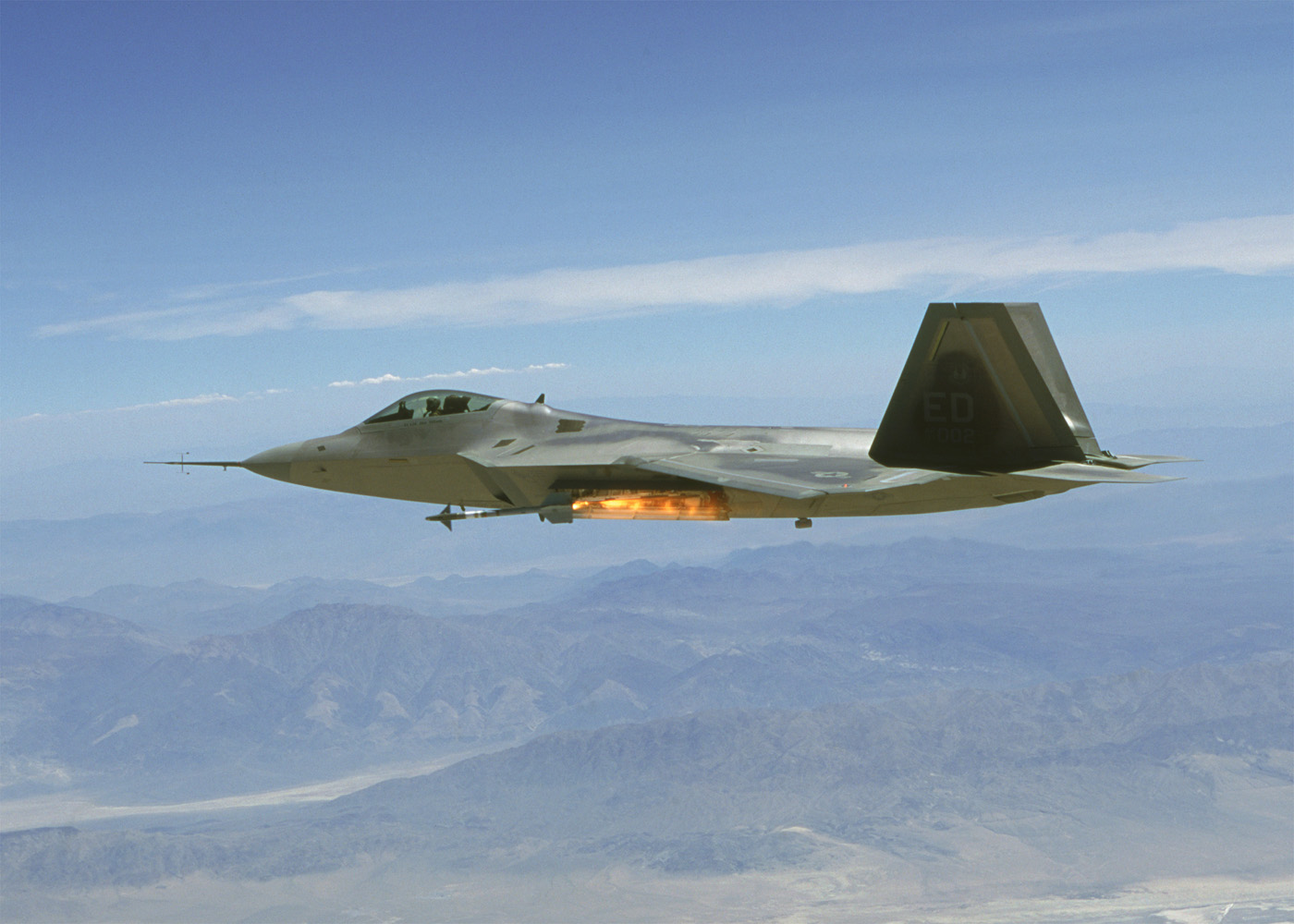
CHINA LAKE WEAPONS TESTING TEAM WORKING ON F/A-22 PROGRAM APPLY LEAN PRINCIPLES
Released by the Naval Air Warfare Center Weapons Division China Lake Public Affairs Office---
By Linda Lou Crosby
P3R/Wyle Laboratories
As the date for introducing the first F/A-22 squadron draws near, and with Naval Air Systems Command (NAVAIR) heavily focused on getting “leaner” and more productive, the F/A-22 NAVAIR Weapons Division (WD) team members looked back on innovative ways they saved time and money during the F/A-22 testing process.
During Spring 2003, a successful Lean event occurred where F/A-22 team members shortened the weapons integration test time, and saved money for the program. The “Lean” concept is a way (as summarized by author James P. Womack) “to Banish Waste and Create Wealth in Your Corporation”. A number of organizations currently view “Lean Thinking” as a way to become more effective and efficient. For the F/A-22 team, every minute and every dollar they could save was crucial to their success.
The F/A-22 Raptor, developed at Aeronautical Systems Center, Wright-Patterson Air Force Base, Ohio, is the replacement for the F-15 Eagle air-superiority fighter. This aircraft combines stealth design with the supersonic, highly maneuverable, dual-engine, long-range requirements of an air-to-air fighter and will have an inherent air-to-ground capability. The F/A-22’s integrated avionics gives it first-look, first-shot, first-kill capability. The F/A-22 program aims to replace the F-15 as the Nation’s premier air-to-air fighter aircraft. The first squadron of fully operational F/A-22s is scheduled to be in place by late 2005.
Lockheed Martin is the prime contractor for the F/A-22. The company in turn uses the services of other contractors, such as Raytheon, and also government teams, such as the F/A-22 AIM-9X (Sidewinder) Integrated Product Team at China Lake Weapons Division to get work done. “When Lockheed wanted technical expertise for the AIM-9M Sidewinder missile, they looked to the Weapons Division,” said WD F/A-22 IPT deputy lead Pete Chmelir.
In a time of shrinking budgets and doing more with less, the F/A-22 team used “Lean Principles” to save time and money throughout the program including the flight test program.
Back in mid-2003, the program entered a period of intense missile firing. The goal was to complete 22 missile separation firings…10 AMRAAM and 12 Sidewinder, in a 10-week period. Further, there was a requirement to analyze each firing to “clear” the next separation point, i.e. the performance of the missile and the agreement of the predicted separation trajectory with the actual missile trajectory had to be completed before the next firing was authorized.
The test schedule and parameters were a challenge for the program. Lockheed Martin has been involved in the LEAN/Six Sigma process for several years and had significant successes when Lean techniques were employed in various projects. A “Kaizen” event was held to identify all of the steps in the data reduction/analysis process and to eliminate any non-value added steps.
The event began by sequestering the leaders of each of the various teams that took part in the missile-firing event, from providing the actual missile hardware to final analysis of the recorded data. Since the team was distributed across the country, the event was hosted at Edwards AFB where the Combined Test Force for the F/A-22 is located. Twenty-eight engineers and team leads worked for a solid week to identify the “now” state and refine it to the “future” state. Our initial focus was on the separation program that was the most immediate stressing issue. The net result was a 20% decrease in the time (work days) necessary to complete a single event and an ability to overlap the differing missile events so that we averaged almost 2 missile firings per week. The work hours were reduced by 28%, and the approvals required to proceed to the next event were reduced by 21%.
At the same time, the group also performed a kaizen event for the avionics missile firings. These firings had a similar requirement to shorten the time between successive events. At the end of the week, the “future” state of the process resulted in a 26% reduction in time (workdays) between events, a reduction of 9% in work hours and a 45% reduction in the number of approvals required to proceed to the next event.
“We worked long and hard to get the results,” said Chmelir, “And the results were extremely successful. I am unaware of any other program firing as many missiles in such a short period of time.” The F/A-22 program brought together people from everywhere. But, according to Chmelir, that mix was a key to success. “It is essential that the right players are available full time to the event,” added Chmelir, “If they’re not, their portion of the process will be incorrectly assessed and either reduced too much or not be reduced enough leading to a less than optimal result.”
-END-
Official Photo by Judson Brohmer