
Wounded employee comes back … one step at a time
By Mike Barton
Public Affairs Specialist
Ed Salau doesn’t really think of himself as a changed man. Sitting in a comfortable chair in his living room with one pant leg pinned up to cover the remainder of his severed left leg, and a pair of crutches leaning within arm’s reach, he shrugs and says, “I’m just me, with one leg.”
It is three days after Christmas and Ed is home in Havelock on convalescence leave from Walter Reed Army Hospital in Washington, D.C. Less than six weeks earlier, he was an Army National Guard first lieutenant commanding a Bradley fighting vehicle in north central Iraq when it was hit by a rocket propelled grenade during an enemy ambush on his patrol. The vehicle gunner standing next to him, Sgt. Andrew Butterworth, was also wounded. He too would lose a leg due to his injuries.
Ed had only been working at Cherry Point Naval Air Depot for less than a year when his Army National Guard unit was mobilized for duty in Iraq. Ed initially worked in the depot’s calibration lab – an occupational skill that he brought with him after 11 years in the Marine Corps. Just two weeks before he got the call, he transferred to the Occupational Safety Division.
During the attack, Ed remained conscious throughout the gunfight that ensued. An hour later, he was undergoing surgery in the field hospital. In addition to the damage to his leg, he had received second degree burns on the left side of his face. When he woke the following morning, the first thing he asked the nurse was, “Am I going to make it?” When she told him he was going to be fine, he ran through a gauntlet of emotions that began with relief and ended with curiosity – he was already looking ahead.
Looking at him calmly telling his story, you believe him. Despite his ordeal, Ed seems to still have a bulletproof attitude. There’s no doubt that it must be hard for him, but sitting here, he looks no more concerned than if he had accidentally left his favorite hat in the desert. But finally he admits that his life is … well … different. “I always prided myself in being self reliant,” he says, allowing a slight frown. “Now I’m dependent. But I’m pretty confident that I’ll be back to my old self – once I get my leg.”
Ed is referring to the new prosthetic leg that he will be fitted with when he returns to Walter Reed. He has already seen the state-of-the-art device that will carry him back to the life he once knew. It gives him something to smile about.
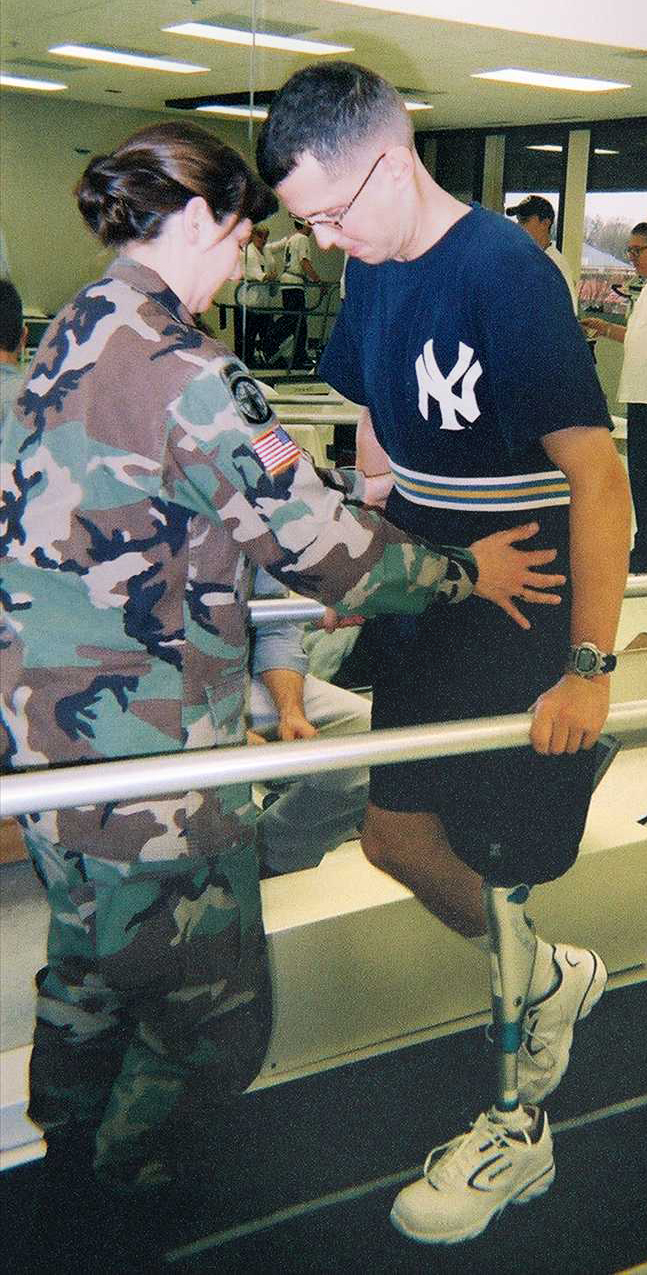
Move forward in time. It is now two months since Ed was injured and he has just gotten his new prosthetic leg. He is on a slowly moving treadmill in the physical therapy unit at Walter Reed. He is walking between long parallel bars, lightly supported by his arms and shoulders. Near him, Army Maj. P. Papazis, one of his physical therapists, holds out a hand for support as she closely monitors his movement. Sitting to the side, Travis Carlson, a prosthetic specialist, watches Ed’s stride and enters data into a laptop computer electronically linked to Ed’s new leg. In short, he is programming the leg, essentially teaching it to mimic the normal movement of Ed’s missing limb. The leg will be programmed for two different modes of operation – one for regular walking and a second mode for some other regular activity of Ed’s choosing. These complicated devices are normally provided for amputees who have lost a leg above the knee, requiring a more complicated motion for every step.
As Ed progresses through his therapy over the next several months, he will occasionally be wired up for additional tune-ups of his leg. Much like a toddler, as he learns to use his leg, it will learn with him. When all of this is done, then he can officially request his second leg – in his case, it will be one designed for running.
If you picture a man struggling through the motions with a grimace on his face and sweat running down his arms and back, well, you’d have it wrong. In fact, Ed is making it look almost too easy. Most of the real work is probably going on inside his head as he programs his own inner computer to deal with the new challenges his handicap will bring.
“When I’m in the hospital, walking on the treadmill in shorts, surrounded by people who work with this sort of thing everyday,” says Ed later, “I feel a lot closer to normal.” He pauses, and then adds, “But when I’m out at the mall or someplace with my wife, moving around on crutches, legless, I get the stares. Then I don’t feel normal.” This new prosthesis will, in time, he believes, change that. “Once I get used to it and it is ready, then I’ll be pretty darn close to normal.” After another pause, he says, “Part of it is a matter of me trusting the leg.”
The sooner that Ed’s mind and body bond with his new leg, the sooner he will get home. Terri Salau, Ed’s wife, is one of many people who await Ed’s full-time return. An engineering technician in the depot’s H-60 Integrated Maintenance Program, she has learned a lot about patience from this experience. But even more so, she has a strengthened appreciation for her husband. “Anybody can be gone in the blink of an eye,” she says. “And we’re extremely proud of him, of what he gave.” She and Ed both acknowledge that he is different now. Who wouldn’t be? The challenge is to return their lives to what was once considered normal.
Presently, it looks like the odds are in Ed’s favor. The amount of support for disabled veterans today is nothing like that known from any previous era. In addition to the technological advancements, military care and other support organizations seem to be moving in the right direction. Ed has been assured that his care will never end … and he believes it. He has also received support from nongovernmental groups like Disabled American Veterans (who have provided logistical support), Disabled Sports USA and firemen from the New York City Fire Department (who have sponsored ski trips for Ed and Terri). Add to that the moral support by family and coworkers and Ed has plenty of tools to help him get back on his feet.
“We hope that, in the end,” says Terri, “it will just be a matter of spending a few more minutes getting ready in the morning.”
-30-
Cutline: Ed Salau practices with his new leg under the watchful assistance of U.S. Army Maj. P. Papazis at Walter Reed Army Hospital in Washington, D.C. Salau was injured in Iraq while serving as the commander of a Bradley fighting vehicle in the Army National Guard. (Photo by Terri Salau)