
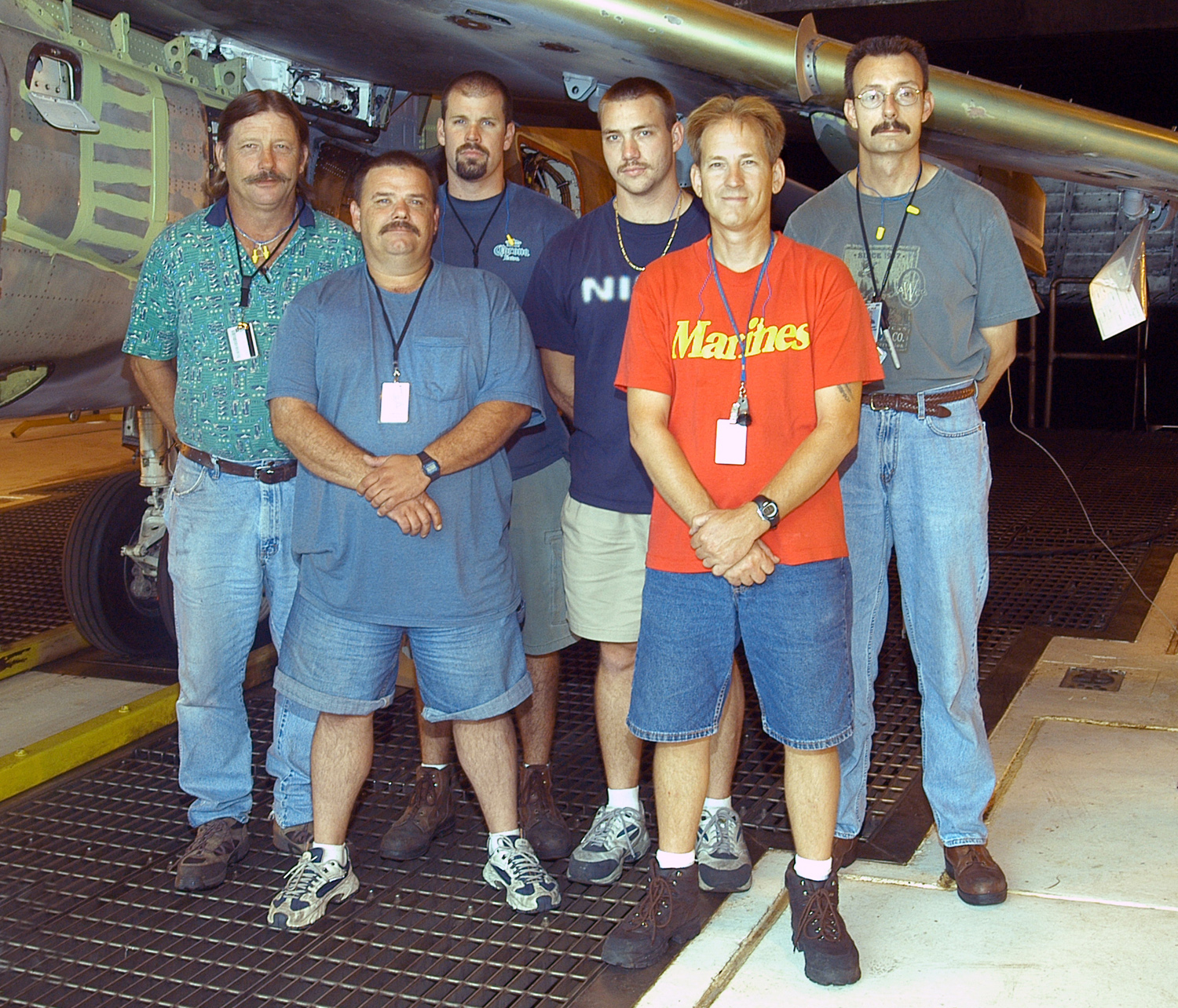
September safety pro: AV-8 Engine Ground Team
By Maj. Steve D. Hagerty
AV-8B Harrier Program Officer
Walter Burke, Robert Bazen, Nicholas Bridges, Robert Henke, Brad Sterett and Roger Gardner of the AV-8 95771 and 95774 shops have been awarded the Naval Air Depot Safety Professional of the Month award for September.
The six-man team was nominated for demonstrating tremendous courage and initiative while detecting and controlling a potentially catastrophic aircraft fire.
On the morning of July 30, the team was faced with an unexpected challenge while conducting routine engine ground checks on an AV-8B Harrier in the AV-8 V/STOL High Power Engine Check Facility, commonly referred to as the Hush House. Burke was in the cockpit at the aircraft controls conducting the initial engine run while Bazen, who manned the operator console, and the other team members monitored the run through an observation window. During Hush House operations the console operator is in direct communication with the aircraft operator via audio and video cameras and is responsible for the safe conduct of all activities while operating the facility. The operator console contains automatic and manual switches to dispense fire retardant foam from overhead dispensers in the event of a fire.
After completing the appropriate pre-engine run checklist, Burke received a “go” for engine start from the console operator, Bazen. Upon initiation of the engine start sequence, Bazen observed what appeared to be ash and smoke coming from the gas-turbine starter exhaust duct located on top of the aircraft behind the cockpit. He immediately informed the aircraft operator of the situation whereupon flames erupted from the smoking exhaust duct. Bazen quickly directed Burke to execute emergency engine shutdown procedures. Bazen then activated the Hush House fire suppression system, which was supposed to release the foam agent from the overhead deluge dispensers while simultaneously opening the Hush House main hangar door. However, the fire suppression system malfunctioned – the foam did not activate and the hangar doors remained closed.
The engine ground team was then faced with having to extinguish the fire using hand-held fire extinguishers stationed on the walls inside the Hush House. Although these extinguishers were not designed to combat an aircraft fire, but rather to extinguish smaller fires that may occur within a structure or building, the team instantly sprang into action. Bazen directed Bridges to open the hangar doors manually while Sterett seized a fire extinguisher from the wall. Henke was standing by to assist as required. Gardner leaped onto the wing of the aircraft as Sterett quickly passed the extinguisher to Gardner, who proceeded up the wing to the top of the fuselage. Gardner looked down into the smoking exhaust duct and noticed it was glowing red and began expending the extinguisher into the burning duct.
Meanwhile, Burke was still inside the closed cockpit completing the engine shutdown procedures in accordance with regulations. Satisfied the aircraft engine was safely shut down, Burke opened the canopy while Henke placed a boarding ladder against the fuselage for Burke to complete his egress without jumping from the cockpit. It was then that the fire reignited in the exhaust duct. This time it was Sterett who grabbed the fire bottle and scaled the wing to put out the fire for the second and final time.
While his team battled the fire and helped Burke exit the cockpit, Bazen contacted the air station Crash, Fire, Rescue team via a 911 call from his station console. He was not aware that CFR had already been alerted when he triggered the otherwise malfunctioning fire suppression system. The entire sequence of events lasted only a few minutes until the CFR team arrived on the scene. The CFR team applied additional foam into the GTS duct to ensure the fire would not ignite again.
The initial investigation determined that failure of the engine gas-turbine starter motor caused the fire. The starter is a fly-to-fail system – there is no way to ascertain its status prior to operation. The starter was submitted for an engineering investigation to determine what caused it to fail.
The Hush House fire suppression system has since been repaired.
The swift response of the AV-8 engine ground turn team demonstrated extraordinary teamwork and prevented a potential catastrophic aircraft fire which could have resulted in the loss of the aircraft, personnel and surrounding permanent structures. The actions of Burke, Bazen, Bridges, Henke, Sterett and Garner are commendable and are in keeping with the highest traditions of the U. S. Naval Service, NAVAIR and NADEP Cherry Point.
-30-
Cutline: (From left) Walter Burke, Robert Bazen, Roger Gardner, Nicholas Bridges, Brad Sterrett and Robert Henke, members of the AV-8 Engine Ground Team, saved an aircraft and the Hush House engine test facility from possible destruction through quick thinking and action. (Photo by Mike Barton)