MMA program officials meet with fleet to address early acquisition issues
By Renee Hatcher
MMA Public Affairs
NAVAIR’s Maritime Surveillance Aircraft (MSA) Program Office hosted the inaugural Multi-Mission Maritime Aircraft (MMA) Fleet Working Group Feb. 8 – 9 in California, Md.
The two-day conference was an opportunity for MMA’s acquisition leaders to meet with the end users and discuss several time-sensitive issues affecting the design, development and support of the Navy’s planned replacement for the P-3C Orion.
“The expertise, insight and guidance from the fleet will be instrumental in developing solutions that meet the Navy’s Maritime, Patrol and Reconnaissance (MPR) community expectations,” said Capt. Steve Eastburg, MSA program manager.
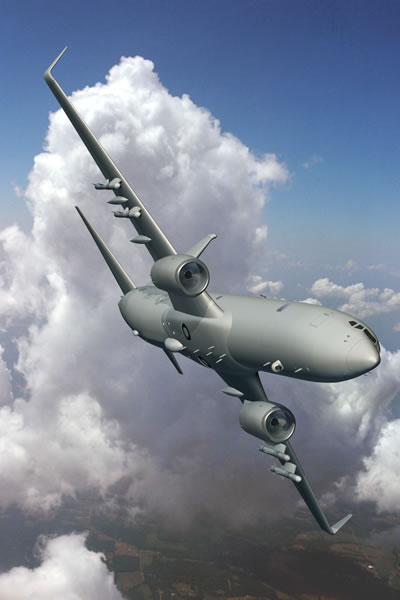
MMA will be designed to support the Sea Shield concept of the Chief of Naval Operations (CNO) Sea Power 21 initiative by providing persistent anti-submarine warfare, anti-surface warfare, and intelligence, surveillance and reconnaissance capabilities. It will be a modernized air vehicle that will provide more combat capability from a smaller force and less infrastructure while focusing on worldwide responsiveness and interoperability with traditional manned forces and evolving unmanned sensors.
“Holding this type of working group with the fleet helps us at NAVAIR insert efficiencies into our process of building this aircraft,” said Cmdr. Joe Rixey, MMA Integrated Product Team lead. “Our discussions were good, necessary and sometimes a little emotional – that just shows how passionate we all are about delivering this transformational aircraft to the warfighter.”
About 50 people attended this first MMA Working Group. Those participating included representatives came from test squadrons, the P-3 fleet replacement squadron, the Navy’s Patrol and Reconnaissance Wings, and the Office of the Chief of Naval Operations. Fleet response to the conference was overwhelmingly positive as evidenced by their comments at the conclusion: “The fleet appreciates this opportunity – it’s been very productive…It looks like you are on track to deliver us what we need to fight”; “You guys really have this wired”; “We have a good vision of where we need to go”.
MMA program office leaders were also pleased to have the opportunity to discuss with the fleet how the program is primed to deliver an advanced warfighting capability that’s aligned with CNO initiatives including the Human Capital Strategy.
The MMA program may be in the early stages of development but it is taking a unique approach to an area that is often overlooked in the acquisition process – the human element. The program has a comprehensive plan for Human Systems Integration that is documented in MMA’s Human System Integration Plan (HSIP). The goal of the HSIP is to optimize total system performance, minimize total ownership cost, and ensure that the system meets the needs of the users. The HSIP is aligned with the CNO’s Human Capital Strategy.
“MMA will radically transform how the Navy’s Maritime Patrol and Reconnaissance Force will man, train, operate and deploy,” Rixey said. “Transformation is coming and we in the MMA program are leading it.”
(For more information, call Renee Hatcher at 301-342-0207.)
PHOTO CAPTIONS:
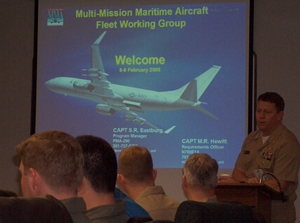
Cmdr. Joe Rixey, NAVAIR’s Multi-Mission Maritime Aircraft Integrated Product Team lead, kicks off the first MMA Fleet Working Group held Feb. 8-9 in California, Md.
The Multi-Mission Maritime Aircraft will replace the Navy’s fleet of P-3C Orions and will be designed to support the Sea Shield concept of the Chief of Naval Operations Sea Power 21 initiative by providing persistent anti-submarine warfare, anti-surface warfare, and intelligence, surveillance and reconnaissance capabilities.