
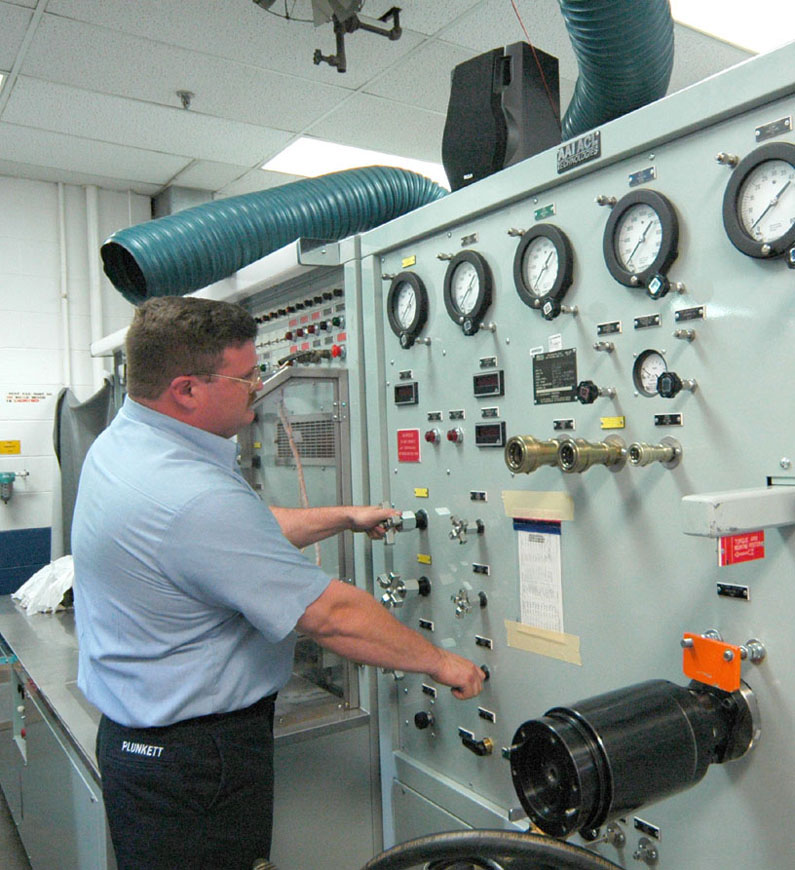
AD1 Greg Plunkett, AIMD power plants division, demonstrates the operation of the pump housing test unit. The unit tests the hydraulic pumps of the propeller. (U.S. Navy photo)
NAS Brunswick P-3 Team commits to NAVRIIP/AIRSpeed
A recent visit by Naval Aviation Enterprise (NAE) leaders to NAS Brunswick, Maine, demonstrated commitment to the cost-wise readiness journey and the improvement of long-standing processes for the P-3 aircraft. The leaders also expressed their continued encouragement of Sailors and Marines to implement the NAVRIIP and AIRSpeed process improvement tools.
Cmdr. Dan Lafond, Commander Patrol and Reconnaissance Wing Five (CPRW-5) maintenance officer, noted: “In order to manage personnel and assets for optimizing ready-for-tasking aircraft (A-RFT), we’ve developed close cooperation within the CPRW-5 triad. The triad consists of the wing maintenance officer (wing MO), aircraft intermediate maintenance detachment (AIMD), officer in charge (OIC) and aviation support detachment (ASD).
“We are open to new ideas and innovative business practices. We welcome and are ready for NAVRIIP and AIRSpeed training for our Sailors and Marines. Our team understands the benefits associated with implementing the process improvement tools,” said Lafond.
The P-3 squadron is actively involved in process improvement initiatives throughout the squadron and AIMD/ASD. Such initiatives include active reserve integration (ARI), AIRPLAN and consolidated isochronal scheduled inspection system for maintenance (C-ISIS). These improvements contribute to increasing A-RFT during a period of flightline gaps by increasing the number of available aircraft and decreasing the number of aircraft in the depot for structural service inspections (SSI) and enhanced structural inspections (ESSI).
“CPRW-5 improvement activities are aligned to NAVRIIP,” said Lafond. “Our Sailors are enthusiastic about C-ISIS, and they see the need for AIRPLAN in our operations and training departments. Also, AIMD participates in the P-3C barrier removal teams. Our people are excited to begin applying Lean to the intermediate maintenance activity (IMA) production processes.”
AIRPLAN, C-ISIS and ARI
Established in June 2004, AIRPLAN is a management tool used to prioritize aircraft assignments. Operations officers manage it with full participation from all P-3 squadrons at Brunswick. All events are prioritized, and a pooled resource concept is utilized. The program helps maximize aircraft use and readiness; it also helps in training aircrews with limited A-RFT to execute the flying hour program (FHP). AIRPLAN effectively maintains readiness.
C-ISIS is the scheduled maintenance plan for the P-3, which combines several work center maintenance areas into one. The wing MO coordinates the schedule, and all maintenance procedures are conducted in a dedicated hangar bay, work center and office space.
“We will continue with C-ISIS and we hope to improve it,” said Lafond. “The schedule is a challenge because P-3 aircraft do not have ISIS non-aging in all their Depot periods, which may include SSI and ESSI. Phased Depot Maintenance does have non-aging and is much easier to schedule when it comes out of the Depot.”
After C-ISIS implementation, maintenance cycle time was reduced from an average of 21 days to 10 days, and aircraft availability was improved. “We changed the cultural mindset of the Sailors,” said Lafond. “Now, through the new practices, cross training and work load planning, we are working toward the operational requirement.”
Through ARI, the active and reserve squadrons have been working closely together, borrowing aircraft and sharing a maintenance hangar. The maintenance officers and maintainers are consolidating resources in an effort to support the need for A-RFT.
Capt. Dan Lynch, CPRW-5 commodore, commented on these new initiatives: “By instituting C-ISIS, AIRPLAN and ARI, we are increasing our fiscal awareness, making informed decisions and enhancing teamwork in support of cost-wise readiness.”
Vice Adm. Wally Massenburg, commander of the Naval Air Systems Command and NAVRIIP chief operating officer, reinforced the point. “Coming from the culture of near-term thinking, we have to manage more effectively. You must be empowered to decide what you need. We are in a tough position where we must focus on balancing cost and readiness.”
New Fixes, New Processes
During the AIMD and squadron leadership tour, maintainers presented other recent improvements and technological advances to old equipment and processes.
AD1 (AW) Stanley Johnson, 400 division production, lead petty officer, submitted a design for a test cell hydraulic fluid recycler, which is now being successfully used in the T-56 engine test cell. A pump filters the fluid, and then cleans it for reuse. The process is now saving NAS Brunswick over $5000 annually, and the amount of hazardous waste has diminished.
“This is one great example of how the Fleet provided ideas and suggestions on ways to improve,” said Cmdr. Craig Munson, AIMD, officer in charge. “We instituted a new process which improved the overall work environment.”
AD2 (AW) Gregg Plunkett presented a new shipping container for P-3 propellers that ensures safer shipment and less rework at the facility when the propeller arrives. The container was purchased by NAVICP for AIMD and squadron use.
Plunkett also commented on the new C-130 and P-3 pump housing test bench. “We now have a safer means to install the pump housing, as well as reducing man-hours and repair costs.” Besides improving processes and parts, the squadron and AIMD also design new tools and facilities to improve their quality of work, reduce maintenance man-hours and cost.
A reduction gearbox (RGB) ring puller and procedure is a new tool and process designed to provide access to the reverse spring assembly. In the past, the squadron lacked the proper tool to access the spring assembly and clean the RGB thoroughly. The new cleaning process reduces the amount of metal contamination which resulted in premature failures of the RGB. By using the ring puller tool, beyond capability of maintenance status and failure rates are reduced, while reliability is increased.
Munson noted, “As the NAVRIIP and cost-wise readiness evolution unfolded, every Sailor began to understand the positive impact the cultural change would have on their man-hours, cost savings and quality of work-life. The impact on squadron readiness is seen throughout our day-to-day operations.”
Quality of work has also been helped by the new hangar facility built to consolidate two inefficient, wooden and outdated hangars. The new facility has an unobstructed entry width of 378 feet and is equipped with fabric hangar doors. These allow for better lighting and insulation; they can be completely rolled up into the hangar for invisibility. The doors withstand the same amount of wind as traditional doors, while allowing entry/exit for larger aircraft. The building will accommodate the Boeing 737 replacement for the P-3C.
Said Lafond, “The P-3 community and CPRW-5 at NAS Brunswick will continue to evolve with NAVRIIP and AIRSpeed as we continue to improve maintenance processes, component reliability and reduce cost.”
NAVRIIP leadership discussed whether the new hangar design should become the hangar of naval aviation’s future. The benefits of the new design and the versatility of the doors allow for flexibility and space which is not currently an option at other bases. “As we make improvements and find success, we need to share this with the entire NAE,” said Massenburg. “It’s important to communicate with others in Naval Aviation to avoid stovepipes of activity and to share lessons learned.”
The Brunswick team is also employing the aviation financial analysis tool (AFAST), utilized NAVRIIP-wide to manage resources. “AFAST data helps make us all smarter on what we need to spend money on,” said Cmdr. Jim Buckley, VP-8 commanding officer. “The maintenance department is smarter when trouble-shooting because of available AFAST data. We have to balance this with requirements from the commanding officers. We are more aware when troubleshooting because we work closer with the AIMD and spend money together.”
Massenburg reiterated the need for the Navy and Marines to share the same path to reach cost-wise readiness. “In the beginning, NAVRIIP was solving the readiness problem,” said Massenburg. “We got it about right. Now, we are moving toward getting the cost-wise piece right. We need to afford the Naval Aviation of the future. We will do this by cultural change, commitment by our Sailors and Marines, and by using the NAVRIIP and AIRSpeed tools.”
NAS Brunswick is scheduled to receive full AIRSpeed training in June 2005. “We will continue to look for improvements and work with the P-3 type-model-series community to improve operational and intermediate-level maintenance,” said Lafond. “We look forward to receiving AIRSpeed training at NAS Brunswick.
For more information on NAVRIIP and Enterprise AIRSpeed, link to www.airpac.navy.mil/navriip or call 301.757.1487.
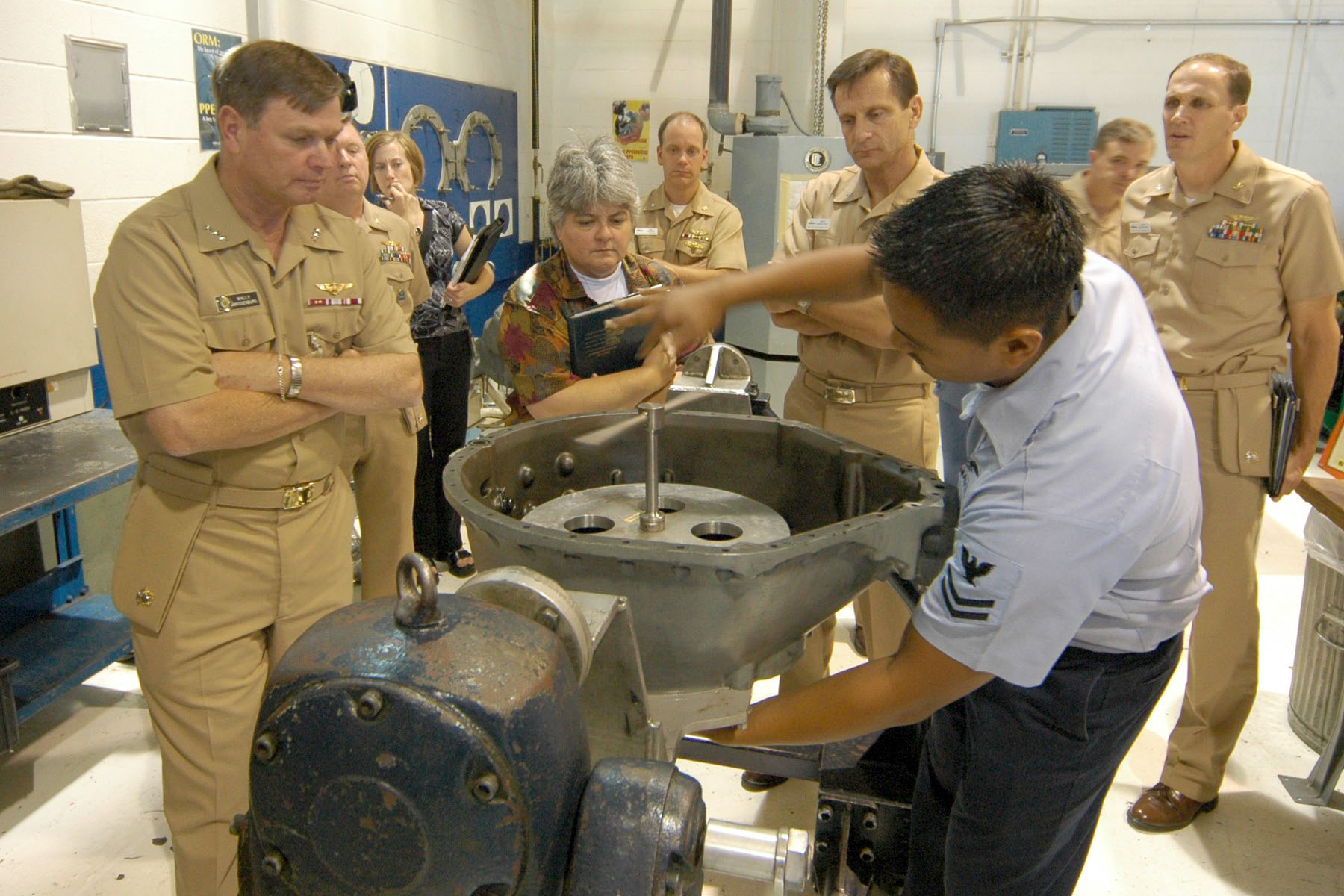
AD2 Christian Mesina, VP-26, AIMD power plants division, demonstrates the proper use of a ring gear box compressor puller to Vice Adm. Wally Massenburg, NAVRIIP COO, and other NAVRIIP leadership. The RGB procedure uses a new tool designed to provide access to the reverse spring assembly. In the past, the squadron lacked the proper tool to access the spring assembly and clean the RGB thoroughly. The new cleaning process reduces the amount of metal contamination which resulted in premature failures of the RGB. By using the ring puller tool, beyond capability of maintenance status and failure rates are reduced, while reliability is increased. (U.S. Navy photo)
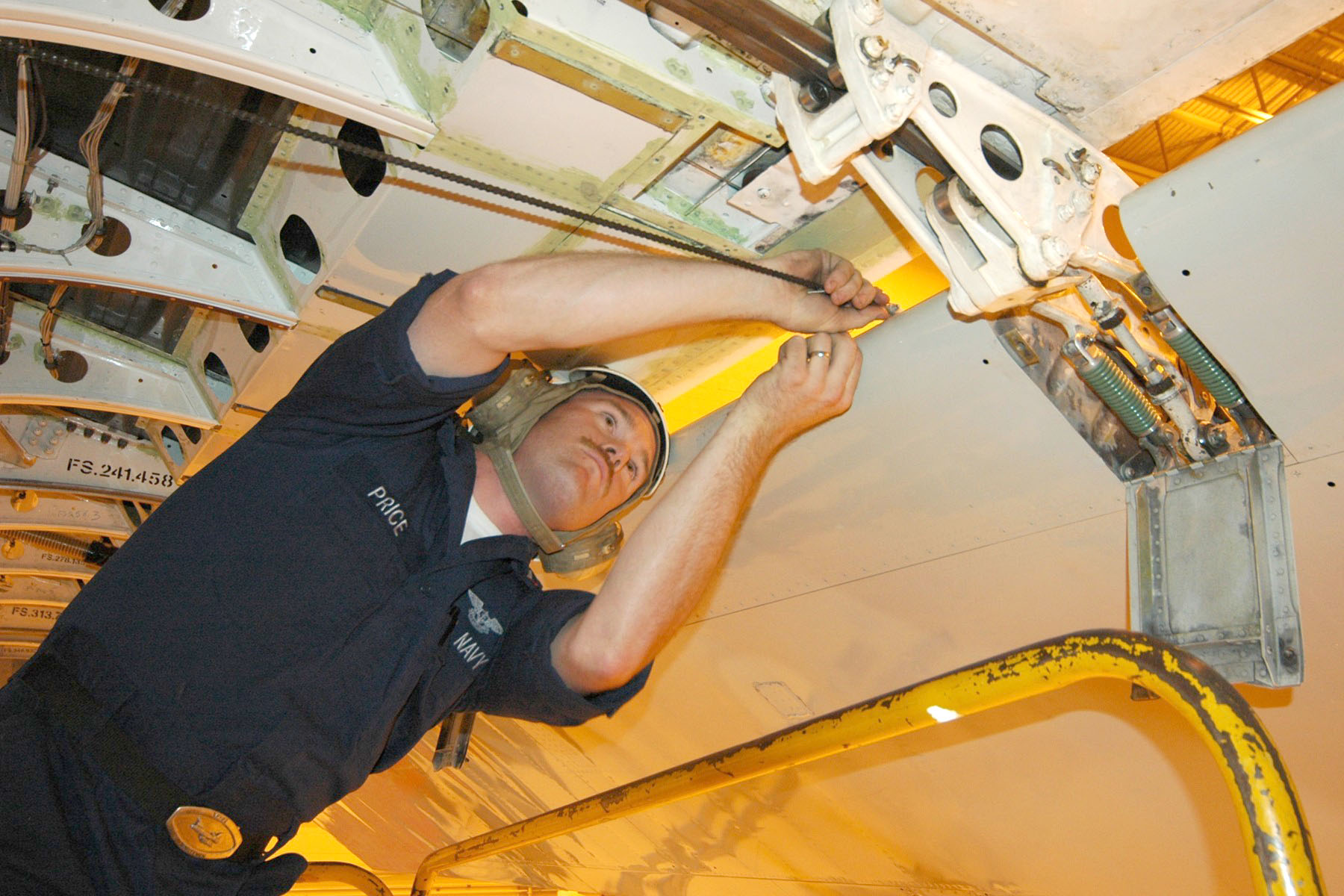
AM2 William Price, VP-92 reattaches a flap asymmetry chain. The chain belongs on the under side of the wing on a P-3 air craft. (U.S. Navy photo)