Hawkeye IMC up, running, flying at Point Mugu
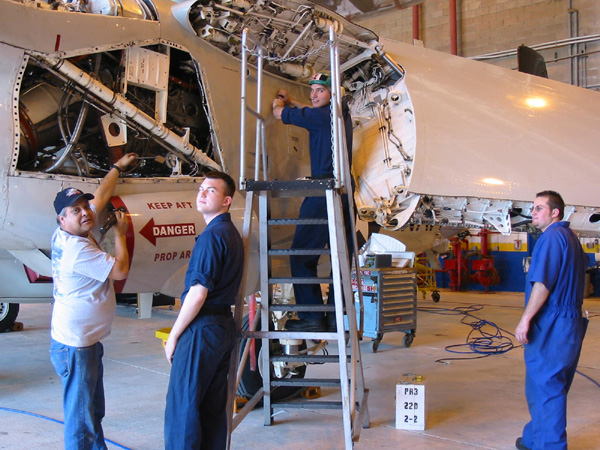
NAVAIR Depot North Island artisans Richard Delgadillo (left) and Noah Apgar (right) perform organizational- and depot-level work alongside sailors on an E2C Hawkeye at Point Mugu. Photo by Mark Nakamura
Hawkeye IMC up, running and flying at Point Mugu
By Bill Bartkus
NAVAIR Depot North Island
POINT MUGU, Calif. – The much anticipated Integrated Maintenance Concept at Point Mugu, Calif., became a reality last month with the first induction of the E-2 Hawkeye. The concept integrates the fleet and Depot maintainers to support the warfighter by working together on the E-2C.
“This ideal philosophy is conducted in fleet spaces as an overall cost-wise readiness venture,” said Davy Chavarria with the NAVAIR Depot North Island Industrial Business Operations Department, who had the lead in organizing the plan.
Cmdr. Ron Kaelber, maintenance officer for Commander Airborne Early-Warning Wing Pacific, agrees with Chavarria’s assessment. “Cost will become and important factor in maintaining our aircraft to meet the increased tempo of the Fleet Response Training plan,” the Depot customer said. “We feel that having the Depot onsite makes them more accessible to the fleet.
“Some of the gains to be realized from accomplishing the PMI (Planned Maintenance Interval) work in an integrated environment include fielding questions, conducting show-and-tell, and reinforcing proper mechanical practices,” Kaelber said. “Enhanced ability to recognize structural anomalies, reduced turnaround time on planner and estimator work, importance of using proper hardware and a greater appreciation of work performed at the Depot level are also pluses.”
Engineer Mark Nakamura said the PMI was the culmination of hard work by members of the Depot E-2/C-2 Fleet Support Team and the Strategic Business Unit, and Program Manager Assistant (PMA) 231 at NAVAIR headquarters. “Since its inception, the PMI-1 activity on the West Coast has been performed at the Depot. However, the activity at the Depot has typically required additional time and effort because of the need to perform functional check flights and other pre- and post-PMI activity compared to the PMI-1 activity at Naval Air Station Norfolk (Va.),” Nakamura said.
“The location of a PMI-1 activity at Point Mugu was anticipated to reduce this level of work. The aircraft is towed from squadron spaces to the adjacent PMI-1 hangar,” he noted.
“Being able to roll the aircraft into and out of PMI-1, instead of flying, is a huge savings of resources. There was a lot of man-hours tied up in the transfer and acceptance cycle that added no value to completing the PMI-1 tasks,” added Kaelber. “Having PMI-1 onsite allows us to remove this waste and reduce turnaround time.”
Everyone agrees.
“This transition was conceived as a means to reduce turnaround time and ultimately produce cost efficiencies,” Nakamura stated. “In addition to co-locating the PMI with squadron spaces, it was felt that an increase in the synergy between the Depot and fleet maintainers could be achieved. It turns out that there was a side benefit to this work that wasn’t anticipated. The fleet maintainers gained valuable insights from veteran Depot artisans as to how to perform aircraft repairs and our artisans learned a few tricks from the fleet maintainers. This cross-training between the workers is a most welcome benefit.”
Gregory Champagne is the Depot’s onsite production supervisor. He has with him at Point Mugu one electrician, one sheet metal worker, and three aircraft mechanics. There is also one estimator and evaluator, and one quality assurance specialist.
“The work is progressing ahead of schedule,” Champagne said. “There haven’t been any major problems. Everything was well planned ahead of the aircraft induction. We are very experienced in the PMI process, so we know what to expect.”
Champagne said the artisans enjoy working at Point Mugu. “They know that what they are doing saves the Navy and the taxpayer money and shortens the turnaround time. PMI also gives sailors valuable training that they wouldn’t normally receive. This is a win-win situation for the Depot and the fleet.”
Nakamura agreed saying, “The successful execution of the PMI-1 is a win-win situation for everyone. We should all be proud that by keeping these aircraft flying, we are part of the total effort that ultimately ensures that our armed forces are able to do their job and support our country.”
Ben Duysings is a Depot planner and estimator for the E-2/C-2 product line who also monitors the work at Point Mugu. He agrees with Champagne that the work is ahead of schedule. “The turnaround time is accomplished faster when you have cooperation between the Depot and the fleet working together,” Duysings said. Different teams are working on the various phases of the five-stage PMI event.
Chavarria said the planning stages to place an IMC onsite at Point Mugu started last May, and the Integrated Logistics Support (ILS) plan detailing the tasking and dollar requirement was presented to the Aircraft Program Manager for Logistics (APML) in June. “Partial funding to support the material requirements came in September. This supported the publications, some support equipment and tool room-type hand tools,” Chavarria said. “The balance of the funding came in January, just in time to support the induction of the first aircraft.”
That balance of funding supported the labor requirements to position those material items at the hangar to meet the induction schedule. “In a nutshell,” said Chavarria, “the ILS (Integrated Logistics Support) plan called for sending the funds, and we’ll be ready in three months. From the initial site survey in May to the induction in January with two funding installments did not follow the plan. But working with the PMA (Program Manager - Air) office, FST (Fleet Support Team), and some concentrated depot effort, NAVAIR Depot North Island was able to meet that induction."
“I feel that integrating the O-level and D-level effort at Point Mugu will pay dividends for years to come,” said Kaelber. “Sailors are excited about being able to work side-by-side with Depot artisans. Being able to acquire specific knowledge, skills and abilities in their trade while working on their aircraft will increase their value to the squadron and help us to maintain the fleet for years to come.
“Both the squadron and Depot personnel are working together to accomplish the work that needs to get done,” Kaelber said.
And that work is to get the aircraft safely back in the hands of the warfighter for him to accomplish his mission.
NAVAIR provides cost-wise readiness and dominant maritime combat power to make a great Navy and Marine Corps team better.