
RESERVIST COMES HOME FROM CAMP VICTORY
Released by the Naval Air Warfare Center Weapons Division China Lake Public Affairs Office--
By Desiree Jones
David Mesa will never forget where he came from: the Shafter home he grew up in, the Navy base where he works, and, most recently, Iraq.
The 41-year-old Navy reservist volunteered to leave his day job as a weapons supervisor and go to war, the same way his father and grandfather did.
“I was raised to love my country,” Mesa said, “and I thought I had a lot of pride in our military. But after Iraq, after being there and knowing what those young kids are going through — what their parents are going through — my pride in the Navy and the military is stronger.”
Mesa, who has served on active duty, in the reserves and as a civilian in the Navy at the Naval Air Weapons Station China Lake, reached his career goal last week when he was promoted to chief warrant officer. It was a high achievement, but he wanted more.
“I didn’t go to war to advance my career. I found out I’d been selected for chief warrant officer before I volunteered for Iraq. Going to war is just something I had to do.”
As a boy, Mesa asked his dad to tell him about being an Army sergeant in Korea. He listened to stories about his grandfather’s role in World War I. One uncle, he learned, served in the Pacific. Another fought at Normandy.
The heritage inspired him. “I never thought Hispanics served in that capacity back then,” Mesa said. “When I joined up and first saw a Hispanic pilot crawl out of an A-6, it made me feel like I could accomplish something big like that too.”
Three months in Baghdad was something big to Mesa. He deployed through China Lake’s Warfighter Response Center to provide technical expertise in supporting intelligence, surveillance, and reconnaissance with carrier-based F-14s and P-3Cs.
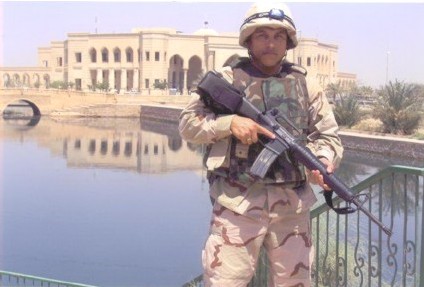
Mesa was stationed at Camp Victory South — a former complex of Saddam Hussein’s palaces near Baghdad International Airport. Coalition forces are now headquartered there.
In the countries of Qatar and Iraq, Mesa personally completed more than 200 support missions. He was instrumental in leading his enlisted team members and offered recommendations and instruction to his detachment officers.
When Mesa arrived in July, only about 50 of the 14,000 military and civilians stationed at Camp Victory were sailors. Most were teenagers.
“I was told before I went over that this is a young man’s war,” Mesa said. “It is. Most of the kids I was with were 18 and 19 years old.”
Sometimes, after a mortar attack, a few of the young sailors would come to Mesa and ask, “Did you feel those rockets go over, Chief?”
“I’d give them a pep talk, try to ease them. They were scared — we all were — but these kids want to do their job. I found out how strong I was after being over there.”
At night, Mesa said he could hear people singing Islam prayers in between the mortar rounds and the tap-tap-tap of enemy fire. Once, his unit came under rocket attack, and he wondered if he would make it home to see his wife and three children.
Watching “Band of Brothers” on a pocket TV helped. “I’d watch that and tell myself, ‘You had people way before you fighting in foreign countries for freedom. And that’s why you’re here, for that same reason.”
He also made promises. “I truly believe in God. Deep down, when stuff over there happened, I knew I’d be okay.”
Mesa came home to his wife and kids in September. “My family gave up so much for me, allowing me to go. It’s a sacrifice I will cherish for the rest of my life.”
Last week his family watched Mesa receive his new rank inside the same hangar where he began his career 24 years earlier.
But things are different for CW02 Mesa. He’s different.
He appreciates his family more. He loves his country more. He reminds everyone he can to show appreciation to our fighting men and women when they return from war.
“You don’t have to be in the military to be proud and support the troops, especially when they come home,” he said. “A handshake or a wave or a kind word makes it all worthwhile. One of my neighbors came over and thanked me and gave me a Christmas gift for serving our country. That meant a lot.”
The Navy work Mesa does each day also means more. “I used to be like the other guys around here … I wanted to go to war. Gunner told me then, ‘You may not think it, but your role here in weapons development is important. Now I tell people that. When I was there, I saw the direct result of the work done here.”
Mesa plans to continue that work and being a reservist until they make him quit.
“I just love the military. Those words – honor, courage and commitment – in that order, they mean a lot. It was such an honor being there, fighting next to guys from other services. It took courage to take it all in – the attacks, the fatalities. And the commitment … so many young people willing to serve and do their part. It was worth my whole career to see that.”
-End-
Cutline:
CWO2 David Mesa holds Navy-issued M-16 in front of the main palace at Camp Victory South in August.