
Supply annex eliminates parts backlog
By Mike Barton
Public Affairs Specialist
If you ask Jackie Attaway if this is a story about Lean methodology, she’ll tell you, no, it’s about people who are using their brains as well as their backs to support depot production.
Attaway is the deputy director for the Cherry Point annex of the Fleet Industrial Supply Command, (part of FISC Jacksonville, under the Navy Supply Command). She is proud of the way her personnel are doing their jobs, and she has good reason to be. In the brief time since the former Industrial Material Management Division made the transition to the FISC, it has reduced parts delivery turnaround time from an average of five days to less than one. And no, it wasn’t officially a Lean project – although it worked through the very same principles that Lean embraces.
When Cmdr. Michael Ropiak officially took the reins as the director of the new supply department in October, he gave his deputy a mission: fix the delays.
That was when Attaway and several of her subordinate supervisors – Rudolph Nobles, Jack Dunaway, Norm Steffen, Andrew Saunders and Mike Kennedy – put their heads together and decided to shoot for the moon – a 24-hour turnaround would be one of their primary goals in the new FISC agreement with the depot. They too were tired of seeing long lines out the warehouse door.
The result was a very smart way of scheduling and prioritizing the pick up and delivery of parts from the receiving warehouse. These changes led to smoother workflow for the supply specialists who receive, stock and deliver parts for depot artisans. Now, instead of long lines, the FISC delivers most requested parts directly to the workshops in less than one rotation of the planet. As one production controller told Attaway recently, “I almost forgot where you guys are.”
Another production controller, Cathy Jones, echoes that thought. “They’ve cut my running down 100 percent,” she says. “It’s made a world of difference.” Jones, who works the ordnance, oxygen and radio shops, says that now when she order parts, she gets them later the same day or by the next morning.
The system works like this: Let’s say that Clarence Edwards, an equipment specialist program manager, orders a few dozen parts based on projected maintenance for the following week. When those parts arrive at the depot, FISC personnel will catalog and store them for when they are needed on the production floor. Meanwhile, Jones is requesting the parts that her artisans will need tomorrow. So while Attaway’s team is storing Edwards’ orders that have arrived at the depot today, they must first ensure that Jones gets her orders to keep the ball rolling in production. Now, multiply that by a several hundred and you can see why these guys would make a juggler dizzy.
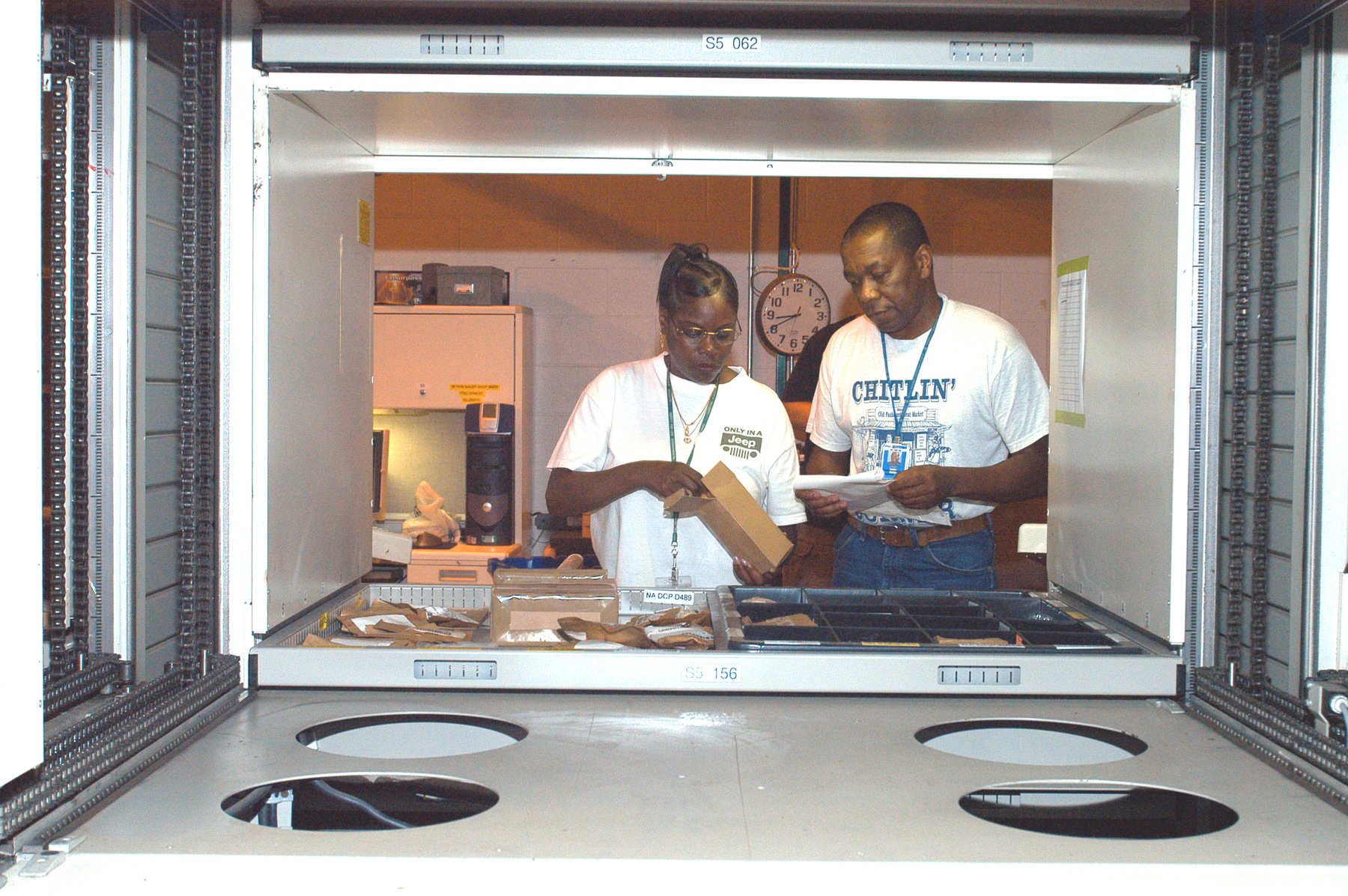
According to Dunaway, the clock starts when parts arrive at the receiving warehouse. The parts are picked up from receiving or delivered to their respective warehouses within a set number of hours – usually the same day. Once they hit the supply warehouse, they are entered into the automated storage system. Meanwhile, that day’s part orders – known as receipts – are filled, with special priority to those that are involved in a work stoppage. In most cases, those parts are already in stock, neatly stacked away on shelves, in pigeonhole storage bins or on the automated stackers that hold thousands of parts in a cataloged system that nearly reaches the roof of the three-story warehouse. While those orders are being packaged for delivery, others are already on their way to the artisans. The new system has virtually eliminated order backlogs.
In an average month, 136 FISC personnel (including a dozen on second shift and two on third shift) receive nearly 5,000 receipts (requests) and distribute between 15,000 and 20,000 orders (issues). This includes processing receipts into stock to account for material (physically and financially), and stocking and issuing material. This material could be aircraft and engine parts, hazardous materials, bar stock, sheet metal (which is cut to order), safety equipment and awards. They build and deliver kits of parts for artisans to help them complete whole repair processes. And they return material not used by the depot to stock.
Don’t bother asking who should take the credit for the new system. Everybody points to everybody else. But it looks like it began when Attaway convinced Nobles, who has more than 30 years of supply experience, to come back on day shift and help her get the system straight. He took the logical route of pooling the experience of the other senior personnel to work the issue. “You’ve got to listen to the people with their feet on the floor,” says Attaway, who insists that you can’t manage while hiding behind a desk. “These guys figured out what they needed and brought it to me. I let them go for it.”
According to Nobles, the tool and parts attendant supervisor, it was simply a matter of figuring out where the holdup was, and agreeing on how to fix it. Sound familiar? It should – these guys essentially used their own version of Theory of Constraints and Lean methodology to speed up their entire work process. Nobles; Dunaway, the tool and parts attendant work leader; Steffen, the material handler supervisor in the Central Receiving warehouse; Saunders, the second shift supervisor; and Kennedy, the special projects supervisor, started the process for the main warehouse in building 137. The FISC team has learned from this experience and is spreading the process to the other warehouse areas, continually seeking to improve the FISC’s support to depot artisans.
“This is one of our biggest achievements,” said Ropiak, who placed his trust in his experienced personnel. “The credit is really due to the people on the floor who analyzed the process, documented its shortfalls and improved the flow.”
Author’s note: On Aug. 1, Jackie Attaway retired from the depot after more than 30 years in the supply business. Mike Kennedy, one of the equipment specialist supervisors who played a role in the FISC improvements, stepped in to fill the department’s deputy slot.
-30-
Cutline: Tool and Parts Attendant Bonita King and Supervisor Rudolph Nobles sort and prepare parts for storage in one of the giant stackers in the main FISC warehouse in building 137. (Photo by Mike Barton)