
Lean process charges into full swing
By Mike Barton
Public Affairs Specialist
Take a walk with Michael Bogdahn through the production areas of the depot and you will see change. Change in the way artisans do business, change in their working conditions and a change in their attitudes toward change itself. When Bogdahn walks into workshops now, people approach him with ideas to make the depot a better place to work. Only a few months ago it was a different story altogether.
As the site lead for the new Lean program, word is spreading that when Bogdahn turns his eye toward your shop, he’s going to work with you to make your life easier – while increasing your value to the NADEP machine.
A perfect example is the T64 engine shop in building 133. If you haven’t been there in a couple of months, you’d better get new directions, because the place just doesn’t look the same. When you think Lean, think clean. Think neatness and a sense of order that smooths the flow of work. For the artisans who work there, it means fewer tools to lug around, needed parts within easier reach, as well as a better system for identifying which parts need to be replenished. It means a more systematic, yet sensible flow of engine work.
“We work with the Lean template to put the tools and parts where artisans do their jobs,” says Bogdahn. “Then we figure out how to work with our FOD and tool control policies to make it work.”
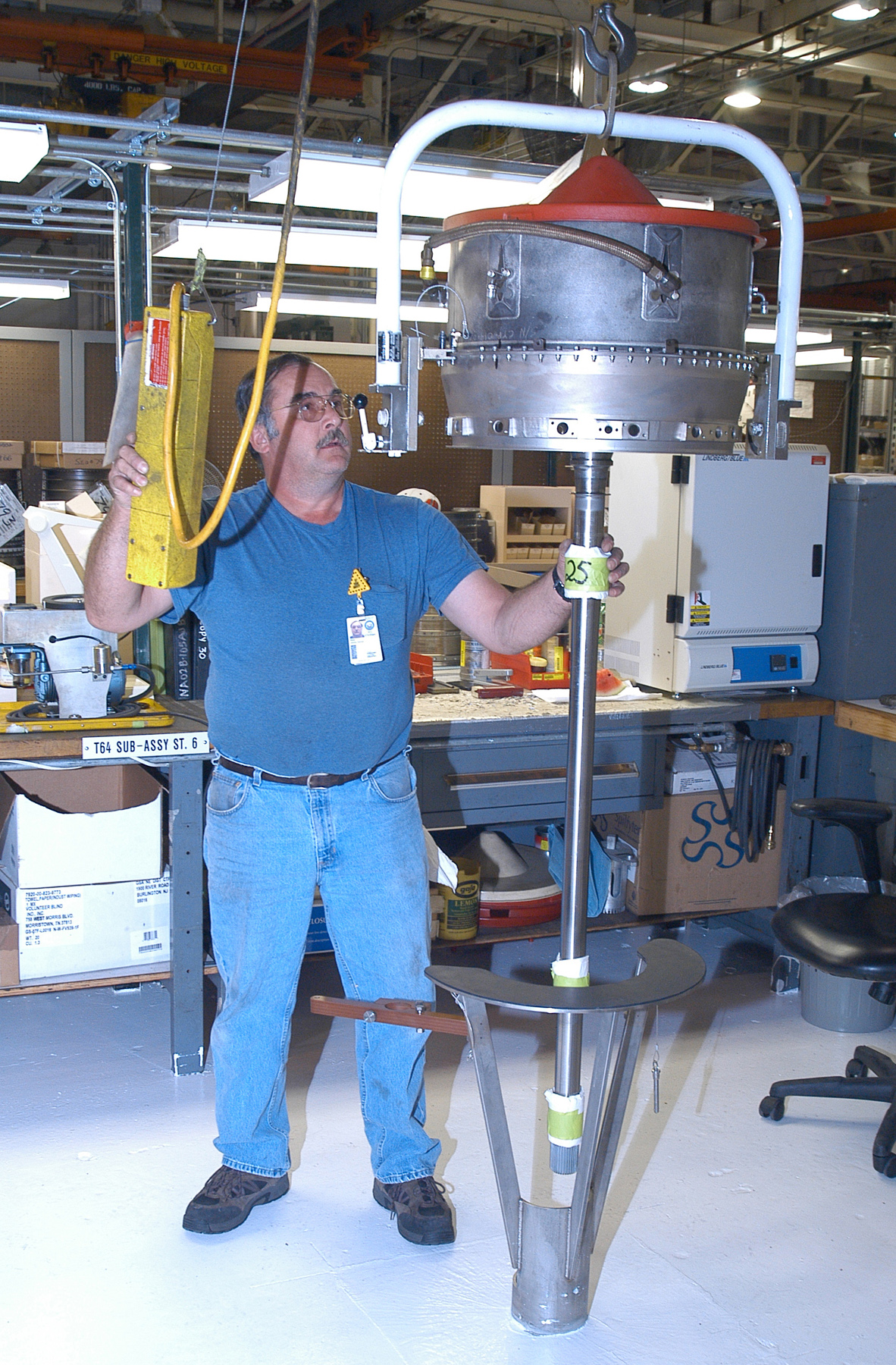
In one corner of the shop, a tall metal stand sits empty. Normally, a seven-foot long power turbine would rest vertically on the stand’s steel frame, as an aircraft engine repairer climbs up and down its short steps to mount hardware around the engine component. Now, instead, Jimmy West does his work from the relative safety and comfort of a rolling chair. This is because of a new stand sunk cleverly into the concrete floor that lowers the turbine to a safer and more efficient level. “I can do the work in half the time,” says West, who admits like many others that, at first, he thought that Lean would be just another “phase” that they would have to go through.
The new work stand that West uses didn’t come off of some master Lean list of cool ideas. The idea began at the shop level with a simple “It would be easier if we could just knock a hole in the floor to get these turbines down lower.” Enter Dale Yarbrough, a mechanical engineer in Support Equipment Engineering. Assigned to provide engineering support for the T64 shop project, Yarbrough designed the new stand and voilá, the T64 shop’s production process got leaner. The entire process took little more than a month. Other engine shops are eyeing the new stand for their work areas too – another Lean advantage – it shares the good ideas with anyone who can benefit.
A short walk away, Charlie Jones and John Stilley perform the final finish on fuel controls. Their work area is a small, well-lit room recently constructed specifically for that purpose alone. Again, Lean methodology has fine-tuned their work process, creating a more logical flow in the work. The fuel controls flow in one window and out another like JP-5 through a finely tuned jet engine.
Down the aisle, in another small room, production controllers muck through never-ending paperwork on their desks and computers. Their workspace is still undergoing Lean changes. Wilbert Bryant, a production controller supervisor, approaches Bogdahn to discuss the work that is being done. As they near the end of the conversation, Bryant says to Bogdahn, “Have you got another minute? I want to show you something.” Bryant leads Bogdahn to another shop across the building. On the way, Bogdahn peeks into the fuel controls clean room to see how Lean changes are working in that work area.
A minute later, he stands with Bryant in front of their destination. “Do you think you can help us in this area soon?” Bryant asks. From a Lean standpoint, the place is a mess. Bogdahn agrees and tells Bryant he’ll try to move that area into the near schedule.
This is a lot like a typical day for Bogdahn. As more shops bask in the benefits of Lean, the word is getting around. Lean is not just another time-wasting project. It is a solid tool under the AIRSpeed umbrella that will help keep NADEP Cherry Point on the map. Other apparent reason that Lean works here is that it has the highest blessing from the top and the funds to back it up.
And last, the process never stops. As Lean spreads throughout the depot, it will naturally pinpoint new areas that need to be fixed. “What we perceive to be the bottleneck (constraint) is not always really it,” says Bogdahn. Like Arnold Schwarzenegger, Bogdahn repeatedly reminds people that he will be back. “When I leave these places, it doesn’t mean that I’m done,” he says. He knows that Lean events in other areas will sometimes allow room for leaner adjustments in places that have already been worked. “In the meantime,” says Bogdahn, “I’m just a phone call or e-mail away.”
The Lean process is scheduled to hit all areas of the depot by July 2005.
-30-
Cutline: Jimmy West, an aircraft engine repairer, hoists a power turbine out of a partially submerged engine stand created during Lean upgrades to the T64 engine shop. The new stand has cut West’s work time on the turbines in half. (Photo by Mike Barton)