New NADEP facility blasts into business
By David Cobb
Industrial Engineer
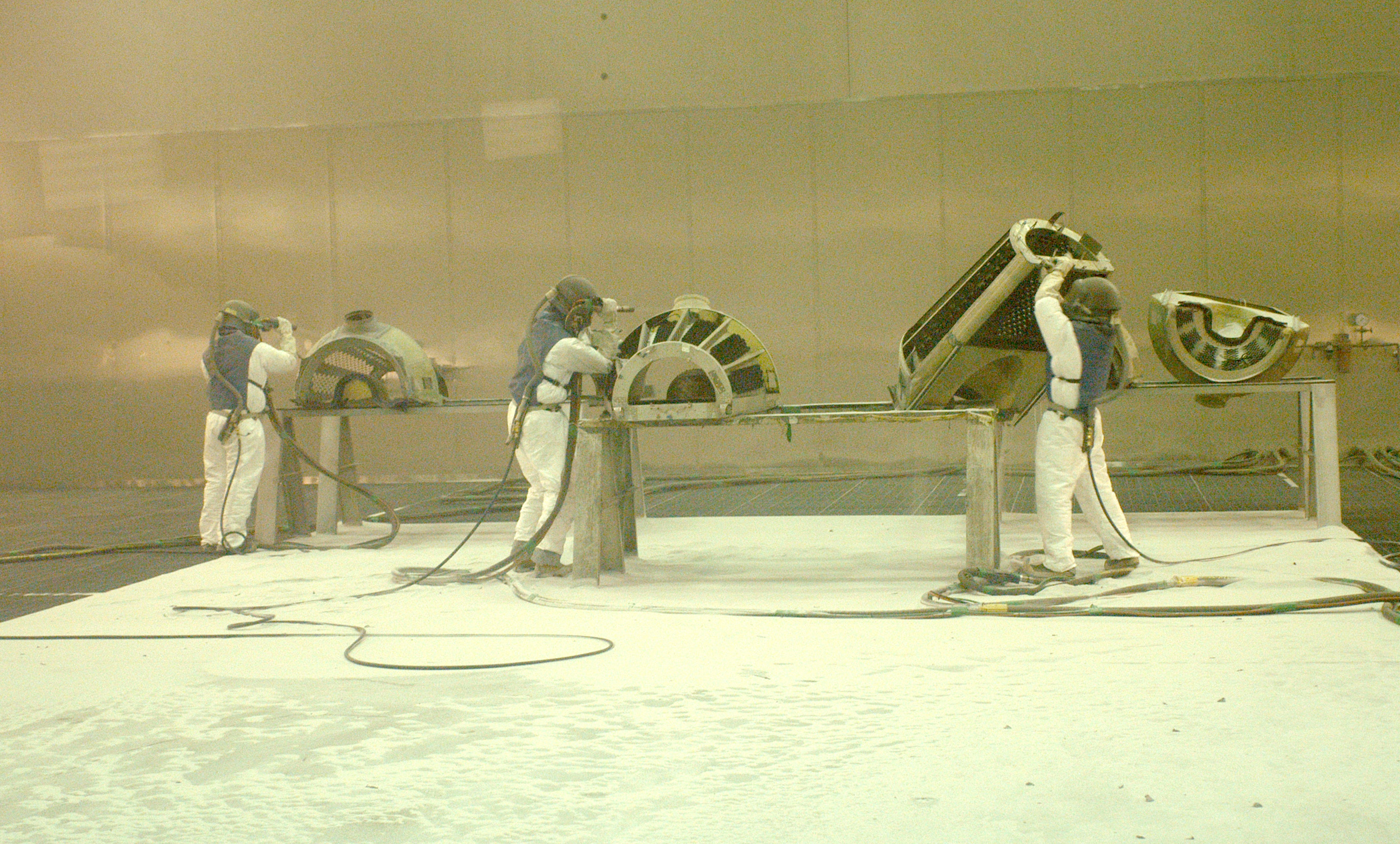
It looks like a scene from 2001: A Space Odyssey or some other science fiction classic. Three men in white full-body suits and heavy helmets slowly and deliberately move about equipment that is under repair. Long black hoses snake across their work area to fittings on their helmets and tools. But that’s where the similarity ends. Their feet are solidly on the floor. There are fine particles of dust moving through the air – yes, air – around them. And the noise is terrific.
Ross Councilman, Jeff Judy and Danny Oliver aren’t in outer space. The three equipment cleaners are in the newest paint removal facility on the planet.
After three years and $8.8 million, Naval Air Depot Cherry Point is in the final stages of opening its new state-of-the-art plastic media blast hangar addition to building 4034. The project was conceived in 1996 as a means to replace the glass bead blasting operation in building 424. The concept was later expanded to include the plastic media blasting operation in building 3766. Construction began in September 2001 and the original-concept team continues to oversee the project.
The facility consists of a stripping hangar sized to accommodate a V-22 Osprey, the largest vertical takeoff and landing aircraft for which Naval Air Depot Cherry Point is responsible.
This new hangar’s plastic media blast system includes an in-floor media reclamation system to retrieve used media safely and efficiently. Four blast nozzles allow up to four artisans to blast simultaneously for improved processing times. Oliver, the team’s work leader, can’t wait until it is up and running at full speed. “This thing is great!” Oliver says later. He would know – he has worked as an equipment cleaner for 16 of the 18 years he has worked here. He is standing helmetless outside the giant hangar doors as the other two blasters finish the components that they are cleaning. Minutes ago he was in there with them, effortlessly erasing paint from the various nooks and crannies of an H-53 engine air particle separator. For artisans like Oliver, the more common term “sandblaster” isn’t exactly accurate anymore, although the plastic media used here has a tiny, sand-like quality to it, without the harsher results that blasting with actual glass or sand media produces.
There is more to the new facility than initially meets the eye. Behind the towering walls there is an office/administrative area with a closed circuit monitoring system, which allows supervision of the operators working in the blasting area. Men’s and women’s toilets, showers and locker rooms are accessed through a “blast down” chamber, which removes any traces of the fine-particle media. These hygiene areas are designed to meet stringent code requirements for stripping facilities, including separated “soiled” and “clean” locker rooms and toilet areas, showers and a negative-pressure exhaust system to prevent contamination outside the controlled area.
When the new facility is fully operational, new glass bead blasting equipment will replace the depot’s existing PMB equipment in building 3766. That equipment is expected to be operational by April, which will allow for the demolition of 50-year-old building 424. Demolition of building 424 will allow for the future construction of planned FY06 Military Construction Project P-986, a V-22 prop rotor blade repair facility.
The construction of this facility required the demolition of building 142, which previously housed some of the NADEP’s production training functions. These functions have also been accommodated within the new addition to building 4034 – including three large classrooms, two of which are divisible with folding partitions, providing the flexibility for large or small classes. Audiovisual storage rooms serve each classroom. Administrative space is also provided for the instructors.
-30-
Cutlines:
Blast1: (From left) Equipment cleaners Ross Councilman, Jeff Judy and Danny Oliver blast paint from engine air particle separators during production testing of the depot’s new plastic media blasting facility in building 4034. Fine particles of plastic media cover the hard surface of the hangar floor, while the rest is recycled through the dark metal grates that surround three sides of the floor. The blasters are protected by full-body suits, protective padding and full helmets that filter sound and air. (Photo by Mike Barton)
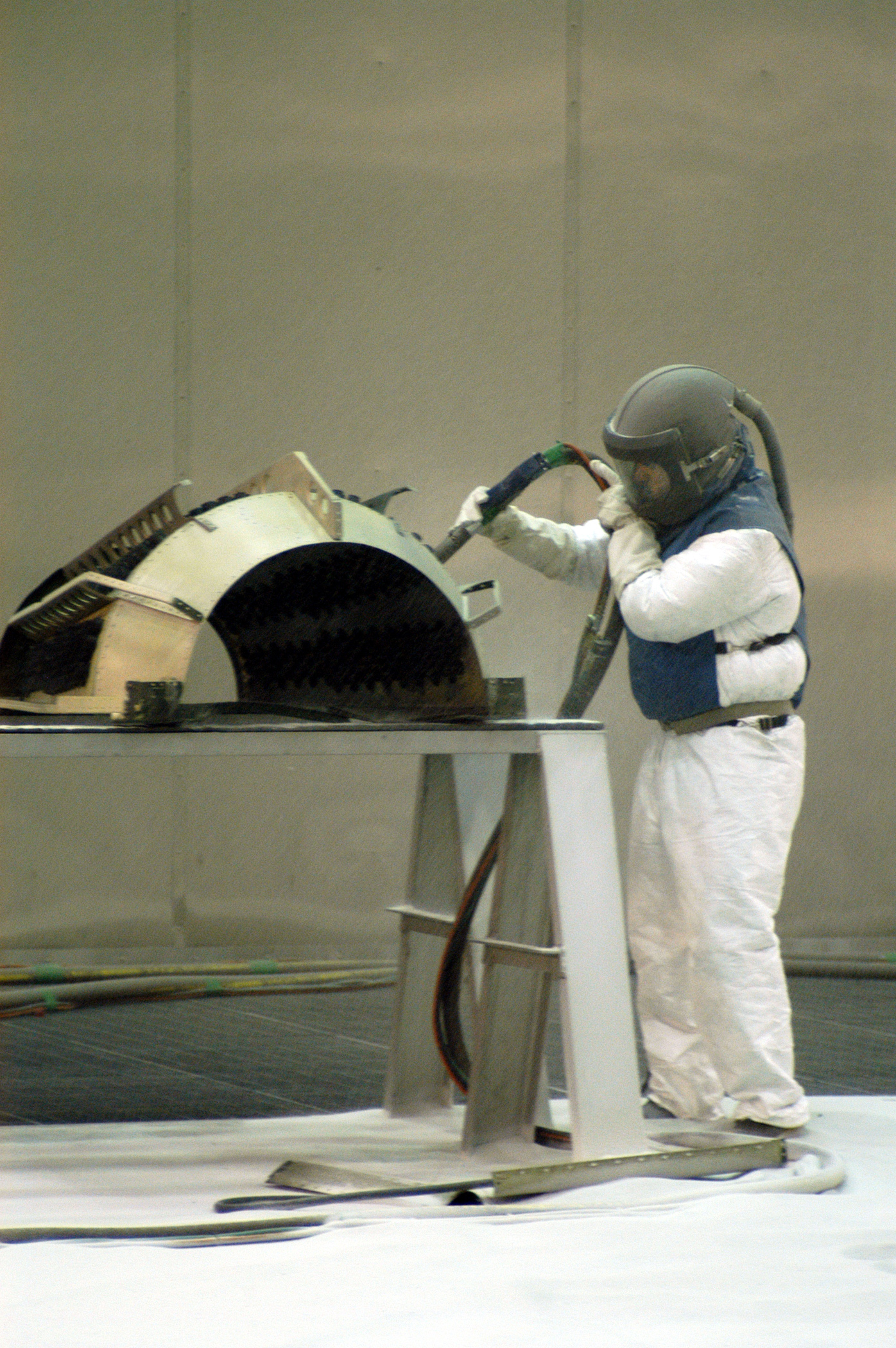
Blast2: Jeff Judy, equipment cleaner, blasts paint from an engine air particle separator in the depot’s new plastic media blast facility in building 4034. The new facility, which uses state-of-the-art paint removal equipment, is the first of several upgrades to NADEP media blast facilities, including a blast hangar large enough to accommodate a V-22 Osprey (Photo by Mike Barton)