NAS Whidbey Island Flexes with NAVRIIP's Shift in Focus
By Betsy Haley
NAVRIIP Communications Team
and NAVAIR Public Affairs
Three years ago, NAVRIIP began its readiness journey with visits to Naval Air Station (NAS) Oceana, Va., Naval Station Mayport, Fl., and NAS Whidbey Island, Wa., with a focus on improving non-deployed readiness and resolving site-specific issues. Since then, NAVRIIP has shifted the emphasis to cost-wise aircraft ready for tasking (A-RFT). When NAVRIIP senior leadership returned to Whidbey in late October, they found the workforce committed to supporting new programs and new directions for the EA-6B type/model/series (TMS).
“We are improving readiness much differently than we did three years ago,” said Vice Adm. Wally Massenburg, commander of the Naval Air Systems Command and Naval Aviation Enterprise chief operating officer. “Based on the visits to Whidbey Island, Oceana and Mayport, NAVRIIP leadership decided to change the site-specific focus to a TMS focus. We thought we had it right in the beginning, but we were wrong. We have it right now.”
There are some important changes. NAVRIIP now recognizes the wing commodore as the single process owner for each specific TMS. Also, leadership triads were established to optimize A-RFT, consisting of the wing maintenance officer (wing MO), aircraft intermediate maintenance detachment (AIMD) officer in charge (OIC) and the wing supply officer. The triad members share concerns and requirements with NAVRIIP provider organizations (cross-functional team 2) and NAVAIR’s program management offices for each TMS.
“After the first visit by NAVRIIP leadership, we placed a greater emphasis on utilizing the triad in an effort to work together for problem solving from the EA-6B community perspective,” said Cmdr. Kate Erb, AIMD OIC. “We now focus on producing the right number of A-RFT at the right time.”
As the evolving NAVRIIP and AIRSpeed methodologies spread through AIMD Whidbey Island work centers, several maintenance divisions demonstrate improved processes and workflow.
J-52 P 408 Engine Production Shop
Under the leadership of AZ2 (AW) Jacob Flowers, AIMD 400 division and AIRSpeed team leader, the J-52 Lean implementation team has applied AIRSpeed concepts to the engine production shop.
“The largest improvement is the new layout and organization of the shop floor,” said Lt. Edward Jensen, AIMD power plants division officer. “The shop’s workflow has improved due to redesigned cells which have created a flow, as opposed to a batching layout.”
The new cells comprise engine disassembly, inspection, cold section assembly hot section assembly, final assembly and final build-up. Also, specific maintenance responsibilities are posted in each cell.
“The team worked with engine mechanics and civilian artisans to layout the most efficient method for performing standard work procedures within each cell while establishing visual management aids,” said Jensen.
“Based on the recent process improvements, we project that engine repair time will decrease from 468 hours to 233 hours,” said Erb.
In addition to the cell redesigns, the J-52 community required assistance meeting increased Fleet operational requirements, due to recent mishaps. In March 2002, Chris Cardinal, power plants division, supply support supervisor, along with other contractors, was hired to help produce more engines to meet the Fleet’s needs.
“Chris immediately recognized areas for improvement,” said Jensen. “He established a kitting method for every engine that enters the shop. Through this innovative process, all required assembly parts and components removed from a disassembled engine are turned in to one area. Then, Chris and his crew replace the worn parts, order new parts as necessary, and assemble a cart which houses all the required parts. Now, when the artisans are ready to assemble an engine, they work from a cart with all the required parts.”
This kitting process reduced the time to collect all necessary components to begin reassembling an engine.
Avionics Division
In the AIMD 600 division transmitter shop, maintainers applied Lean concepts to improve standardized workflow and increase efficiency. Some of the improvements include:
* Scheduled pickup and delivery with tactical jamming system (ALQ-99) pod pool drivers to permit supervisors to plan the workday and manpower allotment around the requirements and deliveries.
* A dedicated work-center storekeeper position was established to manage the awaiting parts locker, track outstanding transmitter documents, depot level consumables and provide training in supply procedures. In the past, work-center technicians handled these functions, limiting the maintenance effort.
* Consolidated automated support system (CASS) work centers were set up. These were previously separate branches with different manpower and workload requirements. Now, working under one common branch chief ensures that personnel and support equipment are employed with maximum effectiveness and efficiency.
“The biggest achievement is growth of the culture of continuous process improvement within the work center,” said Lt. Scott Levkulich, AIMD avionics division officer. “AIRSpeed concepts are a topic of weekly training sessions, and we constantly solicit process improvement ideas from all hands. Changing the mentality of Sailors and Marines used to the old ways of doing business is significant and cannot be overemphasized.”
Other on-going improvements in the avionics division include:
* data collection for future improvements
* transitioning from “working the backlog” to a pull demand system of production, and
* establishing an accurate method to forecast Fleet requirements based on historical repair data.
Airframes Division: Pod Pool and Canopies
The AIMD airframes division recently transitioned I-level corrosion control and composite repair to the pod maintenance facility. This intermediate-level repair decision increased the ALQ-99 ready-for-use rate from 34 percent to 89 percent. Also, increased knowledge by the maintainers in honeycomb repair—installation and use of the oven to dry out oil-soaked radomes—has increased the ready-for-use rate from 25 percent to 75 percent.
“In October 2003, radomes (bottom half of the pod) and hardbacks (top half) were spread throughout the work center, since we lacked corrosion and advanced composite repair experience,” said AM2 (AW) Anthony Pluhar, AIMD 500 division. “Our first goal was to slow and stop the corrosion. We accomplished that and have been able to reduce the backlog from over 100 hardbacks to four.”
Due to backordered canopies for the EA-6B community, NAVAIR Depot Jacksonville required help to keep up with the Fleet demand. To assist, members of AIMD Whidbey Island received EA-6B canopy glass replacement training at NAVAIR Depot Jacksonville and then stood up a canopy shop in February 2003. The new shop turns around canopies in five to seven days. AIMD has repaired 71 canopies to date and continues to fill backorders while also stocking supply shelves.
“This expanded capability contributes to $3.9 million in beyond capability of maintenance cost avoidance supporting cost-wise readiness,” said Lt. Ed Rancourt, AIMD airframes division officer.
“I have found that as more Sailors, Marines and contractors become aware of the benefits and goals of AIRSpeed, they become eager to apply its theories to their own shops. They want formal training,” said Cmdr. Erb. “Many of the work-center supervisors have started to apply Lean and Six Sigma principles without waiting for an ‘official’ AIRSpeed event; they just do it!”
Keys to Success
One of the keys to success for AIMD and the supply department at Whidbey Island is the relationship between organizations. Each organization is closely integrated, and the OICs share information daily.
“The relationship between ASD and AIMD is fantastic,” said Cmdr. David Cruz, NAS Whidbey Island wing supply officer. “This stems from each organization’s ingrained understanding that both possess a single ultimate goal of providing maximum possible readiness to the warfighting community.”
“AIMD and supply host weekly triad meetings with each type wing in order to ensure a free flow of information,” said Erb. “The supply officer and I share the same office space. You could not ask for better communication or teamwork.”
Future for NAVRIIP/AIRSpeed
The outlook of AIRSpeed and NAVRIIP initiatives is positive, driving toward increasing A-RFT at NAS Whidbey Island.
“My primary focus is to identify and develop a correlation between supply support and A-RFT,” said Cruz. “Current tools and metrics have improved the relationship to readiness, but there is still work to be done. The benefits we have realized have fostered the anticipation of continued efficiencies with AIRSpeed.”
AIMD is committed to finding additional areas for efficiencies to further cost-wise readiness. “We will focus on improvements at AIMD that tie more directly to their effect on A-RFT for the Naval Aviation Enterprise,” said Erb. “As AIMD personnel see improvements brought by AIRSpeed implementation in other work centers, they want to get AIRSpeed moving in their own shops. Everyone is asking for training.”
Photo 1 Caption:
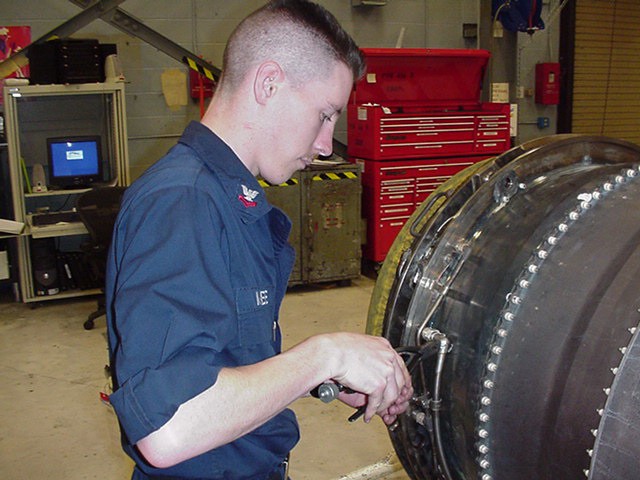
Naval Air Station Whidbey Island, WA. AD2 Gerald McGee wires a J-52 P-408B jet engine as part of final assembly. Photo by AD (AN) David Hudgens
Photo 2 Caption:
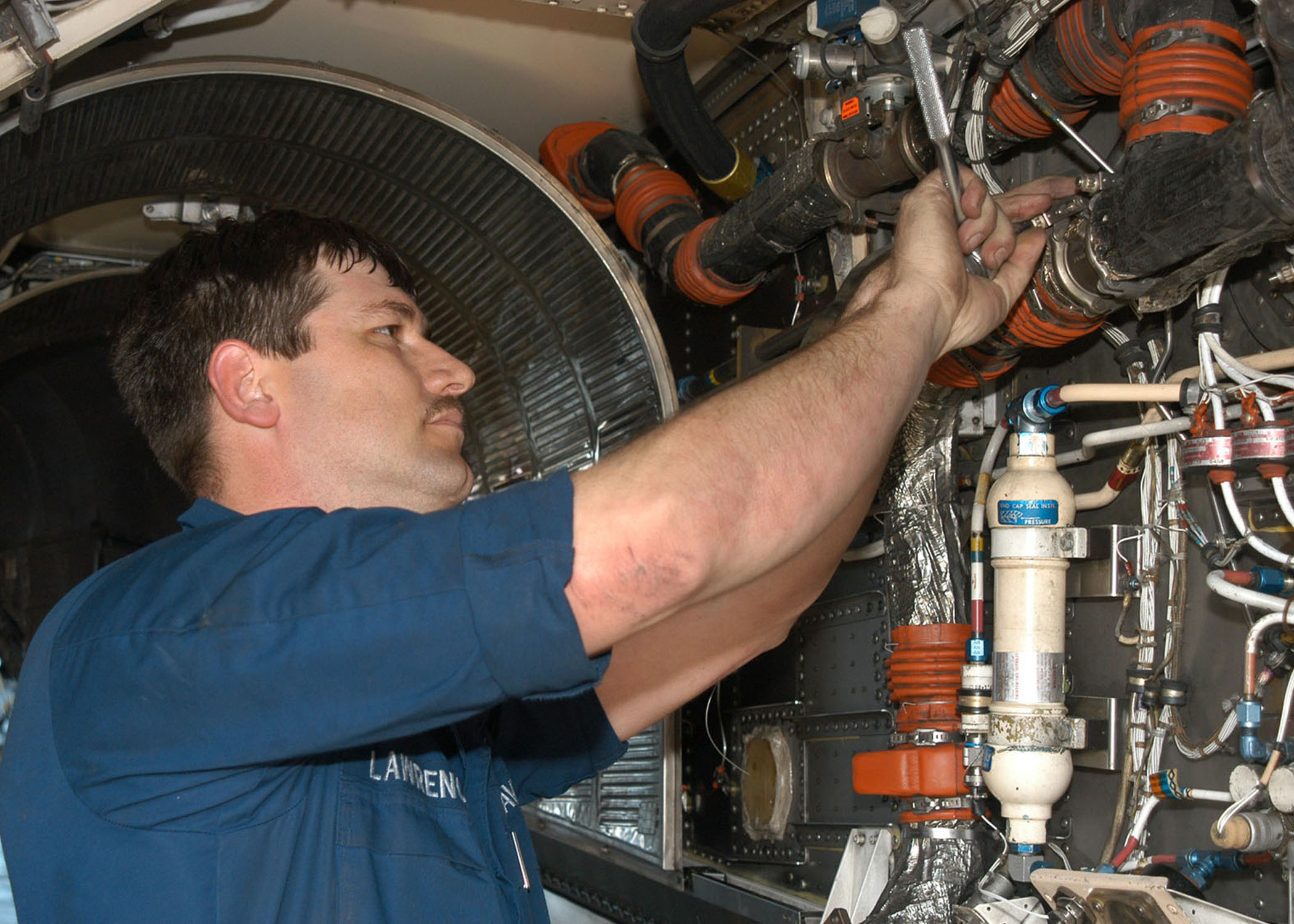
Naval Air Station Whidbey Island, WA.— Aviation Machinist’s Mate 1st Class David Lawrence of Electronic Attack Squadron 129 works on a check-valve, in the engine cavity of an EA-6B Prowler. U.S. Navy photo by Photographer’s Mate 1st Class John D. Hamill
Photo 3 Caption:
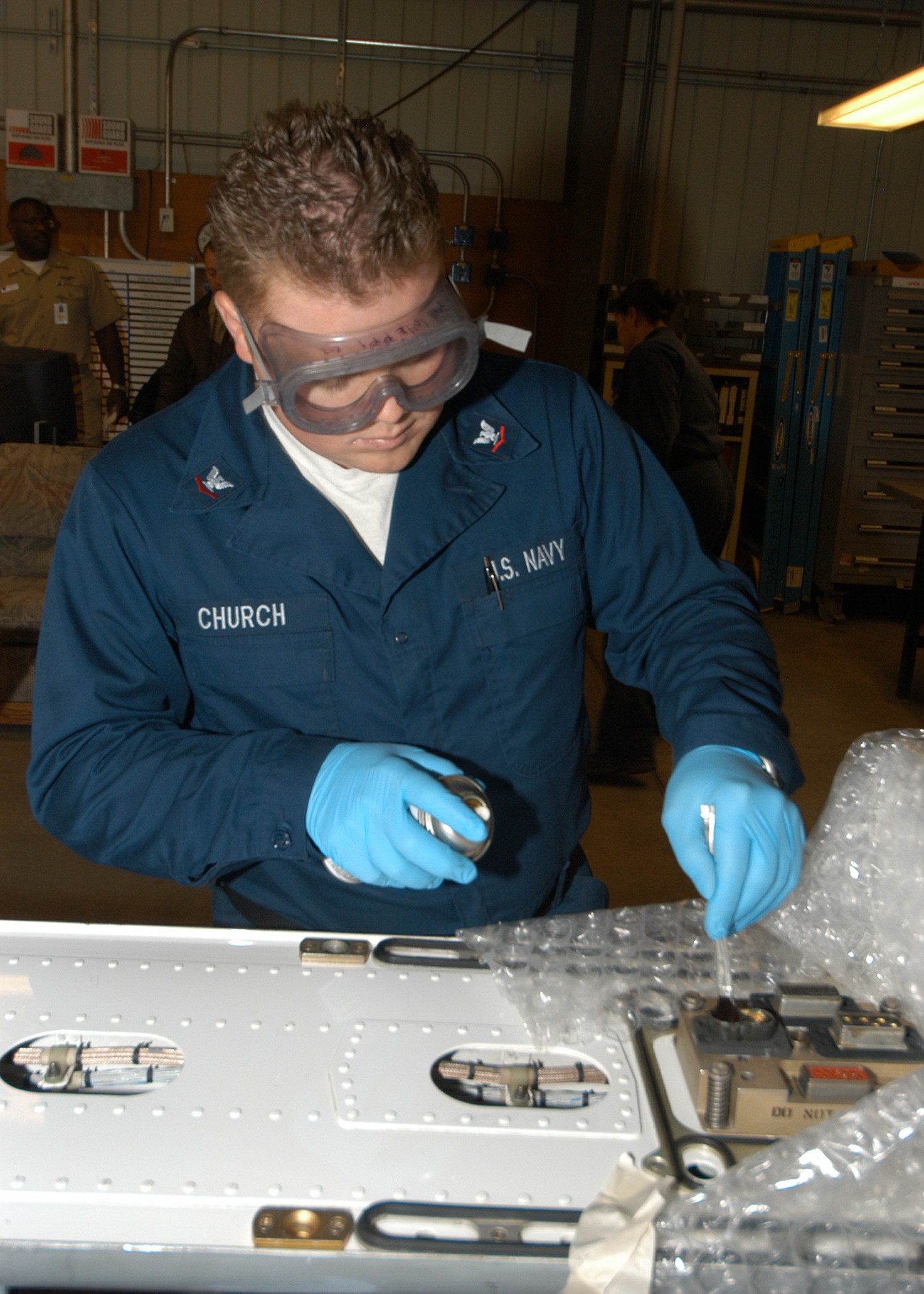
Naval Air Station Whidbey Island, WA.—Aviation Electronics Technician 3rd Class Leon Church of NAS Whidbey Island Aircraft Intermediate Maintenance Detachment gets an aircraft hardback ready for preservation. U.S. Navy photo by Photographer’s Mate 1st Class John D. Hamill
For more information, contact NAVAIR Public Affairs by calling 301.757.1487, or link to www.airpac.navy.mil/navriip.