
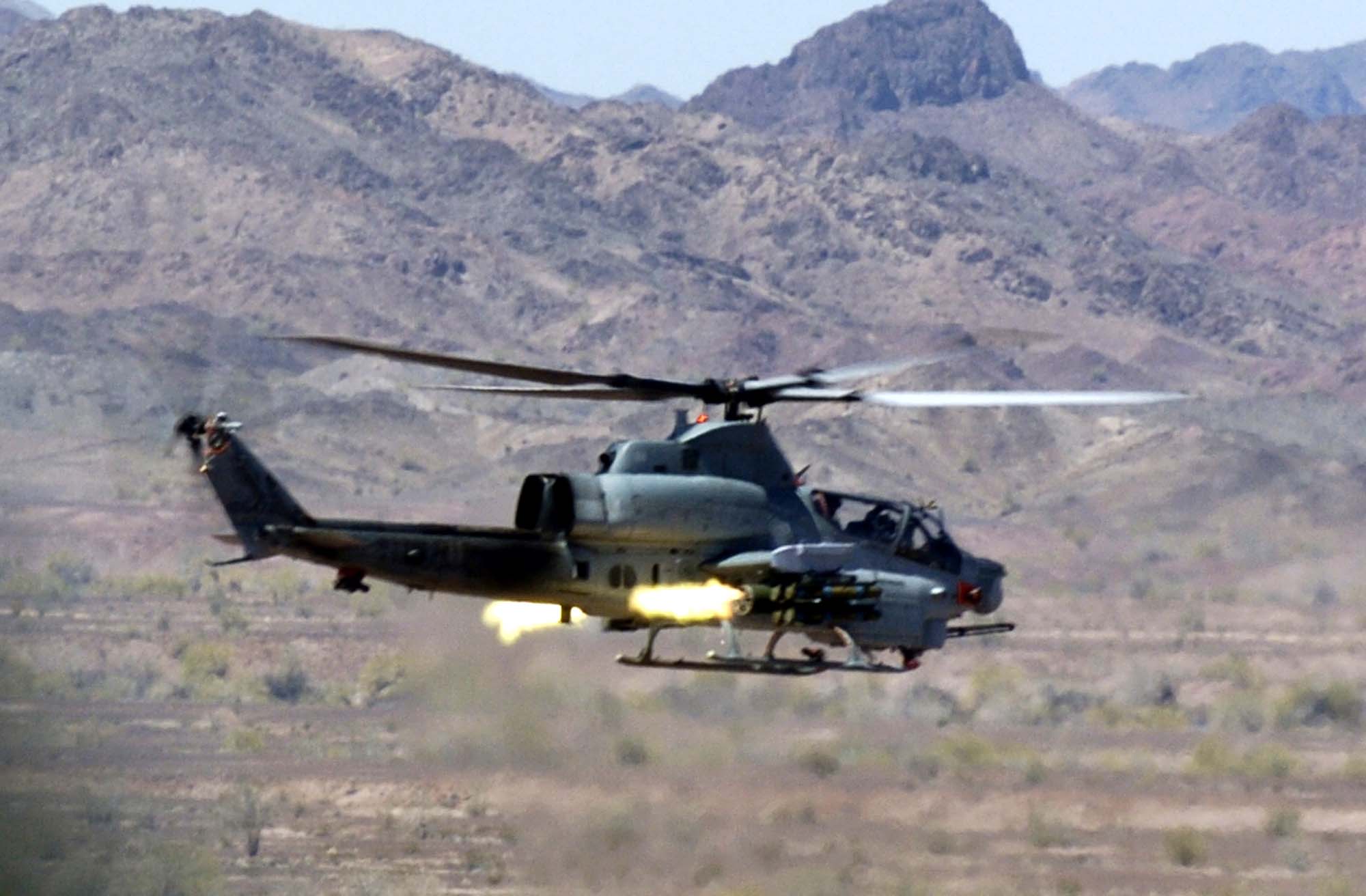
Over-torque affects AH-1Z weapons testing
By John C. Milliman, H-1 Public Affairs Officer
NAVAIR PATUXENT RIVER, MD – An AH-1Z nearing completion of weapons firing tests in Arizona Thursday ingested hot rocket exhaust into its engines, which prompted program officials to halt the test and return the aircraft here for evaluation.
The unexpected event occurred during the final stage of weapons testing when the rocket exhaust from a launch of multiple 2.75-inch rockets caused the helicopter’s engines to fluctuate in power and “over-torque” the drive train, according to program officials.
As a result of the over-torque, the H-1 test team at the Army’s Yuma Proving Ground followed established procedures by halting the test and landing the aircraft. Program engineers will evaluate data and hardware to understand what happened and prevent it in the future, as is typically done in rotorcraft over-torque situations.
In progress at the time was a test of the aircraft’s ability to fire multiple rockets in a sequential, or “ripple,” pattern. The over-torque occurred in the first three or four rockets of a “12 ripple pair” launch where single rockets are launched in pairs from pods on both sides of the aircraft simultaneously, according to Lt. Col. David Anderson, the H-1 program’s assistant program manager for systems engineering.
“We were testing at the edge of the envelope to find our limits,” Anderson said. “We did.”
Because the Yuma weapons testing phase was approximately 90 percent complete, the aircraft is being returned here by truck to enter its next scheduled period of activity, a block modification period, the last one before the aircraft’s operational evaluation scheduled to begin in the spring, according to Col. Doug Isleib, the H-1 program manager.
“We need to study the data and inspect the aircraft as a result of this event so inducting the aircraft into Block Mod D a little earlier than planned is probably the best use of our time,” he said.
At the time of the event, the AH-1Z had fired nearly 800 Mk-66 2.75” rockets at air speeds ranging from 60 to 200 knots during four months of testing at Yuma. The aircraft had also fired five AGM-114 “Hellfire” anti-armor missiles, three AIM-9 “Sidewinder” air-to-air missiles and approximately 3,000 rounds of 20mm ammunition from its M-197 automatic gun.
To date the H-1 Upgrades program has amassed more than 2,300 flight test hours and is rapidly approaching the end of its developmental flight test period and its “final exam,” a six-month operational evaluation by Fleet pilots and crews. Following a successful OpEval, the program is expecting to be approved for full-rate production.
The aircraft was approved for low rate initial production in October 2003.
For more information, please contact the H-1 public affairs officer, John Milliman, at (301) 995-7410 or [email protected]
-30-
Cutline
rocketlaunch.jpg – The Marine Corps’ newest attack helicopter, the AH-1Z (shown here test firing Mk.66 air-to-ground rockets at the Army’s Yuma Proving Ground), halted weapons testing after having fired nearly 800 Mk. 66 2.75”-inch rockets due to a drive train over-torque caused by the aircraft’s engines ingesting rocket exhaust during a test. Since this phase was approximately 90 percent complete, and because the aircraft’s drive train will have to be disassembled for inspection, program officials have elected to induct the aircraft into the next scheduled event, a block modification, early. To date, the H-1 Upgrades program has amassed more than 2,300 flight test hours and is on track to start its operational evaluation, the last step before full-rate production, early in 2005.