
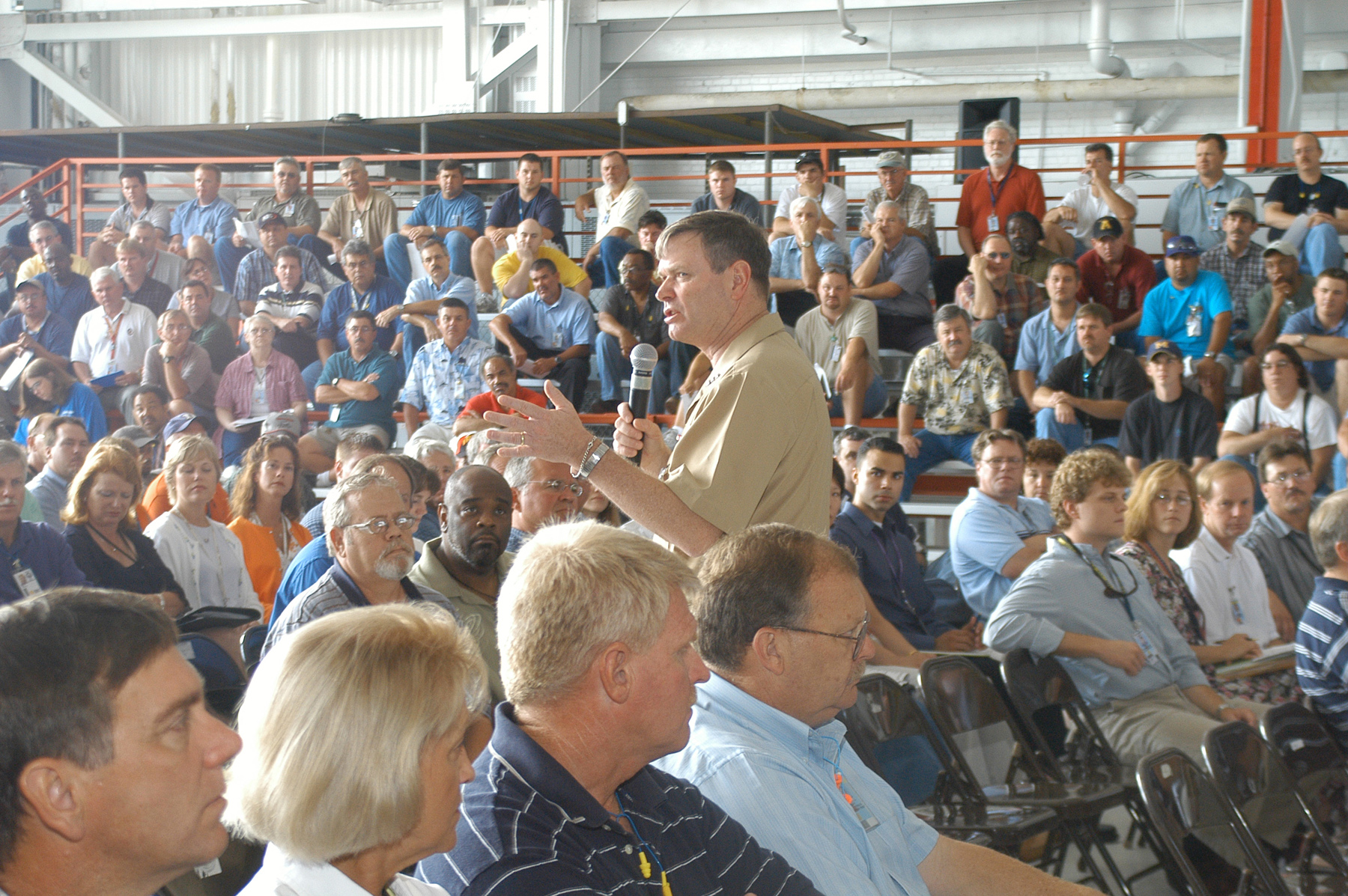
NAVAIR commander delivers update
By Mike Barton
Public Affairs Specialist
The commander of the Naval Air Systems Command visited the depot recently to reinforce his vision for all of NAVAIR.
Vice Admiral Walter B. Massenburg, who took charge of NAVAIR in December, was here June 22 to talk with all hands about where NAVAIR is now and where it is headed. After an early meeting with depot leadership personnel, he spoke to hundreds of employees gathered in a crowded hangar on the depot flight line.
The admiral set the tone of his talk by walking around and shaking everyone’s hand, putting new meaning into the term “all-hands meeting.” In his opening statement to the crowd, he explained why: “The most important thing I did today is what I did in the last 15 minutes – that is acknowledge and thank you all for the job that you do for your warfighter.”
This was the second Cherry Point visit in a regular series that the admiral plans to make to all NAVAIR sites. This particular visit, said Massenburg, was a result of “the first hundred days” of change during his tenure as the head of NAVAIR. Those 100 days of change are all about the NAVAIR vision and goals, but, he said, “the one thing about those first hundred days of change is, with the exception of some minor cleanup, we’re done. Now,” he added, “we’re into execution.”
Massenburg covered a lot of ground during his hour-long meet with personnel, but the main focus of his discussion remained on the future of NAVAIR depots. He discussed how “Best Manufacturing Practices” tools, such as Lean manufacturing and Theory of Constraints, must become everyday tools for artisans here if the depot is to compete with modern industry. (The Best Manufacturing Practices Program was created in 1985 by the Office of Naval Research to help businesses identify, research and promote exceptional manufacturing practices, methods and procedures. Its objective is to empower defense and commercial customers to operate at a higher level of efficiency and effectiveness.) These same practices will be necessary to accomplish the NAVAIR goals outlined in the admiral’s vision.
All of Massenburg’s topics, as well as the questions he answered, directly or indirectly addressed a burning question among employees here: Does the depot have a future? Everything he said pointed to one response: Yes, there is a future here … as long as everyone gets on board, accepts the changes that the times demand, and lets their current actions address the future as well as the now.
Today’s depot goals are very different from what they were in the past, said Massenburg. Before, the depot goals were just to get “a tide of money, just produce stuff, and then when we get cuts, figure out how do we get rid of people. They’re all bad behavior metrics.” Now programs like Lean manufacturing and Theory of Constraints are descending into the workplace to make the work more efficient, to increase productivity. “That is everything about where we need to go in our future.”
“A lot of people will sit there and say as you bring in Best Practices, you’re going to affect the workforce and the workforce will probably get smaller,” said Massenburg. “My comment is this: you build productivity first, and then see if we can reach the readiness so that we support our warfighters. That’s first and foremost. At that point in time, if you’ve created an asset, then you can manage your workforce, shape your workforce for the future.” If the depots do not do that, he added, they won’t provide the support needed to their Marines because they’ll cost too much money.
As the admiral talked, he clearly spelled out why the NAVAIR goals make sense for the depot. Ever with an eye on the future, he attacked practices that “drain the lifeblood of our depot” – the newer, younger employees who are “going to make our Navy/Marine Corps team a success in the future.” Best Practices will be NAVAIR’s way of combating those problems, said the admiral. Is it happening fast enough? “No,” he said, “because we’re changing and modernizing our processes. We are behind. You must be competitive first with yourself, and then with the commercial world. We need to get the best commercial practices as quickly as we possibly can to create the asset for our warfighters, at the same time driving cost out of our organization.”
When Massenburg quoted a study done on military repair depots, he pointed out that the results praised the Navy and Marine Corps depots as having “world class artisans.” And it is his belief that the depots are improving on the few shortfalls that were identified.
“Frankly, I am extremely proud of the efforts of this group, because when you look at what’s flying over in Iraq today, it’s all about what you’ve touched here in this depot, every bit of it,” he said. “Those aircraft are going to come back, and they’ll look bad, and it will be up to your artisanship to put those airplanes back into shape, to put those helicopters back into shape … to reset for the next time.”
The admiral’s future vision has its reason. He echoed many of the audience members when he said that he believed the war on terrorism is going to last a long time, so the depot will have to continue at a much greater rate – from a readiness standpoint – to put out quality products for the Marines to fight these insurgencies.
The depot must plan to fight this war for the long haul, said Massenburg. “There must be a transfer of knowledge to the newer artisans. How do we transfer knowledge? The transfer of knowledge is an artisan’s craft. Their legacy will be built on how they teach and train the intricacies of taking care of these airplanes from one generation to the other.”
-30-
Cutline: Vice Adm. Walter Massenburg speaks with assembled artisans at NADEP Cherry Point. (Photo by Mike Barton)