
2 engineers build new lives in eastern NC (revised)
By Mike Barton, Public Affairs Specialist
One day when Joshua Honaker was five years old, his father walked into a coal mine and didn’t come out. For years, his friend Michael Bryson watched his dad make that same dangerous trip into the dark innards of the mountain. For many in their part of the Blue Ridge, this was a way of life. But like many of their peers, the two boys shared the same dream – to get out of town and see the world that lay outside the fringes of their small West Virginia community.
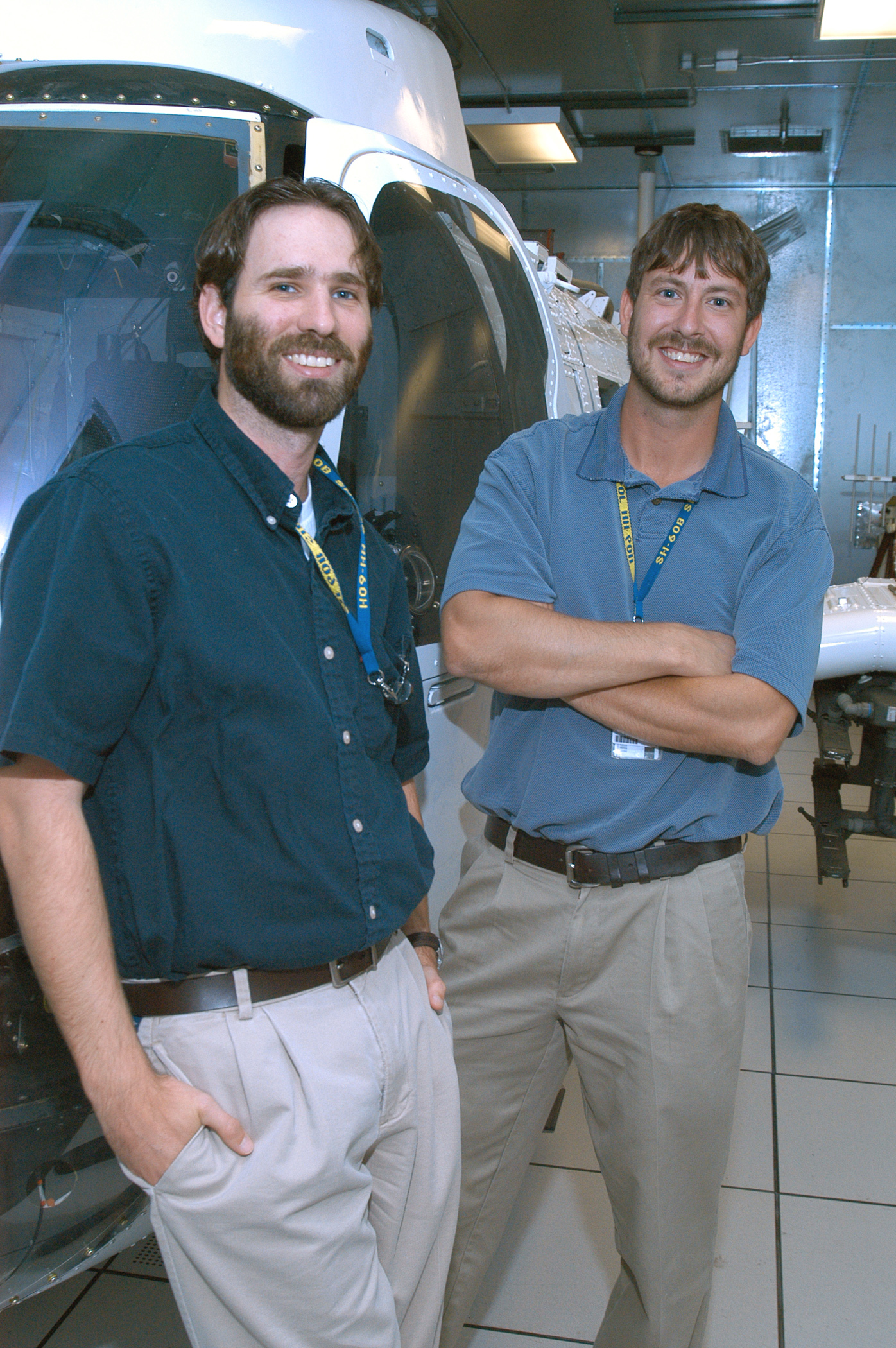
Today, Honaker and Bryson are electronics engineers on the H-60 Avionics Fleet Support Team at Naval Air Depot Cherry Point, N.C. Friends since grade school, their story is the classic tale of people who hope for a different life and put in the work it takes to make it happen. They had help along the way, from friends and relatives just as eager to see them make it, and from each other as well.
If you walk into their small cubicles on the first floor of the avionics department, you might see mementos of the world they left behind mixed in with symbols of the new. You could stand with both arms raised shoulder height, fingers pointing toward your biological east and west, and with very little movement at all, you would find pictures and diagrams of military aircraft, books and manuals and computer hardware. You would see sayings about West Virginia coal mines on stickers not far from actual helicopter parts. Their desks are littered with pens and paper clips and stacks of paper covered with technical jargon and complicated diagrams. On Bryson’s desk, there is even a chunk of coal. But the thing that seems to stand out the most is the collection of family photos that decorate the cubicle walls – smiling wives and googly-eyed babies. When Honaker and Bryson look at these, the sun really begins to shine.
Their workspaces are no Shangri-la. In fact, they’re not much bigger than the inside of the H-60 helicopters that they work on. But on a good day, one or the other will step out of that small space and take the short walk to the test lab where various H-60 configurations – from individual panels to a full-sized fuselage – are set up to test the engineering changes that they are helping to develop. There are also days when these engineers, individually or as part of a team, travel to various fleet squadrons to work on operational aircraft. In any case, you won’t hear them complain. There’s no doubt that they would both choose their cubicles over the potential workspaces that they escaped from in the West Virginia highlands.
Working together wasn’t part of the master plan either – sometimes things just work out that way. There was a time when Bryson thought he was going to be a dentist. Honaker planned to be an architect. Both made the transition to electronics engineering for different reasons, at different times and with different expectations. It was only after another hometown friend alerted them to job openings here that they found themselves, once again, sharing a road to the future.
Bryson took the plunge first, starting at the depot a little more than a month before his friend. Honaker’s timing wasn’t as good. His first day on the job was the same day that airliners were turned into deadly missiles in New York and Washington, D.C. – not the perfect first day to go to work on a military base. But since then, they have both adapted to a new lifestyle in a world very different from that in which they grew up. And neither could have guessed that they would spend their early years a stone’s throw away from each other and end up working almost within arm’s reach.
“I was expecting more hands-on work, less paperwork,” admits Bryson as he plods steadily along on his computer. There’s your engineer thinking – he wants to do the fun stuff, but forgets that he has to explain how it is done to the rest of us mortals. Today, Bryson is working on an instruction manual that will be used in the fleet for a project that began before he was hired on here – complicated stuff. But he still thinks this is the place to be. “I always wanted to get out and see other places,” he says. “This job allows me to do just that, and to work with some pretty fascinating aircraft.”
Honaker, who works only a few feet away, is in the middle of an H-60 conversion project. He looks at the stack of material on his desk and shrugs. “This is pretty much what I expected,” he says, smiling. “But working with my friends makes it good.” Unconsciously, he glances at a photo on the wall of his infant daughter. Several years ago he discovered that his father had always wanted to be an engineer. That fact, and his friend in the next cubicle serve as links to his old home. But, for both, perhaps it is the little girls pictured on their office walls that are the real symbols of their new lives.
-30-
Cutline: Michael Bryson (left) and Joshua Honaker grew up together hundreds of miles from here only to find themselves working nearly side-by-side in the NADEP Cherry Point, N.C., Avionics Department. (Photo by Mike Barton)