NAVAIR AIRSpeed Black Belts begin training
By Vicky Falcón
NAVAIR Public Affairs Office
Wave One of the much-anticipated AIRSpeed Black Belt training began last week with 26 NAVAIR employees committing to spend the next two years of their career applying (and teaching others to apply) AIRSpeed principals throughout the organization.
AIRSpeed is a means to reduce the cost of doing business and to improve productivity. Specifically, NAVAIR AIRSpeed is a philosophy, strategy and proven set of tools that will enable NAVAIR to achieve cost-wise readiness.
With his first week of the intense training behind him, Capt. Samuel “Gordy” Coward, can now officially add the title “NAVAIR Black Belt” to his other title of AIR-3.0B Executive Director.
“I’ve had a taste of these processes over the last 10-12 years of my career,” said Coward. “But now I’m getting the actual training – I’m excited about it.”
Coward, who plans to immediately begin to apply what he’s learning to several projects within his department, is in a unique position within NAVAIR as part of the Wave One (NAVAIR’s first) Black Belt class.
His classmates come from all across NAVAIR and represent every competency within the organization. All of them are “high performers” within NAVAIR and were recommended by their supervisors for this position. Black Belts are full-time, certified positions requiring a two-year commitment to their “home” competency where they, as the subject matter experts, will work alongside other employees to improve business processes.
Six “waves” of Black Belts are planned, with Wave Two class starting their training in mid December. Each class will meet for five weeks – one week of training per month for five consecutive months.
Each Black Belt is required to put in a lot of reading and homework for the class. They are accountable for leading a project that captures and sustains improvement results using AIRSpeed productivity tools, including Lean, Six Sigma and Theory of Constraints.
“It takes a leap of faith to jump out of your former role and into this one,” said John Gatt, NAVAIR Black Belt and head of AIR-4.4 Power and Propulsion at NAVAIR Cherry Point. “A lot of the unknowns are still being worked out while we’re in training because we’re the first Wave to be trained.”
Though he had some difficulty finding a replacement for his former responsibilities, Gatt is hopeful about the future. “To be on the forward end of this initiative has been great,” he said.
“I’m looking forward to taking what we’ve learned back and applying it to my project,” he said. Gatt’s project is developing a rapid deployment of engineering services for the fleet.
Steve Harnig is a contracting officer at NAVAIR Orlando and a NAVAIR Black Belt who believes he’s embarking on an interesting mission. He plans to apply what he’s learning to a project on data calls within AIR-2.0 to standardize why data is gathered and how to respond.
“The class has been helpful because it’s teaching me what I need to know to be successful,” he said. “It’s giving me the tools I need to do my job.” Harnig’s project could be a tremendous benefit for contract specialists across the team, he said, as he works to relieve them of extra burdens related to those data calls.
Tina Creighton, another NAVAIR Black Belt and F/A-18 Engineering Team Lead at NAVAIR China Lake is enthusiastic about what she is learning.
“I’m very optimistic about this program,” she said. “This is a new way to conduct business and I’m hoping it will spread like wildfire!”
Creighton’s project is the test determination process within AIR-4.3. “Being in this kind of process initiative is not new to me,” she said about the training, “but learning how to make things better in a shorter period of time is quite different. We’re looking at implementing changes in a four month period, versus two-to-six years down the road,” she said. “That’s the cool part!”
Creighton and her colleagues have two key responsibilities as Black Belts. First, they will be AIRSpeed project leaders within and across level one supervisors. Secondly, they will offer training to other employees and provide support to Deployment Champions and the Core Team.
Like the Black Belts, Deployment Champions and the Core Team have also dedicated the next two years of their careers to AIRSpeed deployment throughout NAVAIR. The Core Team is responsible for fiscal planning and overseeing execution of the program. The Deployment Champions will monitor Black Belt projects, coordinate best practices and training, and will facilitate cross-discipline collaboration.
Aaron Whitaker, NAVAIR Black Belt and Operations Director for Research and Engineering at NAVAIR North Island is excited and energized by the whole experience.
“This class is going to provide us with the tools to craft what our future will be,” he said. “We can become more efficient and this class is providing us with examples of how that can take place.”
According to Whitaker, having the support of senior leadership within NAVAIR is very encouraging. “Dr. (Al) Somoroff and Admiral (RDML Walter) Skinner both stopped by this week,” said Whitaker, an action that re-affirmed to all participants how important AIRSpeed is to NAVAIR.
Rear Adm. Walter Skinner, NAVAIR Weapons Division, Commanding Officer, is the NAVAIR AIRSpeed Champion. Skinner is the point of contact for AIRSpeed related policy and issues on behalf of the command. Somoroff chairs the AIRSpeed Advisory Group (AAG) and facilitates decisions presented to the group by the Deployment Champions and Core Team.
NAVAIR’s Commander, Vice Adm. Wally Massenburg addressed the need for AIRSpeed in a recent “Admiral’s Call” to employees. “Years of under-investment in new acquisition/modernization have led to aging navy systems across NAVAIR,” he said, adding, “Part of the solution – the way to afford the aircraft and systems the fleet needs – is to incorporate AIRSpeed into NAVAIR.”
“I’ve committed,” said Massenburg, “by the end of my tour in 2006 to train one-half of the workforce in this business practice.”
Black Belts are the first to receive formal certification, but other levels of training (for Green Belts and Yellow Belts) will be available in the future. Following their two years of service, a Black Belt may return to his/her previous assignment or may continue on as a Master Black Belt.
Potential Black Belts need to possess certain characteristics, including: respect and expertise in their field; strategic thinking; strong management and leadership skills; interest in organizational development and improvement; excellent communication skills; critical (out-of-the-box) thinking; innovation and creativity; an understanding of risk management; sound judgment; and an ability to learn financial analysis and computer-based tools.
Starting now, and continuing over the next year, approximately 180 employees will receive Black Belt training on the application of AIRSpeed productivity tools. By next summer, NAVAIR will pursue over 400 AIRSpeed projects team-wide, which will include the participation of over 2800 NAVAIR employees.
For more information about NAVAIR AIRSpeed and about the Black Belt training, contact the NAVAIR Headquarters Public Affairs Office at 301-757-1487.
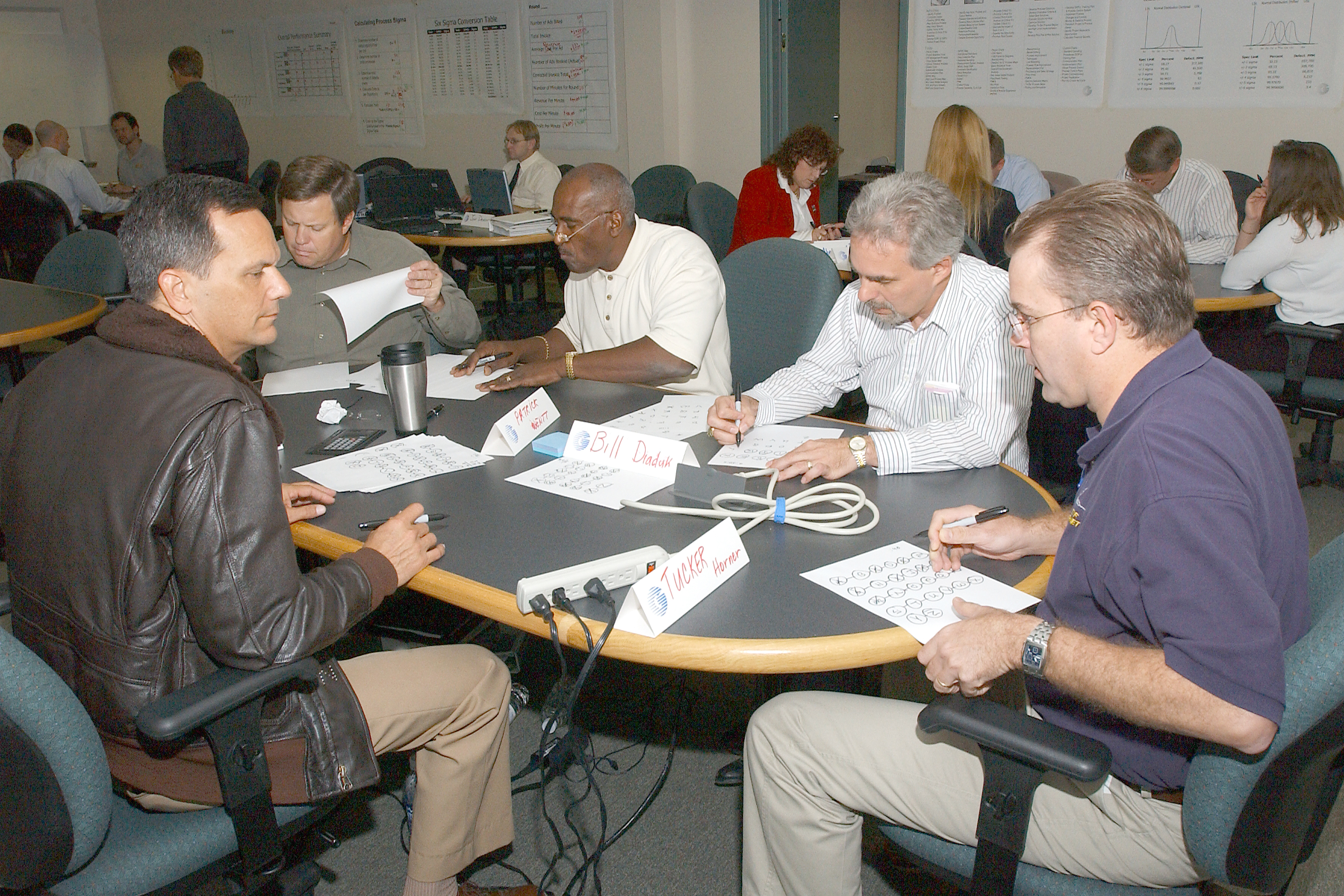
Photo 1: NAVAIR AIRSpeed Black Belts in the Wave One class work in teams to complete an exercise in streamlining a process to reduce cycle time and increase productivity. Seated in the foreground are (from left to right): Capt. Samuel "Gordy" Coward, Ron Stepp, Patrick Wentt, Bill Diaduk and Tucker Horner.
Photo 2: NAVAIR AIRSpeed Black Belt, Steve Harnig, Contracting Officer at NAVAIR Orlando, averages his team's times during an exercise in streamlining a process to reduce cycle time and increase productivity.
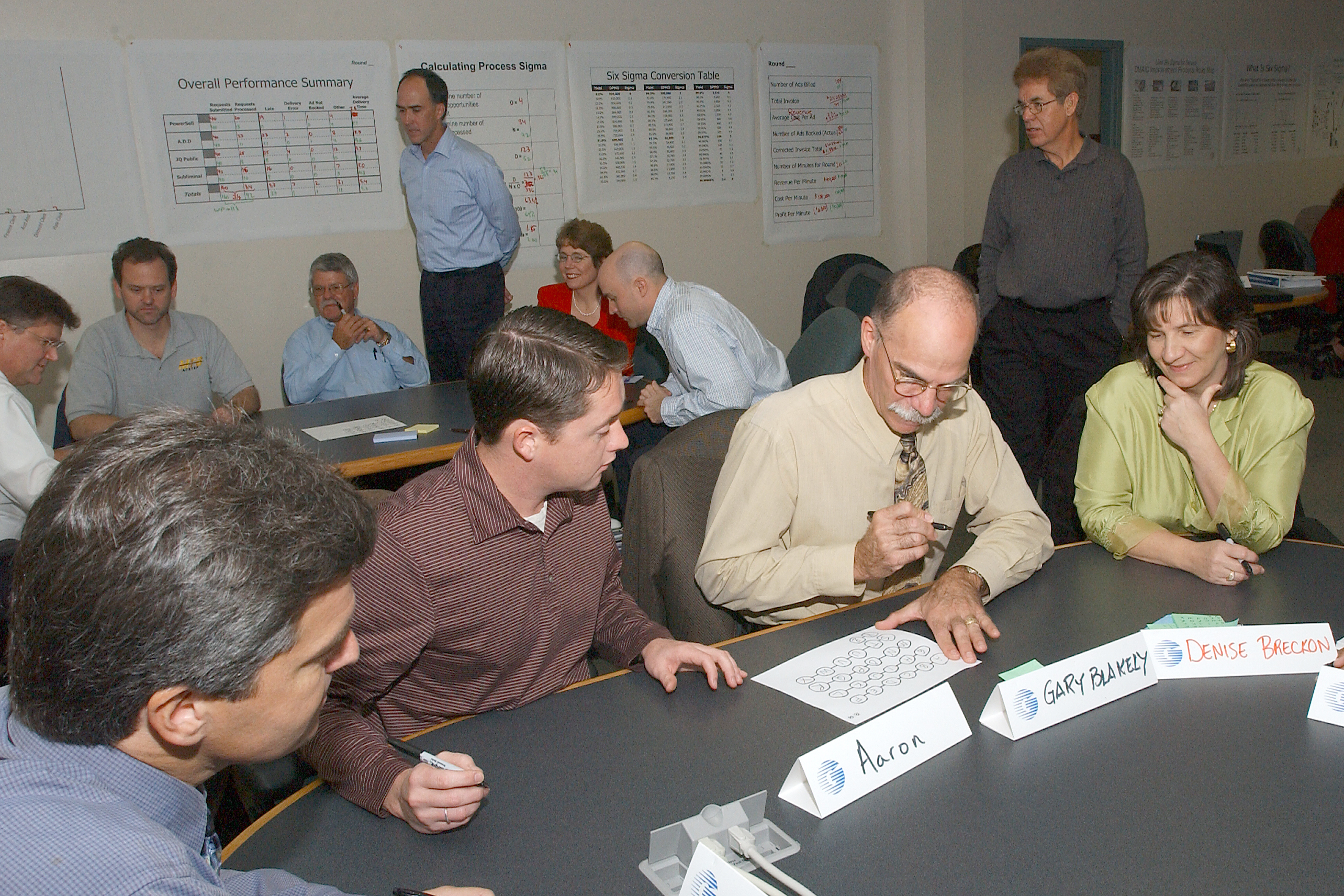
Photo 3: NAVAIR AIRSpeed Black Belts work in teams to complete an exercise in streamlining a process to reduce cycle time and increase productivity. Seated in the foreground are (from left to right): John Gatt, head of AIR-4.4 Power and Propulsion at NAVAIR Cherry Point; Aaron Whitaker, Director for Research and Engineering at NAVAIR North Island; Gary Blakely, AIR-5.1.2 Division Head at NAVAIR Patuxent River; and Denise Breckon, AIR-4.1 Division Head at NAVAIR Patuxent River.