
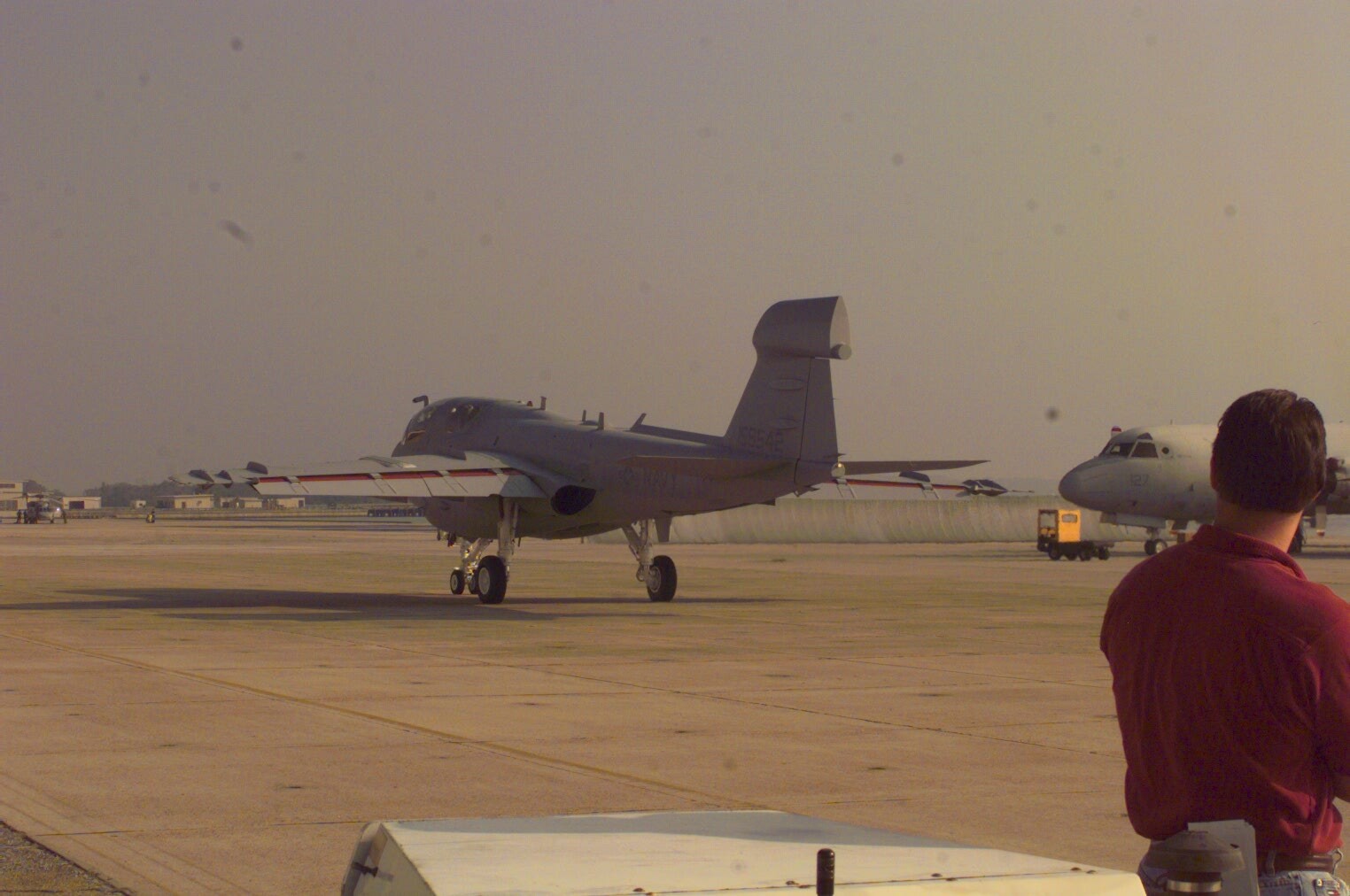
Franken Prowler brought to life at Depot
Franken Prowler Brought to Life at Depot
LCDR Kenneth “Jerry” Brown, EA-6B Product Manager
“It’s alive…It’s alive!” This quote from Mel Brooks’ 1974 cult classic movie, Young Frankenstein, aptly expresses the joy felt by the Naval Air Depot Jacksonville upon completion of the Franken Prowler project. The aircraft was named Franken Prowler, because like the original Frankenstein, it was created from the parts of donors. Three retired development EA-6B Prowlers were salvaged from various locations, including the Bone Yard at Davis-Monthan Air Force Base, and used to create one incredible aircraft.
The history of Franken Prowler began more than 30 years ago. In 1972, the Navy’s 20th EA-6B Prowler (P-20) was manufactured. This Electronic Attack aircraft entered service and was intended to follow a typical aircraft life cycle. During upgrade in 1991, the aircraft was diverted for use in a Vehicle Enhancement Program (VEP). The VEP changes were designated for the Advanced Capability Program (ADVCAP). This program was designed to bring the entire EA-6B Aircraft Type to an advanced configuration that would build on capabilities already in place with the final EA-6B (P-170, manufactured in 1991). The program also included an Avionics Improvement Program (AIP), changes prototyped in both aircraft (P-25), and a Full Scale Development (FSD) aircraft (P-5). The AIP aircraft would eventually become the ADVCAP model for fleet implementation.
Like EA-6B P-20, P-25 followed a very similar fleet life, until it too was inducted into the ADVCAP program as an AIP aircraft during 1990. The third EA-6B (P-5) was the first aircraft in the ADVCAP program to be modified. It was originally manufactured in 1970, and was the oldest airframe of the three in the program. In 1988, the aircraft underwent its fourth modification to become the flagship in the Advanced Capability Tactical Receiver System Program. By the fall of 1993, all three of the aircraft were in the ADVCAP flight test process. Unfortunately, the ADVCAP program was terminated and funding was reallocated.
The EA-6B had performed well during Operation Desert Storm, so it was decided that the Airframe and Avionics improvements being tested in the Prowler were not necessary. The above three development aircraft were then transferred to different activities and each met a different fate. The VEP P-20 aircraft was shipped to long-term storage at Davis-Monthan Air Force Base, Arizona; the AIP P-25 aircraft was shipped to Northrop Grumman in St. Augustine, Florida; and the FSD P-5 aircraft was shipped to Naval Air (NAVAIR) Depot Norfolk, Virginia, where the Wing Center Section was removed and placed in an aging fleet aircraft The remaining forward and aft fuselage sections were also shipped to Northrop Grumman in St. Augustine, Florida.
In 1998, the EA-6B community was experiencing a critical shortage of Wing Center Sections. The lead-time for delivery of newly manufactured wing center sections was two years, so the community began to look for aircraft that were no longer flying, but were donor candidates.
That same year, the decision was made to ship the VEP P-20 aircraft from Davis Monthan AFB to NAVAIR Depot Jacksonville, where it would undergo removal of its Wing Center Section. The remaining forward and aft fuselage sections were stored in a humidity-controlled environment awaiting disposition instructions. During 1998 and 1999, the EA-6B program office began to compile a “Master Save List” based on fleet and depot inputs to keep the parts that were critical to the long-term material survival of the EA-6B aircraft. It was at this time, the suggestion was made to rebuild VEP back into a fleet configuration.
This decision to pursue rebuilding VEP created deep division in the Program Office as to the merits of investing in restoration on an aircraft that was in two pieces versus investment in other Program funding requirements. As more and more information became available on a cost estimation, opinions began to slowly change in favor of rebuilding. As efforts continued to restore VEP, an early critic of the initiative, Commander Mark Nye, began to refer to this initiative as “Franken Prowler”. At the same time, Commander Casey Collins, a Requirements Officer from OPNAV, heard of the idea to rebuild VEP. During reviews of the FY-00 budget in Congress, a congressional inquiry phone call from a Congressional Staff member was forwarded to Commander Collins. The question was posed: “How much funding would be needed to rebuild VEP in conjunction with the standup another EA-6B squadron?”
In support of this Congressional inquiry, the Program Office quickly put together an estimate based on the work scope that had already been determined and much that had yet to be researched. The NAVAIR Depot Jacksonville Team, led by Burt Hood, Monty Pearce and Roger Burmeister, pulled together lists of outstanding Technical Directives that would need to be incorporated, labor hours to restore VEP developmental structural configurations, and numerous other costs associated with rework and restoration. Those estimates were combined with the already known issues of new Wing Center Section and Outer Wing Panel costs, Technical Directive Kit Cost, Availability of Critical Components, engine inventory and Program Leadership costs. The sum total that was passed to Congress was $20M for the restoration and support of VEP and a newly formed squadron that it would be attached to. To the surprise of all involved, the FY-00 budget was returned with a Congressional Add of $20M. In October 1999, VEP, or “Franken Prowler,” was laid on the surgical table for the start of a long operation that would bring it back to life. CDR Mark “Sparky” Nye became the Integrated Product Team (IPT) lead for the VEP restoration project.
The Franken Prowler Integrated Product Team (IPT) was established under the Level One PMA 234 leadership of CDR John Green and later CDR Don Zwick, CDR Mitch Hayes, and LCDR Tracy Moon. The Level Two Leadership was given to Monty Pearce from NAVAIR Depot Jacksonville. The rest of the team consisted of Planner and Estimator personnel, Quality Assurance Specialists, Production Supervisors, Material Specialists, Logisticians, and a team of Electrical, Avionics, Systems, and Structural Engineers. Now a funded program, the support had to be planned for and put in place for the De-modification engineering and production efforts as well as the Rebuilding phase of the airframe and systems. The original plan was a three-phase evolution, with the entire De-modification Engineering accomplished by Northrop Grumman, Bethpage, and De-modification Production was to be performed by Northrop Grumman, St. Augustine. The re-build and manufacture of the final airframe would be performed by NAVAIR Depot Jacksonville.
Northrop Grumman started the research of the Design Engineering and De-modification contract in August of 2000. In December 2002, the program was changed to a two-phase project that eliminated the De-modification Production phase for Northrop Grumman St. Augustine. Instead the De-modification and Re-build of the entire airframe and systems would be completed by NAVAIR Depot Jacksonville.
Once the aircraft sections were identified, the IPT and the Depot at Jacksonville started assembly preparation. The final aircraft would have the original VEP bureau number. The total engineering budget for the De-modification Phase totaled $2.3M for research in determining which sections of aircraft would be utilized and providing the engineering data required to de-modify the selected sections to a Block 82 configuration. Remarkably, only $1.6M was expended, a cost avoidance of approximately $700,000.
Upon arrival of the donor sections, the Depot’s IPT started preparing the aircraft for the de-modifications. One of the most difficult, yet amazing, success stories of the entire aircraft re-manufacture was the alignment and joining of the nose and tail sections of the separate VEP and AIP aircraft with a new wing center section (Wing Center Section).
To minimize the potential for fastener-hole misalignment upon assembly, primary joining components at FS 285.5 (bulkhead, longeron splices, side panels, etc.) were identified and procured new. Ms. Ellen Bullock, lead structures engineer for Franken Prowler, worked with Mr. Dave Crawley, a Mechanical Engineering Technician and several Tool and Die Technicians, to come up with a way to verify that the forward, aft and tail sections were aligned with the WCS in the EA-6B Re-wing fixture, prior to installing permanent fasteners. Ms. Bullock identified over 50 potential target points located from the forward-most bulkhead to the rudder hinge-line on the vertical tail.
Because the position of the WCS cannot be altered once mounted in the fixture, the wing-to-fixture attach points were chosen to establish the origin of the reference planes to which the VEP forward and AIP aft fuselage sections would be aligned. Mr. Crawley then laid out a plan to use optical measurements for the alignment obtained via Theodolite system. Invented in mid-sixteenth century England, the Theodolite was used as a portable surveying instrument, and then developed over the centuries for uses in aircraft and tooling alignment. The system had been used at the Depot before, but never on the EA-6B line. The instrument consisted of a small telescope mounted so as to move on two graduated circles, one horizontal and the other vertical, while its axes pass through the center of the circles.
After the primary joining, components were verified, and the VEP forward section, new WCS, and AIP aft fuselage section were joined. Additionally, the VEP vertical tail and fin pod were joined to the aft fuselage section of AIP to complete the aircraft assembly. The end result showed major aircraft sections were very closely aligned after joining of major airframe sections with temporary fasteners. Ms. Bullock stated, “Results of the Theodolite shoot show that aircraft were sufficiently aligned and, in fact, better aligned than we had expected.”
The Franken Prowler remanufacturing process started in February 2001, the final assembly phase began in April 2004. After the structure was de-modified, all new wiring was installed and aircraft systems were restored to prepare for the Block 82 to 89A upgrade. Throughout the entire process of piecing together VEP, the team re-verified over 465 Airframe Bulletins (AFB) and Airframe Changes (AFC) and Materials Management personnel established a comprehensive database of over 10,000 consumable, repairable, and one-of-a-kind assets. This effort resulted in taking an aircraft that was dormant for 20 years and piecing it together to make an aircraft that was fleet configuration ready.
The aircraft was sent to Final Assembly on April 20th , 2004 and remained there until late September of 2004. During the Final Assembly process, since there was no “cookbook for building a Prowler,” as Monty Pearce said, the team had to essentially build a database, and in the final stages, determine what was or was not missing.
The efforts of Team Franken Prowler resulted in taking an aircraft that was dormant for 20 years and piecing it together to make an aircraft that is a fleet configuration Block 89A. Over 300 artisans performed the work to resurrect this aircraft. Franken Prowler was delivered to and accepted by VAQ-141 as a fully functional, 34 year-old re-manufactured EA-6B Prowler.
NAVAIR provides cost-wise readiness and dominant maritime combat power to make a great Navy/Marine Corps team better.”