Production of the First EA-18G Test Aircraft Begins
PROGRAM EXECUTIVE OFFICE FOR TACTICAL AIRCRAFT, NAVAIR Patuxent River, MD
At a ceremony today in the Boeing Company’s St Louis, MO facility, Navy and Industry leadership commemorated the start up of the production line for the forward fuselage for EA-1, the first EA-18G test aircraft being built under a system development and demonstration (SDD) contract.
The EA-18G is the Navy’s next-generation electronic attack aircraft and combines the combat-proven F/A-18 Super Hornet with a state-of-the-art Improved Capability III (ICAP III) electronic attack subsystem provided by Northrop Grumman Corporation. The EA-18G will serve as the Navy’s replacement for the EA-6B Prowler, providing a capability to detect, identify, locate, and suppress hostile emitters.
EA-1 will be the first of two test aircraft produced under the SDD contract covering all laboratory, ground and flight-testing.
“Today marks a note worthy day in naval aviation history as the first EA-18G officially commences on the Boeing production line,” said the NAVAIR F/A-18 and EA-18G Program Manager Capt B.D. Gaddis. “The joint Navy and Industry team has done a remarkable job of managing an aggressive acquisition strategy that included achieving the best value for the government by anticipating change instead of reacting to it. The EA-18G, like the Super Hornet that precedes it, will be a great example of the Navy's ability to operate on a joint, networked battlefield.”
During the ceremony, Capt. Mark Darrah, EA-18 Integrated Program Lead, signaled Boeing assembly line personnel to officially begin production. Attendees watched as the first aluminum bulkhead was hoisted up and installed into the forward fuselage of EA-1. The radar ring bulkhead is a critical component of the forward fuselage, providing support for the Advanced Electronically Scanned Array (AESA) radar and the nose cone of the aircraft. This is the first of many parts in the build cycle of the test aircraft, scheduled to fly in September 2006.
Addressing the audience, the Program Executive Officer for Tactical Aircraft Programs Rear Admiral David Venlet said, “congratulations on the progress you made here today. All of your efforts are contributing to the defense of freedom.”
Built on the same assembly line as the F/A-18E/F Super Hornet, the EA-18G retains a high degree of commonality with the Super Hornet. Boeing will begin assembly of the second test program aircraft, EA-2, in the third quarter of 2004. Initial Operational Capability for the EA-18G is scheduled for 2009.
56 EA-18Gs are included in a multi-year contract that was signed with the Boeing Corporation in December 2003. The multi-year procurement covers years from 2005-2009.
NAVAIR’s PMA-265 provides the program management for the EA-18G, a part of the Program Executive Office for Tactical Aircraft. The Boeing Corporation is the prime contractor for the F/A-18E/F Super Hornet and the EA-18G. Northrop Grumman Corporation makes the center and aft fuselage of the F/A-18E/F Super Hornet and EA-18G at its El Segundo, Calif. facility, and is the EA-18G electronic attack subsystem integrator at its Bethpage, NY, facility. The Raytheon Company makes the advanced APG-79 AESA radar and General Electric makes the two F414-GE-400 engines that power the Super Hornet
For more information pertaining to the F/A-18 or the EA-18G program, contact Denise Deon Wilson, Public Affair Officer for PEO-T, at 301-481-6263 or [email protected].
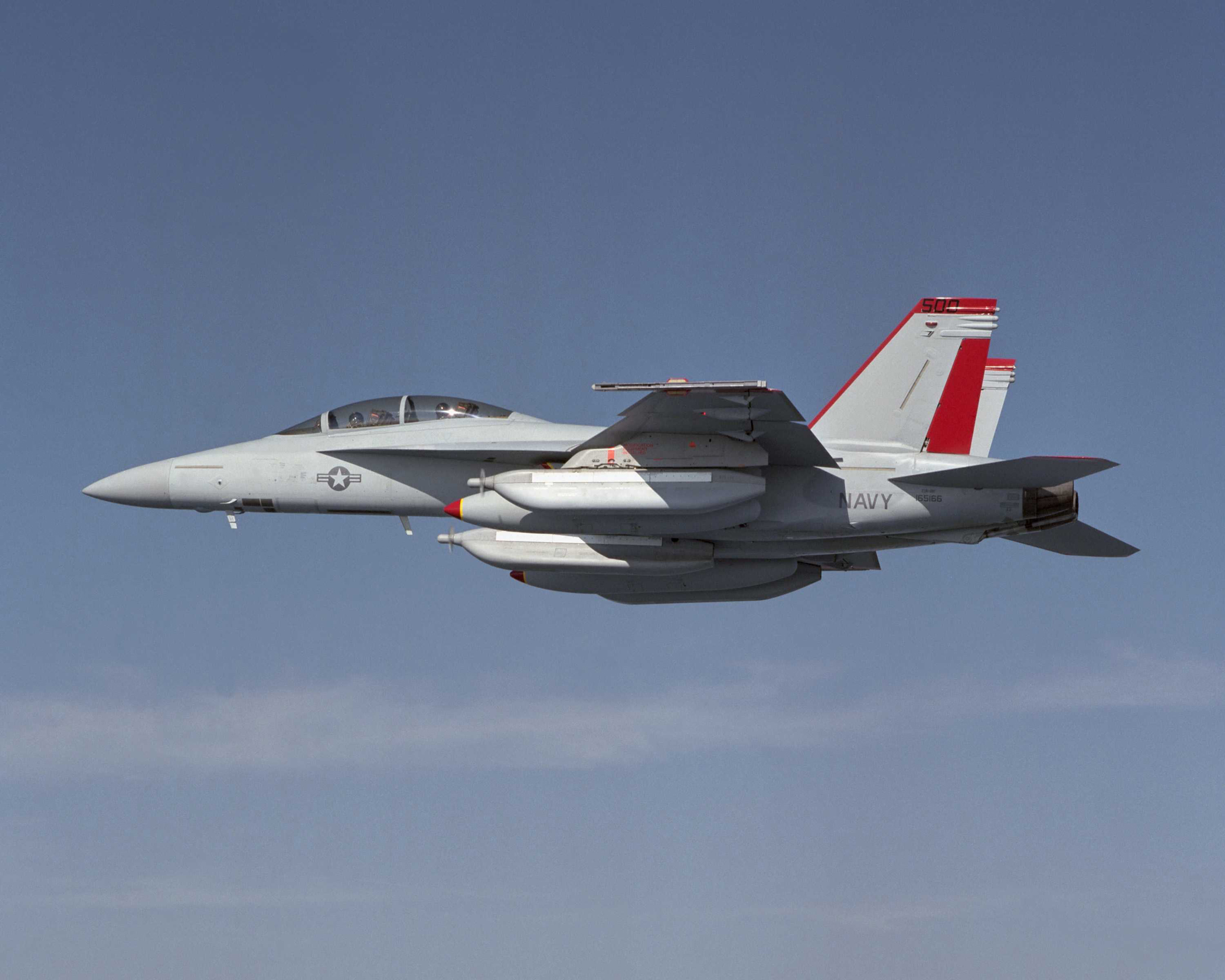
Caption for photo:
The Boeing Company used an F/A-18F Super Hornet to conduct flight test demonstrations for the EA-18G airborne electronic attack aircraft configuration. The F/A-18F Super Hornet carried three ALQ-99 jamming pods and two fuel tanks while measuring vibration and loads data, as well as assessing aircraft flying qualities. Photo compliments of the Boeing Company.
# # #