
Latest Round of All-Hands Briefings from NAVAIR Commander Begin at Pax
By Vicky Falcón
NAVAIR Public Affairs
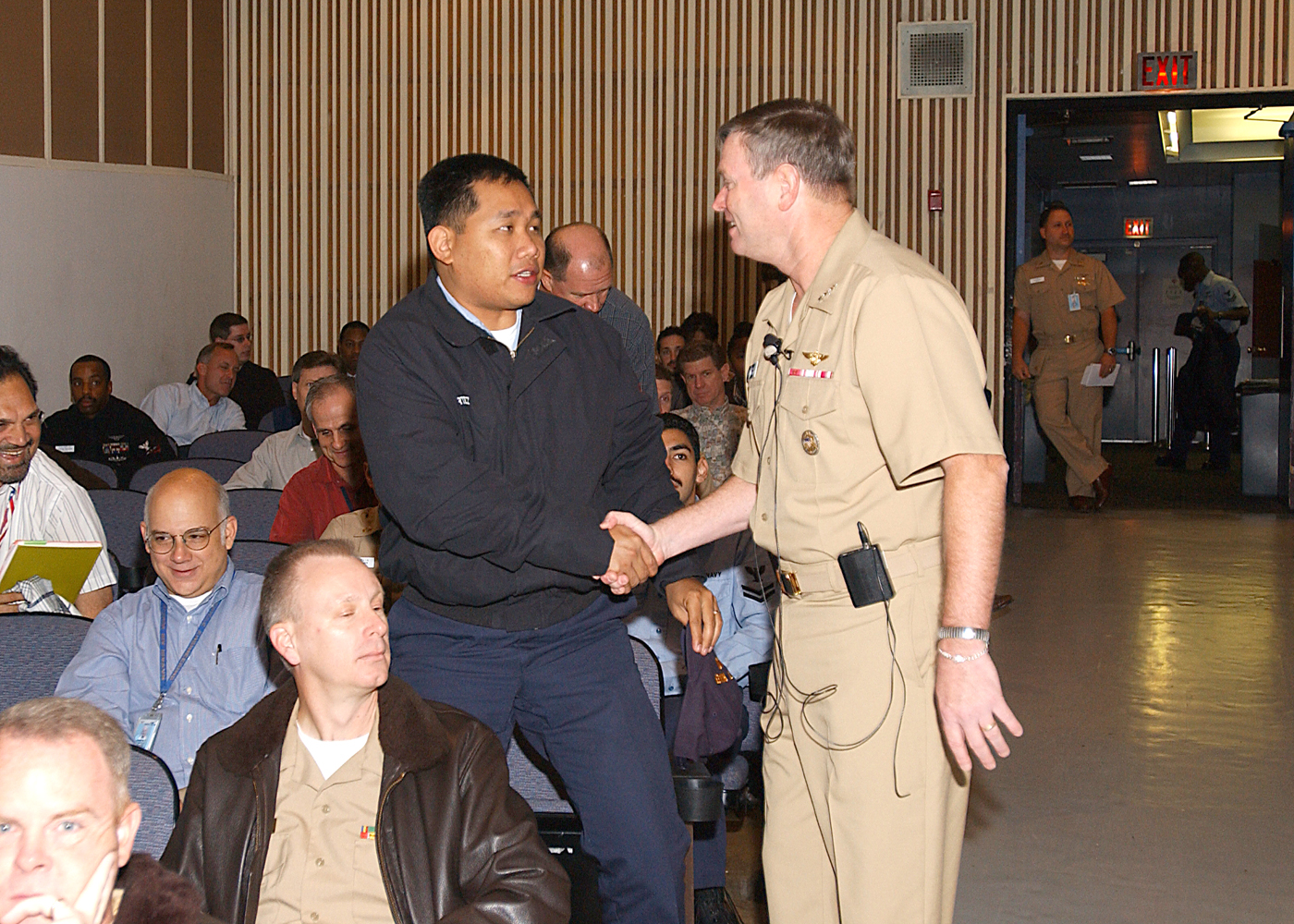
Using the end of the fiscal year to kick-off his third round of “Admiral’s Call” all-hands briefings for the NAVAIR work-force, Vice Admiral Walter Massenburg made his latest presentation to NAVAIR employees during two sessions on Thursday, October 7, at the Patuxent River Base Theater.
Both the morning and afternoon sessions were packed with civilian, contractor and military personnel who turned out to hear the NAVAIR Commander use the fiscal tradition of end-of-year spending to emphasize a new direction for NAVAIR.
“We’re going to change the mentality of ‘burning up’ the money at the end of the fiscal year,” Massenburg said, challenging the NAVAIR workforce to instead focus on the funds, productivity and resources that can be found through the efficient use of manpower.
Massenburg began his discussion by introducing a Human Capital Strategy that has been adopted by Admiral Vern Clark, Chief of Naval Operations.
“There is an enormous amount of money in our people,” he said. According to the Vice Admiral, the strategy being implemented by CNO will help NAVAIR find efficiency and effectiveness by determining the number of people needed for the future.
The inspiration for the Human Capital Strategy comes from a need to pay for the Naval Aviation of the future. “We will not get there if we cannot go to a better business practice across the Naval Aviation Enterprise to help us afford our future,” Massenburg said, emphasizing that the days burning money at the end of the fiscal year to ensure the same money next year are over.
“It’s about the greater good. It’s about understanding what we’ve got to spend today – getting it right – and then getting it for our future. If not,” Massenburg said, “we will have a much different Navy in the future.”
So what is this Human Capital Strategy? Massenburg was quick to point out it was not about reducing people “and in NAVAIR it is certainly not about Reduction in Force,” he said. “It is understanding what we need to do across today, tomorrow and in our future and then shaping our workforce to get there.”
According to Massenburg the goal is to get to a Human Capital Management Cycle, a constantly evolving process that tests future requirements against productivity and tests productivity against the shape of the organization, which is then tested against the baseline total workforce in an ongoing process.
“We’re trying to get a hold of productivity in relation to the work that we’re supposed to do in relation to the people that we have,” explained Massenburg. And that starts with program staffing, he added, because that’s where the work gets done.
The Vice Admiral explained that NAVAIR’s focus should be on the work that needs to be done, not on the number of jobs or man-hours used.
“Years of under-investment in new acquisition/modernization have led to aging navy systems across NAVAIR,” said Massenburg. Part of the solution – the way to afford the aircraft and systems the fleet needs – is to incorporate AIRSpeed into NAVAIR, he added.
There is a commitment from the CNO on down to improve productivity while reducing the cost of doing business, Massenburg said. The only answer to the funding problem is to find the extra money ourselves.
“We need to reduce the cost of “stuff” – reduce the cost of people – in a managed, organized fashion,” he said. “(We should) take advantage of the challenges we have with our aging workforce and turn it into an opportunity that allows us to make decisions today before other people make those decisions for us.”
“We need to take the same journey that the depots have done, only we’re going to do it in the intellectual capital world,” said Massenburg. “(We’re going to) tie the programs and the competencies and the warfare centers and the business units together for the greater good, and the common good, so we can produce what we need to and get it to the sailor and marines when they need it, at the right time, in the right place, and with the right capability.”
Massenburg illustrated his points with AIRSpeed success stories from the depots and a Business/Financial Management Comptroller pilot process improvement. “The same group that does the work (within NAVAIR), went to work on the process map to figure out how they could do the streamlined organization,” said Massenburg. “Our own people understand what it takes to get productivity in our organization.”
“We have the greatest intellectual capital,” he said, “just like we have the greatest artisans in the world in our depots. And we need to understand our organization to produce the output that is required by our aviation enterprise and tie ourselves directly to it.
According to Massenburg, the first steps have already been taken in this program staffing revolution as a result of a recent workshop. New billets have been formed to receive “black-belt” training in NAVAIR AIRSpeed. Work definitions, resource estimation and IPT structure and staffing models are being looked at to more clearly characterize work, produce accurate estimates and determine necessary numbers of staff.
“I’ve committed,” said Massenburg, “by the end of my tour in 2006 to train one-half of the workforce in this business practice.”
In response, Massenburg is asking for commitment and passion from the workforce. He also wants to see new challenges to past assumptions. “Don’t ever hesitate to ask ‘why’ we do something,” he said.
“We’ve got a long journey to take,” said Massenburg in closing. “I hope that you understand the direction we’re going and why we have to get there – we have a responsibility and accountability to support the fleet.”
For more information about NAVAIR AIRSpeed or the "Admiral's Call" event, contact the NAVAIR Public Affairs Office at 301-757-1487.
Photo Caption: VADM Walter Massenburg, NAVAIR Commander, takes time to shake hands with everyone in the base theater prior to speaking at last week’s “Admiral’s Call.” Photo by Roger LeJeune.