Marines unite with NAVRIIP effort
By Betsy Haley
NAVRIIP Communications Team
Touring Marine Aviation Logistics Squadron 26 (MALS-26), including the CH-46 and 53 type-model-series (T/M/S) workbenches, the NAVRIIP leadership team of senior flag officers and civilians learned how NAVRIIP and AIRSpeed processes are effectively and productively evolving at the 2nd Marine Air Wing (MAW) at Marine Corps Air Stations Cherry Point and New River.
The Marines and Navy senior leadership joined forces on April 26-27 to discuss and evaluate recent successes and the positive impact to Marine Aviation readiness after adopting NAVRIIP and AIRSpeed processes. The Marines also addressed the nuances of Marine aviation maintenance, rotary wing expeditionary capabilities and readiness requirements to meet operational commitments.
“Readiness now is our most important metric,” said Maj. Gen. John G. Castellaw, commanding general, 2nd MAW. “I need to have everything I have ready to deploy at any time. I need aircraft ready and maintained.”
Using some of the components of AIRSpeed (Basic Theory of Constraints (BTOC)/Relevant Information for Leadership (RIFLe) and Lean), NAVRIIP’s enabler for operationalizing cost-wise readiness, MALS-26 Marines began to notice process improvements and increases in efficiency with their maintenance and diagnostic workbenches.
“We are now proactive versus reactive,” said Lt. Col. Carmine Borrelli, executive officer, MALS-26. “If we are proactive instead of reactive, we can prevent the next expeditious repair. AIRSpeed improvement tools help to maintain and sustain our readiness.”
Specifically, MALS-26 is concentrating on BTOC/RIFLe, which is used to align the organization and assign ownership and metrics to relevant processes. RIFLe is a leadership information software system that is used in the BTOC/RIFLe practice. Instead of focusing on all processes at once, BTOC/RIFLe allows leaders to focus on areas that require the most attention and vital issues that provide the largest impact to their readiness goals. Currently, 15 projects have been identified by the BTOC/RIFLe process to receive Lean implementations within the logistics squadron.
“This is a journey. You should look at each step as a success,” said Vice Adm. Wally Massenburg, commander of the Naval Air Systems Command and NAVRIIP chief operating officer.
“The Marine Aviation logistics support package (MALSP) provides support to deployed and non-deployed units. In the future, MALSP must be smaller and more flexible to better support simultaneous real world contingencies and a constant state of readiness,” said Borrelli. “We need to get the response time down across the logistics footprint. TOC and the focus on Lean is helping to achieve this goal.”
Other approaches the Marines are using to work toward this end include facilitating the linkage between squadron commanders, T/M/S commodores and program managers. By creating this connection through the NAVRIIP cross-functional team (CFT) involvement, each member now sees and understands the relationship to each step in the readiness process.
“NAVRIIP helps to open our eyes to every required step along the way,” said Borrelli. “TOC and Lean help us to understand cause and effect relationships within our organization to better focus on our readiness goals.”
“NAVRIIP gives you the tools down the chain of command to determine what to work on when and how to increase readiness,” said Massenburg. “NAVRIIP works using two dimensions – horizontal linkages and vertical linkages. Understanding where your team fits is critical to the whole process.”
The horizontal linkages include supply, maintenance and the operators, and the vertical linkages include the Naval Aviation Enterprise partners, such as NAVAIR and the Office of the Chief of Naval Operations, which execute and fund the requirements. The entire group encompasses the CFTs that prioritize and attack the barriers to readiness. The NAVRIIP leaders toured areas within MALS-26 where process improvements have been made using Lean and TOC.
Gunnery Sgt. Charles McRory, assistant production control chief, manages the maintenance control facility for MALS-26. On a daily basis he posts the number of critical items waiting repair, and the number waiting for parts. He explained that his highest number of repairable items is due to waiting for parts.
“The maintainers in the shop have increased their responsibility and accountability in the shop since initiating AIRSpeed tools, in particular, Theory of Constraints,” said McRory. “They work toward operational goals and to lowering customer wait time.”
Massenburg stressed that creating metrics that link to operational goals will help to guide maintenance and supply in the direction of the greatest readiness need.
TOC is a process improvement tool, based on rigorous cause and effect, used to increase a systems’ throughput while simultaneously decreasing inventory and operational expense.
“TOC and Lean help to create more visibility between each department. Maintenance now knows what supply is doing and vice versa,” said Capt. Jeffrey Bolduc, MALS-26 supply officer. “TOC helped to tie it all together to increase interaction and communication between departments,” continued Bolduc. “Our main difficulty is maintaining constant communication between different departments.”
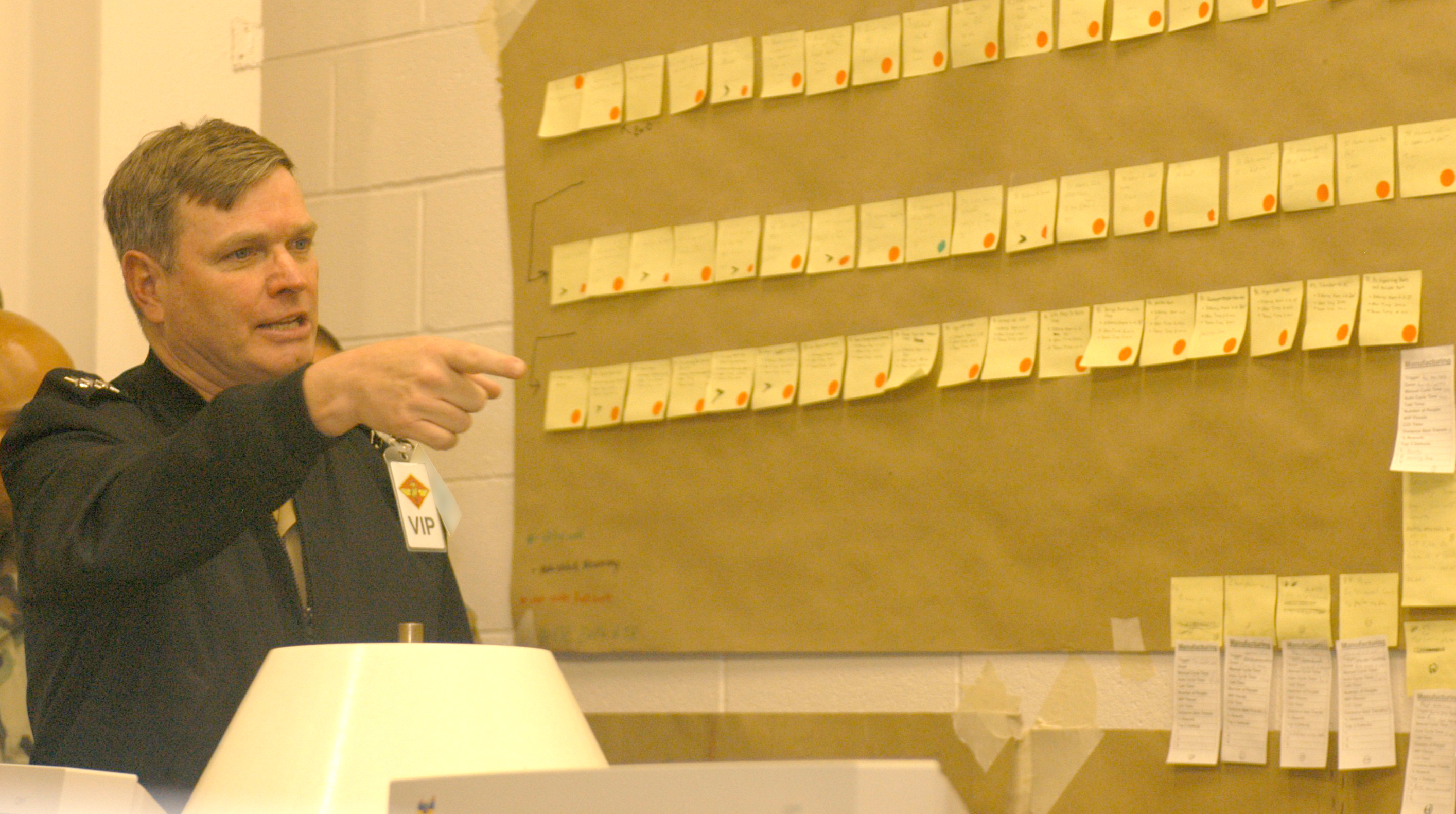
In the airframes department, which oversees the maintenance on both the CH-46 and CH-53 T/M/S aircraft components, Master Sgt. Aston Dacosta, air frames division chief, explained to the leadership group how his shop evaluated the current repair process by using spaghetti diagrams and stick-on notes to track all of their steps and to help redesign the cell for increased efficiency.
Spaghetti diagrams are standard work sheets that provide process flow diagrams. Value stream mapping is a Lean tool applied to eliminate waste.
“We performed a rapid improvement event (RIE) where we took a detailed look at the cure time for adhesives, paint and sealants. During the RIE, we also performed a detailed evaluation of the engine air particle separator (EAPS) repair process for the CH-53 T/M/S,” said Dacosta. “Using stick-on notes to document each step in the repair or adhesive process, we were able to visualize the route from when we receive the component in the shop to the time it took to go back to the aircraft. We tracked our steps and displayed the course using a spaghetti diagram. The total repair process took 98 steps. After we eliminated and combined steps, our process reduced to 33 steps, while staying within the manufacturer’s guidelines.”
One of the main improvements to decrease the number of steps was a reduction in the drying time of the adhesive that reduced the overall process flow time. Additional improvements included rearranging the cell for increased efficiency, combining process steps, direct delivery of parts to the division and the increased capability to test the EAPS motor and actuator.
Other TOC achievements include reducing critical due in from maintenance (DIFM) items by 50 percent in the first month, and from 129 items to 20 items overall. Also, from January 2002 to present, the average yearly readiness rate increased from 72 to 77 percent.
“Lean is a constant. We are always seeking perfection in the process. To us, improvement is never complete – it is ongoing,” said Dacosta.
Within the airframes shop, reductions in waste and inefficiencies in the repair cycle were realized after Lean implementation. The shop moved parts/supplies closer together, consolidated consumables in one location and aligned one process closer to the next that enabled quicker access to tools and test equipment. The changes allowed for a reduction in touch time on the EAPS by 5 percent, a reduction in flow time by 20 percent and a reduction in distance by 87 percent.
“Our next focus is on supply (awaiting parts) where most of the bottlenecks seem to exist,” said Chief Warrant Officer Warren David, air frames division officer.
The maintenance and supply departments are realizing the benefits of information sharing and aligning their activities. Massenburg challenged them to take the next step.
“You’ll never get the full affect of NAVRIIP until you include all of the players –supply, maintenance and operators. By incorporating the operators, you work toward a requirement metric related to what they need. No one is left off the hook, or to point fingers,” said Massenburg.
By outlining current and future requirements being supported, MAG-26 operational squadrons exemplified their need for constant readiness and continued support. In 2003, HMM-264 squadron maintained a seven and a half month deployment cycle. During their operations, they supported Operation Iraqi Freedom (OIF) and deployed six CH-46s and six CH-53s. This schedule has not ceased and the squadron continues to support operations in support of Joint Task Force Haiti, with a constant need for maintenance and supply support of their requirements from the MALSP.
“NAVRIIP is important to me to help achieve the most effectiveness, the most efficiencies and to ensure the best management of resources,” said Castellaw.
“We are here to find out how Naval Aviation Enterprise leaders can get what the Marines need to increase readiness by removing barriers and constraints, and by lowering our cost and reducing cycle time,” said Massenburg. “Lean initiatives are also important tools for non-supply and maintenance centers, such as a hazardous materials facility. Lean will help to create efficiency, increase timeliness and enhance improvement processes.”
For more information on NAVRIIP and AIRSpeed call 301.757.1487, or link to www.airpac.navy.mil/navriip/.
Photos by Lance Cpl. Wil Acosta
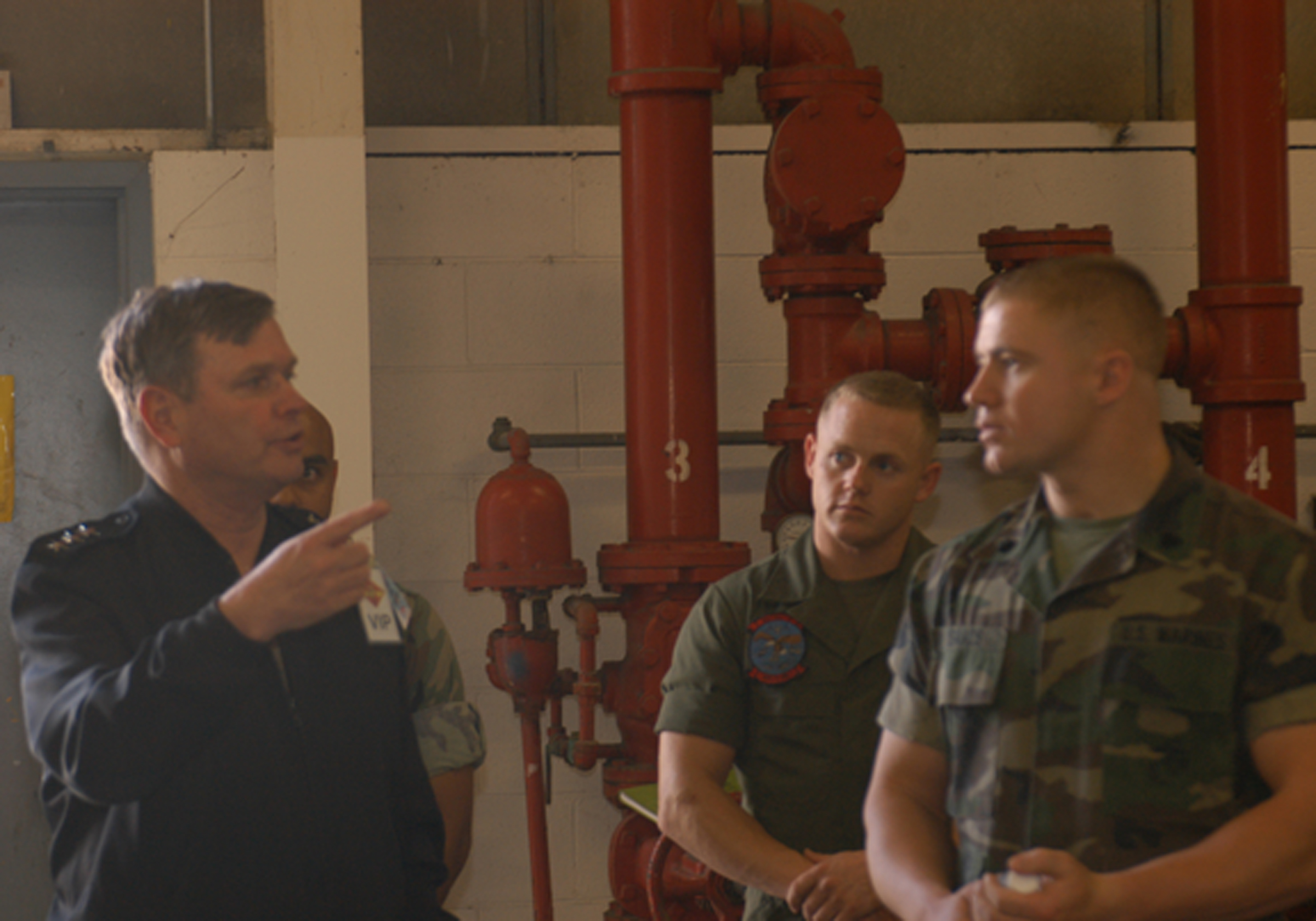
Photo 1 Caption: Vice Adm. Wally Massenburg and Marines from MAG 26 discuss the improved layout for work a area after Lean implementation.
Photo 2 Caption: Vice Adm. Wally Massenburg reiterates the value of how stick-on notes bring visibility to all steps in the repair process and help redesign the cell for increased efficiency.