BRTs aggressively attack barriers to cost-wise readiness
By Margaret Kenyon-Ely
NAVRIIP Communications Team and NAVICP Public Affairs
“Barrier removal teams give NAVRIIP the ability to quickly and effectively attack any issue” – Rear Adm. Mark Harnitchek, Commander, Naval Inventory Control Point (NAVICP), and NAVRIIP Providers Organization (Cross Functional Team-2) team lead.
The Naval Aviation Integrated Improvement Program (NAVRIIP) nine existing type-model-series (T/M/S) teams continue to diligently partner with the cross-command subgroups to remove various process barriers that will result in measurable improvements.
By working through the NAVRIIP process, the T/M/S Teams, which include the F-14, E-2, F/A-18, P-3, S-3, SH-60F/H, SH-60B, MH-60S and EA-6B aircraft, discovered numerous aggregate barriers impacting several platforms.
Representing all type wings with the same type of aircraft, the T/M/S Teams include: program manager for acquisition (PMA); assistant program manager, logistics (APML); integrated weapons support team (IWST); and aircraft intermediate maintenance department (AIMD) representatives.
Each T/M/S includes a barrier removal team (BRT) empowered to define, measure and make recommendations on the removal of barriers that hinder progress in meeting improvements in readiness, aircraft ready for tasking (A-RFT) and cost reductions within the community. Often other commands join BRTs as required to help remove barriers. BRTs select barriers by examining the performance data represented on the monthly cockpit charts. Each barrier must be linked to improving at least one of the measurements displayed. Once the barrier is removed and the measurement responds, the BRT is disbanded.
“BRTs are established to attack difficult and complicated problems. To get results, you have to focus on one problem or issue at a time,” said Harnitchek. “BRTs also give NAVRIIP the cross-functional focus and expertise needed to quickly attack and solve problems. Their cross-functional nature ensures that the course of action that the BRT comes up with is the best available solution,” Harnitchek continued.
Since the inception of the NAVRIIP and BRTs, T/M/S teams have removed numerous barriers, resulting in sustained increases in A-RFT at the squadrons. Over 30 BRTs are now active, addressing issues ranging from a shortage of radar devices to a lack of trained maintainers.
The breadth of the current BRTs with the T/M/S Teams is: lack of required radar (6 active BRTs), number of aircraft in depot repair (5 active BRTs), engine shortages (3 active BRTs), lack of Forward Looking Infrared (FLIR) (2 active BRTs), too much scheduled maintenance time (2 active BRTs), too many aircraft in O-level repair (2 active BRTs), other barriers, including cost reduction (10 active BRTs).
Sharing of BRT information between T/M/S Teams occurs through briefings to other support commands. Each month the type commander (TYCOM) assistant chief of staff group conducts a workshop to monitor the barrier removal progress of a T/M/S team. Similarly, the provider organization (CFT-2) holds a monthly review with the T/M/S teams. These formal reviews are supplemented by communications among the Thomas Group facilitators, a NAVRIIP consulting company working with each T/M/S Team.
Key examples of T/M/S BRTs in action include the S-3 and SH-60B communities.
For the past 9-10 months, the S-3 BRT has worked hard to resolve issues involving the aircraft control logic assembly (CLA), right-hand side. The team first looked at its items that cost the most for the Fleet to obtain and further researched whether or not the high cost was an anomaly. In the case of the CLA, the team was uncertain why the cost was excessive.
Since the CLA’s circuit cards were failing, the Fleet would wind up beyond capability of maintenance (BCMing) the entire assembly to the Depot, thus incurring the cost to buy a new CLA.
“We worked with the AIMD in Jacksonville, Florida, to provide them with a loaner, or a maintenance action module (MAMS). We gave them a ready-for-issue (RFI) CLA and helped with the coordination,” explained Lt. Cmdr. Richard Heinz, NAVICP S-3 IWST Head.
AIMD Jacksonville created a gold disk that could take a working circuit card to create a signature on the disk and then copy it to a CD that would show what a circuit card signature looks like when it works correctly. Now that the Fleet can turn in its CLAs for circuit card inspection at AIMD, they no longer have to pay for a BCM at the Depot level.
To date, this process improvement has produced a $450,000 cost avoidance for the S-3 community. The S-3 T/M/S BRT next plans to address the left side CLA issues.
“It’s neat that we’ve started to focus on costs and what’s driving them. The maintainers and supply guys are now looking at why we spend money,” commented Heinz.
The H-60 BRT has also struggled with aircraft parts issues.
The AAS-44 Forward Looking Infrared (FLIR) has been a logistics support challenge since its inception, due to accelerated Fleet introduction, higher than expected systems failures, and limited spares availability. In addition, Operations Enduring Freedom and Iraqi Freedom created increased demand for a limited number of FLIR mission kits, impacting A-RFT.
Current Fleet inventory has 116 modified airframes and 86 mission kits. To negate the impact, funding is required to purchase 100 fixed forward-firing/head-up display kits and 10-armed helicopter kits.
NAVICP is addressing FLIR system reliability issues by a performance based logistics (PBL) contract, which was awarded in September 2003. The FLIR PBL provides the Fleet customer reduced total life cycle costs, improved supply material availability and enhanced system reliability, and is estimated to provide the U.S. federal government in excess of $31.3M cost avoidance over the total life of the contract.
“Our focus has been on improving the quantity (availability of spares) and quality (reliability) of FLIR spares in response to the needs of the Fleet,” said Carol Kotowski, NAVICP H-60 IWST Deputy. “We’re doing miracles (with the PBL) and the team is applying lessons learned from its first FLIR to future FLIRs,” Kotwoski continued.
In addition to its issues with the FLIR, the H-60 community is faced with growing obsolescence challenges.
Since the SH-60F/B platforms are 20 to 25 years old, many of their systems developed in the 1980s are no longer state-of-the-art. The primary obsolescence plan for the SH-60F/B aircraft was to replace it with a new helicopter, the MH-60R, through a re-manufacturing effort. However, the subsequent decision to change from re-manufacture to new manufacture created a new set of H-60 obsolescence challenges. Not only are the F/B aircraft not being retired as early as originally thought, they will now remain in service for a decade or more than originally planned.
The SH-60F/B and HH-60H aircraft continue to experience increasing reliability issues, resulting in decreased readiness levels. Funding is required to investigate technology insertion, perform end-of-life buys, and develop engineering change proposals (ECPs) for known obsolescence issues.
The inability to address obsolescence issues has resulted in a steady decrease in readiness; currently with a 22 A-RFT gap overall and a five to six A-RFT gap due to obsolescence each month.
“Prior to the emergence of these obsolescence issues, more O and I level repair and swapping out of components was possible. Now, since many of the piece part components are obsolete, in many instances the O/I level must BCM a whole assembly to the depot. This adds to Fleet cost and frustration,” said Kotowski, adding that in many cases private industry may try to reverse engineer the system, but often that becomes too cost-prohibitive for all parties involved.
“Now we’re trying to find better ways of self-financing and different ways of looking at things. With NAVRIIP we know what the problems are and we are asking more why questions,” Kotowski said.
Kotowski noted the example of a Petty Officer stationed in Sigonella, Italy, asking why he potentially had to BCM a $150,000 H-60 display converter if he only needed a $750 linear microcircuit piece part to fix it. “No one thought that way before or wanted to ask the right questions,” she said.
For more information on NAVRIIP and AIRSpeed, link to www.airpac.navy.mil/navriip.
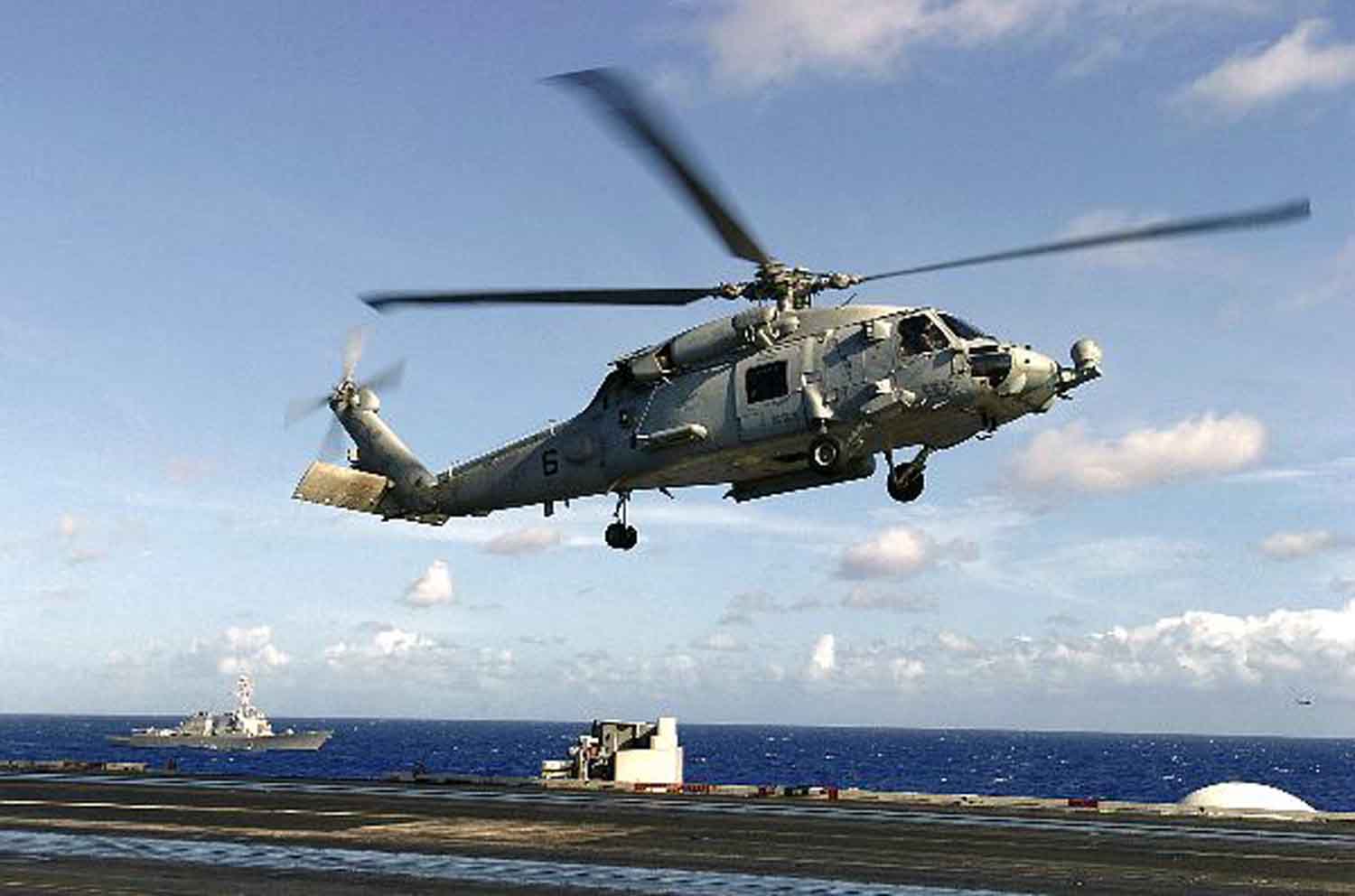
Photo by Mate 3rd Class Mark J. Rebilas (RELEASED) An HH-60H Seahawk from the “Black Knights” of Helicopter Anti-Submarine Squadron Four (HS-4) lands on the flight deck aboard USS John C. Stennis (CVN 74). The ship and Carrier Air Wing Fourteen (CVW-14) are taking part in Rim of the Pacific (RIMPAC) 2004, during her scheduled deployment supporting the Navy’s new Fleet Response Plan (FRP) Summer Pulse 2004.