
New Commander for Naval Reserve Air Systems Program
By Lt. Mike Randazzo, USNR, Air Systems Public Affairs Officer
NAVAL AIR STATION PATUXENT RIVER, MD. --Rear Adm. (lower half) Richard J. Wallace, USNR, recently assumed command of the Naval Reserve Air Systems Program from Rear Adm. (upper half) Mark M. Hazara, USNR. As Director of the Reserve component of the Naval Air Systems Command, Wallace also serves as the Deputy Assistant Commander, Naval Air Systems Command.
Wallace is a native of Dayton, Ohio, and spent most of his youth in Rockville, Md. He graduated from Hamilton College in Clinton, N.Y., and was commissioned after completing Aviation Officer Candidate School in Pensacola, Fla., in 1976.
Earning his Wings of Gold on April 8, 1977, at Kingsville, Tex., Wallace was assigned to VA-174, the A-7E fleet training squadron. Upon completion of training he was assigned to Attack Squadron 86 (VA-86) and deployed aboard the USS Nimitz (CVN 68) for Mediterranean and Indian Ocean cruises. Wallace augmented to the regular Navy in 1979.
Following his tour with VA-86, Wallace attended the Naval Postgraduate School, Monterey, Calif., earning both a Master of Science and a Professional Engineer degree in Aeronautical Engineering. After completing the postgraduate program in 1983, he joined Fleet Composite Squadron 8 as a fleet "adversary" pilot flying the A-4 Skyhawk at Naval Air Station Roosevelt Roads, Puerto Rico. Over his career Wallace has accumulated more than 3,600 flight hours in a variety of aircraft, and has logged more than 300 carrier-arrested landings.
Rear Adm. Wallace left active duty in 1985 and accepted a commission in the Naval Reserve. He was initially assigned to a Naval Air Logistics Unit in 1986, and later served as the executive and commanding officer of four Air Systems Program reserve units. He was selected for promotion to Rear Admiral in February 2003.
In civilian life, Dr. Wallace served as Assistant Deputy Undersecretary of Defense for Full Spectrum Dominance, and is presently Chief Scientist for the Space and Naval Warfare Systems Center, Charleston, South Carolina. He also earned a PhD in Aerospace Engineering from the Virginia Polytechnic Institute in 1991.
He and his wife Vicci have a son Matthew, who attends the University of Southern Florida. The Wallace's reside in St. Petersburg, Fla.
In his remarks at the change of command ceremony, which took place at Naval Air Station Patuxent River, Wallace thanked his family for their unfailing support. He also conveyed that he, like his predecessor, is committed to NAVAIR's fleet-driven metric of "Aircraft Ready for Tasking at Reduced Cost" and making NAVAIR even more innovative with a mission-critical focus.
"We have a rare opportunity to start with a new canvas and paint our own picture of what the Naval Reserve Air Systems Program should look like in the future by seeking out ways to better align the program with the active duty component, reducing the cost of doing business, and delivering value-added products and services to NAVAIR customers and our warfighters," Wallace said.
The Air Systems Program provides qualified and diverse civilian and military experience in operational support of NAVAIR research and development, engineering, program management, logistics, and industrial capability activities. The 650 Navy Reserve officer and enlisted men and women of the ASP train constantly to respond to evolving NAVAIR missions enabling the organization to harvest tangible cost reductions for fleet recapitalization. The ASP is comprised of 32 units located in 14 states.
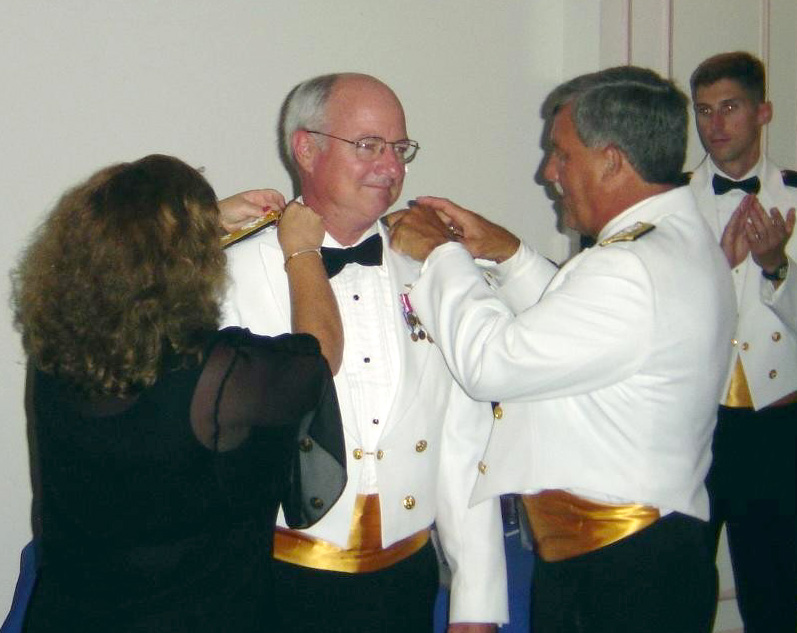
PHOTO CAPTION: During a ceremony at Naval Air Station Patuxent River, Md. on Saturday, June 26, 2004, Rear Adm. Richard Wallace assumed command of the Naval Reserve Air Systems Program. Wallace, shown here with wife Vicci and Rear Adm. Mark Hazara, was promoted to the rank of Rear Admiral at a traditional “Dining Out” event the evening prior to the change of command ceremony.