
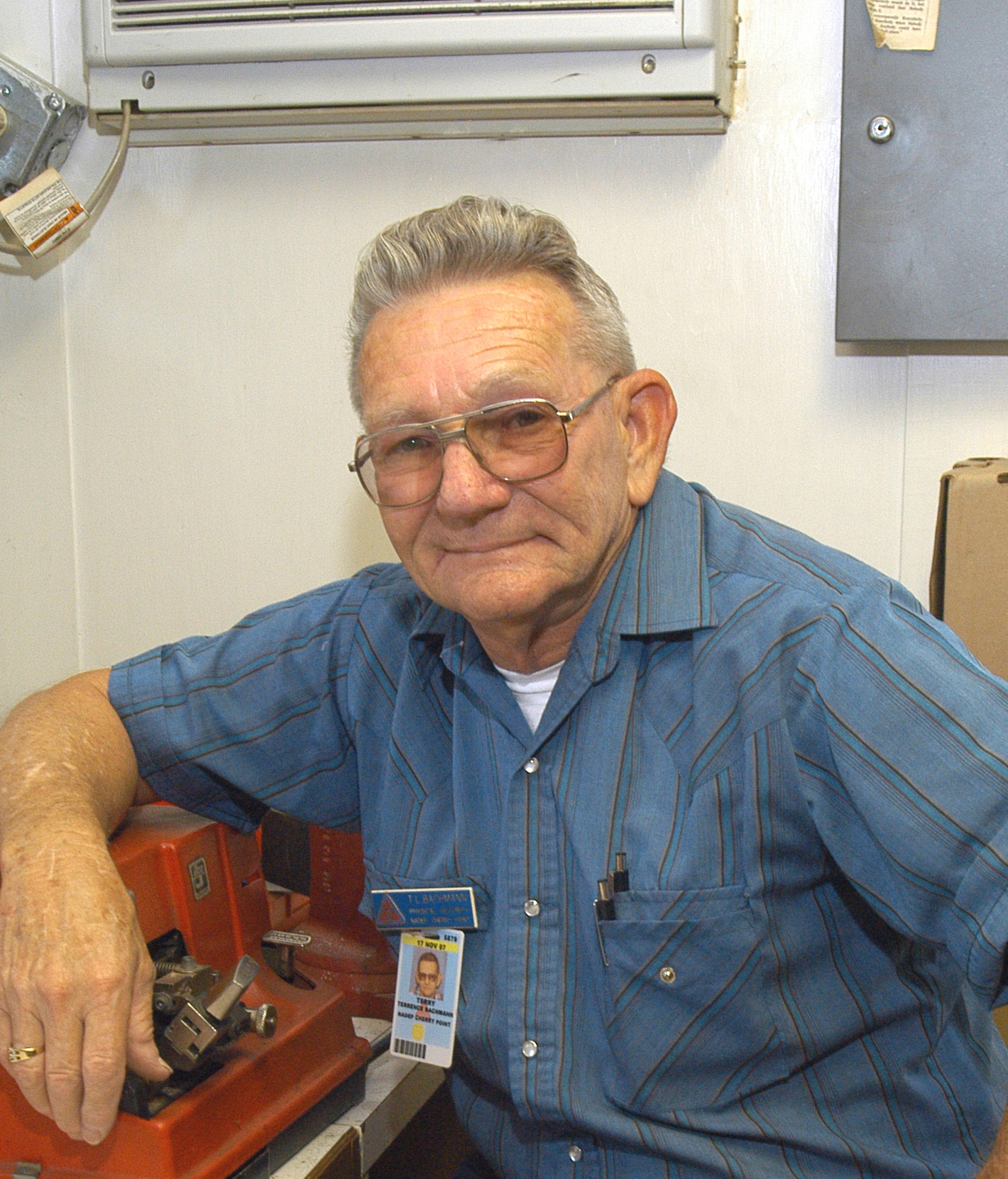
Terry Bachmann: depot keymaster
By Mike Barton
Public Affairs Specialist
When Terrence L. “Terry” Bachmann was four years old, his grandfather gave him a new toolbox complete with everything a budding carpenter would need. “These are your tools,” said Grandpa Bachmann, adding, “Leave mine alone.”
It wasn’t that young Bachmann was doing anything wrong with his grandfather’s hammers, planes, squares and rulers. It was just that carpenters are, by nature, protective of their tools. And in his elder’s eyes, it was already time that the boy started to get some of his own. “My grandpa was my hero,” recalls Bachmann now, more than 60 years later. “I followed him around like a little puppy.”
Bachmann is sitting in his workshop office, nestled in a small one-room brick building behind depot gate 8 with steel bars on the windows and a door that’s always locked. A plain-lettered red sign attached to the door carries the title, Lock Shop. Probably the first thing that you notice about his office is how neat, or better yet, orderly everything is in here. You can tell a lot about a person by looking at their workspace. In fact, if you had to describe Bachmann, you might paint a picture of him just like this building – small, neat and hard as brick. And like Bachmann, this small space holds the key to decades’ worth of NADEP history.
Bachmann isn’t a big guy, but that rarely has been an impediment to him. There was that time in southern Illinois when he was 17 and he tried to sign up for the Marines. The recruiter took one look at his then 4-foot-8-inch, 98-pound frame and said come back when you grow up. Went home, worked hard, ate his vegetables and come back he did, to begin a tour that would build him up even more. As a Marine, he saw the world, got winged a few times in a little place called Vietnam (just scratches, he says) and eventually landed here at Cherry Point. In time, that led him to the depot. The rest, as they say, is history.
Bachmann began working here 27 years ago as a woodcrafter. A natural carpenter, he designed and built work fixtures, created and organized work areas, and renovated office and other workspaces. Over the years, thanks to his craftsmanship and can-do attitude, he left his mark in many parts of the depot. And he has the scars to prove it. O.K. – about those missing fingers on his left hand. That is a result of an argument that he lost with a two-by-four and a dado-cutting machine in his early depot days. He doesn’t seem to mind. Remember, he’s a carpenter, not a concert pianist.
These days, most people here know the man inside that red brick box as the keymaster. And why not? His office has thousands of keys arranged by type and size and purpose hanging in handmade key files designed and built by the keymaster himself. To someone who doesn’t understand his system, finding the right key there wouldn’t be like searching for a needle in a haystack – it would be more like searching for a specific size needle in a stack of needles. Bachmann began here in his original trade as a carpenter, until it was discovered that he had a locksmithing background, one of several skills he picked up during his dozen years in the Corps.
Not just anybody can fill the keymaster’s billet. For obvious reasons, that person must be a physical security specialist – part of the depot’s security department – because he can open practically any lock in the depot. He must be involved in force protection, access control and loss prevention. As the resident locksmith, he handles key control and the electronic security systems.
When Bachmann first joined the security department in 1995, one of his first duties was to set up a key control program. Today, he knows what kinds of locks are where, what keys will fit them, and for the most part, who has those keys. Some of the locks that he maintains date back to 1943 when the depot was born. Bachmann also set up a key recycling program where people can turn in old keys – he makes them usable again, saving the depot the replacement cost of new keys.
Late next year, Bachmann plans to lock the door of that small brick building for the last time. When he turns in his master key, he will be nearly 67 years old. But it will be more than just a job that he leaves behind. The results of his labors can still be found here and there throughout the depot: work stands and dollies on the production floor, custom work in offices and the learning lab/conference room, and a key security program that will protect the depot’s secrets for years to come. Grandpa Bachmann would be proud.
-30-
Cutline: Terry Bachmann has mastered the key to success through hard work and a rock-solid attitude. (Photo by Mike Barton)