
Life of new machinist takes shape
By Mike Barton
Public Affairs Specialist
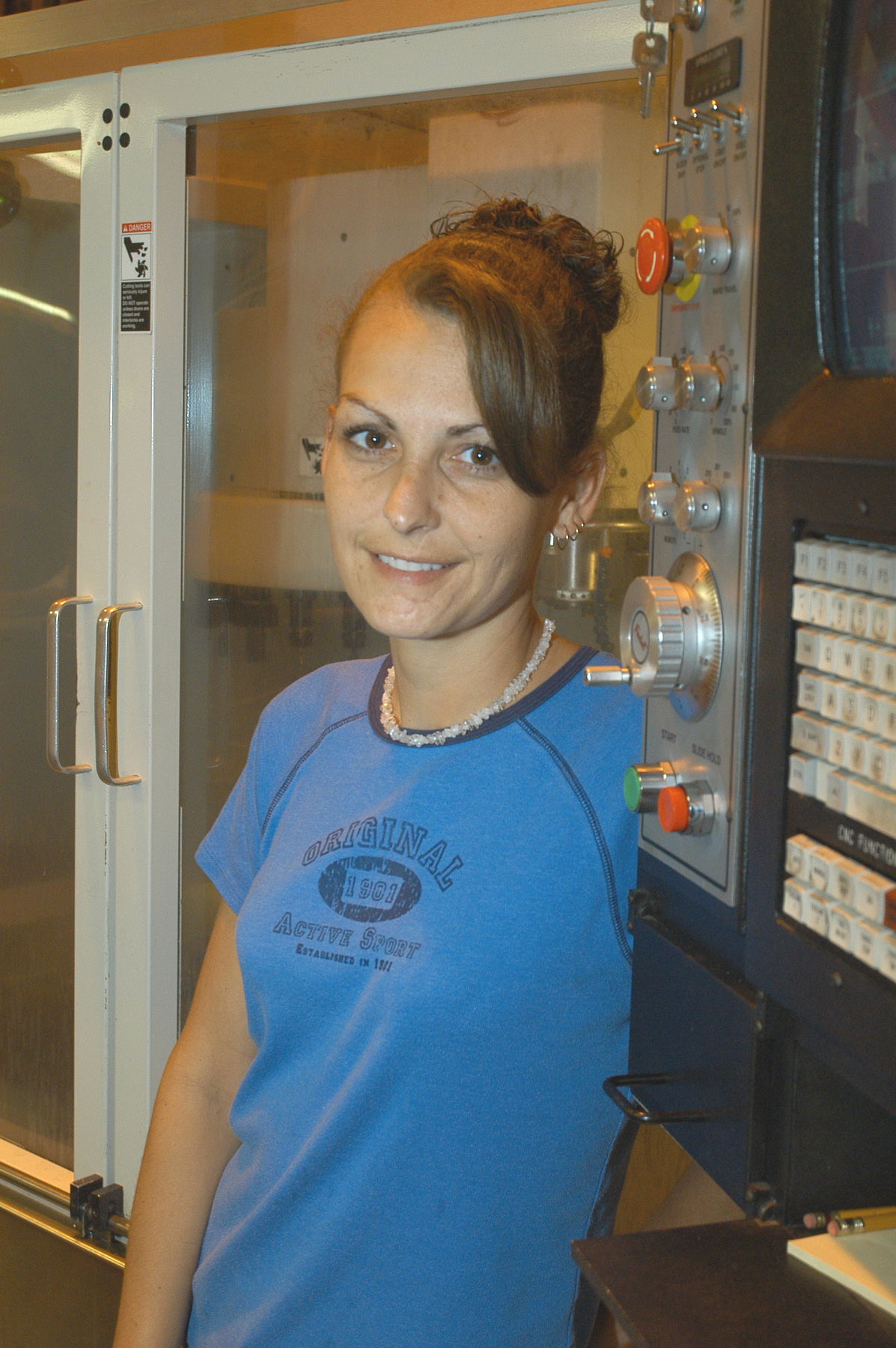
In the back of building 137, in a crowded work area between the two main hangars, a machine is humming. Part of the machine is a metal and Plexiglas enclosed cabinet that houses a device that is cutting and shaping a large gear-like piece of metal into a usable aircraft part. Another part of the machine is a complicated control panel with a monitor, dials, buttons and a keypad. And then there is the brain of the machine. She stands about 5 feet 4 inches tall, is not much heavier than a second thought, and wears a smile that lights up quicker than a spotlight.
That’s one of the cool things about being the brain – you don’t have to be big and mean. Rachel Saulter, the machinist apprentice who is running this machine, is a perfect example. What she lacks in size, she makes up for in intelligence and determination.
Saulter peers through safety glasses and the machine’s transparent shield as a hardened bit chews neatly into the metal under a cooling wash. This machine, a computer numeric control milling machine, is fast and precise, once Saulter gets the work design programmed into its processor. That means it is best used for multiple orders. Smaller orders are generally handled by the artisans who machine parts by hand on more conventional machines.
In a sense, if Saulter were to look at the metal taking shape inside her machine from just the right angle, she just might see herself in there. When Saulter first came here just over a year and a half ago, she was like a raw piece of titanium ready to be shaped into something new, a usable asset to the nation’s military forces.
She had some advantages in this endeavor. First, you could say that she is genetically predisposed for this kind of work, or, as some locals would say, “she got it honest.” Her grandfather served time in the Marines and then spent his remaining years working here at the depot. Her father works here still. It’s in her blood.
Second, she has that valuable ability to turn a difficult situation into something positive. In her case, it was the need to single-handedly raise a child and make a future for the both of them. “When I realized that I had to be the provider, I knew I had to get a good job to do it,” says Saulter, who began that journey by returning to school in hopes to learn a good-paying trade. Not an easy road to travel – balancing school with work and child rearing, while keeping her eye on the ball. Her parents helped when they could, but she also gives credit to her daughter, whom she says is her biggest cheerleader.
She was juggling work, school and being a mom when she reached out and grabbed for another challenge, getting into the depot’s Student Career Experience Program, commonly known as the Co-op Program, which would allow her to train on the job here while still attending school. It’s a good deal, if you can get it – only about half of the applicants are selected each year. And she did get it, so the depot began paying for her school; all she had to do was keep her grades up and stay on track here. If she was surprised to get it, she shouldn’t have been – the hardest workers are often the easiest to spot. In fact, if the depot’s training department was looking for a poster child to showcase the Co-op Program, Saulter could be it. Proof came when she was named this year as NADEP Cherry Point’s Outstanding Co-op Award winner.
In the co-op, Saulter started out as a machinist helper, changing shops every three months to cross-train on every machine that she could get her hands on. Some folks are hired to work on a machine and they stick with it for years, the resident expert on that particular piece of equipment. On the other hand, co-op trainees move around to learn as many machines as they can. It suits the depot just fine.
“I’ve been accepted a lot easier than I thought I would be,” says Saulter. “They don’t treat me any different than anybody else.” But don’t call Saulter one of the boys. Sure, the budding machinist knows she’s in a male-dominated field, but she is reminded every day when she gets off the job that one of the main reasons that she is here is because she is a mother. “My mom says, ‘You’re just like your dad,’” laughs Saulter. “But I learned first to be a good mom from her.”
In May, Saulter finally began to see the fruits of her labors. She graduated with honors from Craven Community College with an associate’s degree in tool and die making, an associate’s in general occupation technology, and a diploma in machining. This meant an immediate move from the Co-op Program into the Apprentice Program, where she will work toward the journeyman level of her trade. “This is a great opportunity,” says Saulter. “NADEP takes you under its wing, tells you that it’s going to take care of you and teach you. You just do your job.”
In front of her, the machine keeps cutting. The metal, and Saulter as she watches over it, both begin to look more like a finished product. But, unlike the metal, Saulter won’t ever stop changing, improving. The difference is that Saulter and people here like her will become tools themselves, tools that will continually reshape and improve the depot.
“I love my job,” she says, alert to the machine’s movement and every sound that penetrates the shield. “Being a machinist is often like being an artist. You get the opportunity to create something new from a hunk of metal. It is challenging – mentally and physically.”
She is clearly aware how that same creativity also applies to the way she will mold her daughter as a person. But as Saulter inspects the final cuts on the component in front of her, she seems oblivious to the fact that in the busy work space between building 137’s two main hangars, not only has she made a place for herself – she has also become a precise new tool for the depot.
-30-
Cutline: Rachel Saulter works like a machine to reach her goals in her personal life and on the job. (Photo by Mike Barton)