NAVAIR Depot North Island engineers and scientists, children conduct "slimy" experiments on polymers
Hancock 1
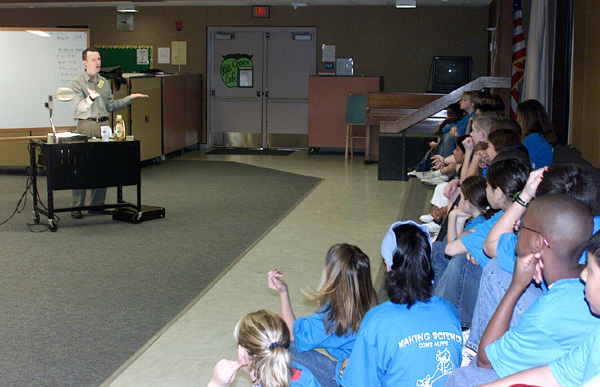
Paul Johnson leads a class discussion on polymers.
Hancock 2
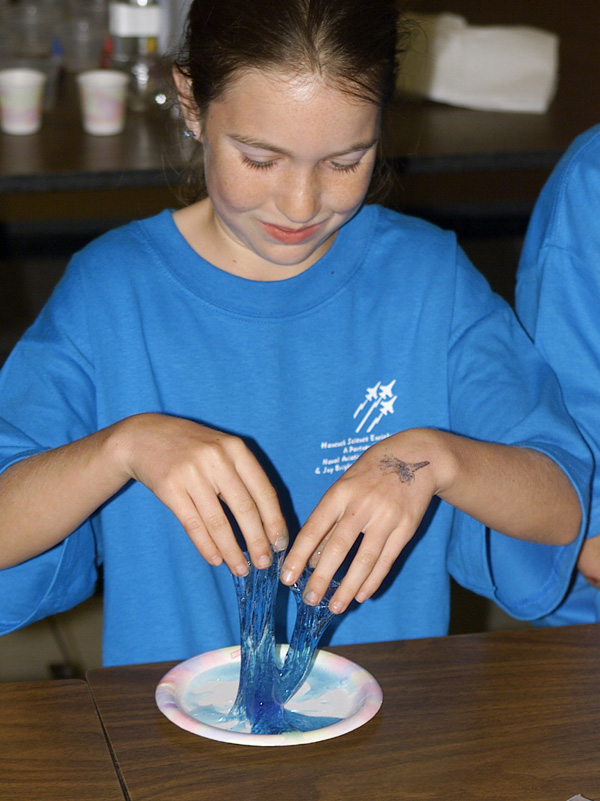
A student tries to get her “slimy” experiment off her hands.
Hancock 3
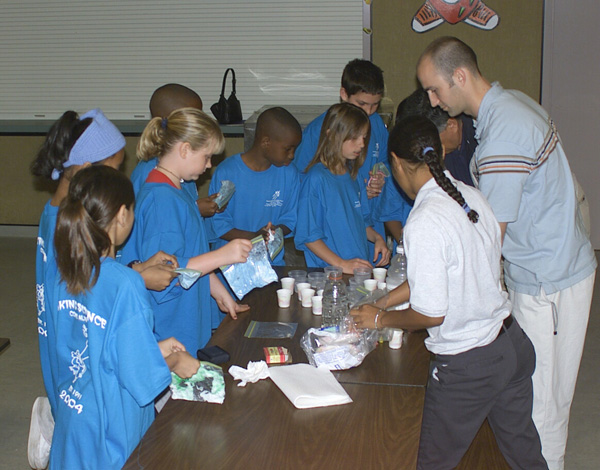
Raina Taitano, a Depot intern (back to camera), and Ryan Call help the kids with one of their three experiments.
Hancock 4
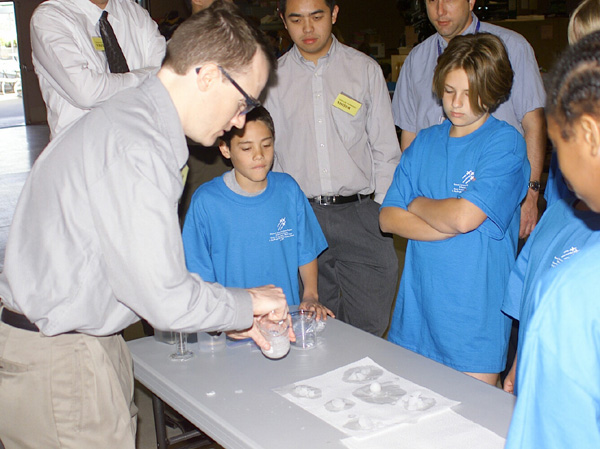
Paul Johnson shows the students how mixing sodium silicate and rubbing alcohol form a “super ball”, as other Depot engineers watch.
Hancock 5
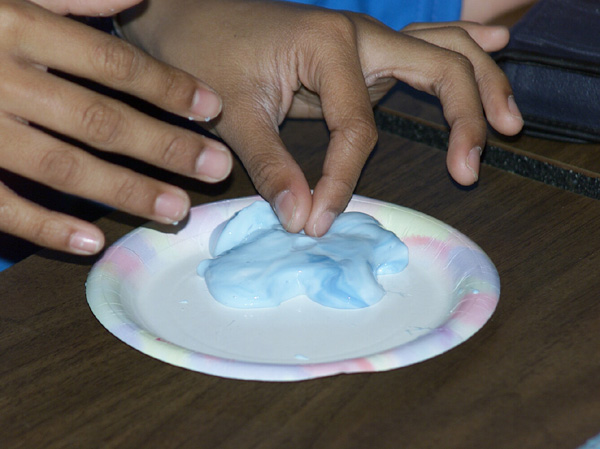
Elmer’s Glue and water with borax and water makes a form of slime that looks like clay.
NAVAIR Depot North Island engineers and scientists, kids conduct class experiments
Story by Bill Bartkus
Photos by Scott Janes
CORONADO, Calif. – What do you get when you combine borax and water with polyvinyl alcohol and water plus a drop of food coloring? Don’t know?
What is the outcome when you mix Elmer’s Glue and water with borax and water then add a smidgen of food coloring? Still don’t know?
OK, one last question. What do you get when you mix sodium silicate with rubbing alcohol?
These were three simple questions that Paul Johnson, a NAVAIR Depot North Island engineer, asked of 25 fifth-graders in the Science Enrichment Program at Hancock Elementary School. The school and the Depot here are partners in education, and the engineers volunteer their time several times a month throughout the school year to teach the students about physical science.
The school, situated in the Navy housing area in Tierrasanta, has a small science class. “The science class can only accommodate eight students from each of the four fifth-grade classes,” said teacher Shelley Friend.
For this particular class, Johnson led a team of 10 Depot engineers to teach the students about polymers. Johnson began the day’s lesson by defining polymer. “Poly means many,” Johnson told the students, “and mer means units.” He asked the class to give him examples of polymers. Students had to raise their hand and identify themselves when Johnson called on them. “Plastic is a polymer,” shouted one enthusiastic boy. “I think polyester is an example,” said another young student.
During his discussion class, Johnson used words, like viscosity, which apparently didn’t faze the children.
This writer heard one student whisper to another, “I know what that means. It means a liquid is slow.” And right he was.
Using water, cooking oil, and shampoo, Johnson poured each liquid into small cups so the students could see how slow or fast each liquid pours.
“Now let’s have some fun and make some slime,” said Johnson. The students were more than eager to get their hands all slimy.
Sandra Wong-McKellips divided the class into three groups for the three experiments that the kids would work on that day. “We’ve taught the kids everything from rockets (using plastic bottles) to flying aircraft,” she said. “And the kids are eager to learn.”
McKellips chairs the Science Enrichment Program at Hancock, and she is one of the five original Depot members who started the program 13 years ago.
Now to answer those questions. Borax and water coupled with polyvinyl alcohol and water make slime. Add a drop of food coloring and you have red slime, green slime or whatever color you want. “This stuff feels like Jell-O,” said Matthew, 11, after he mixed his ingredients and rolled it off a small plastic bag onto a paper plate. Christopher, 11, said, “It’s so sticky that you can make a mousetrap of this stuff.”
Elmer’s Glue and water mixed with borax and water also makes slime, but the texture looks and feels like Silly Putty. The engineers helping the kids with this product had some newspaper and told the youngsters to roll their slimy stuff across the paper. The kids were amazed that their product actually lifted the newsprint.
And when you mix sodium silicate together with rubbing alcohol, you get a super ball that actually bounces. “This stuff looks like slush,” said Jeffrey, 12, who also said that he’s “into science and experiments.”
Once the students completed one experiment, they moved on to the next one. “This is so cool,” said Dallas, 11. “This has got to be the coolest class in the school.”
Generating an interest in science among the young students is the ultimate goal of Depot scientists and engineers who mentor the class. “Children cannot get ahead today unless they have a firm grip on science as well as math,” McKellips said. “Perhaps one day, some of these kids will be working as scientists or engineers for NAVAIR.”
NAVAIR provides cost-wise readiness and dominant maritime combat power to make a great Navy and Marine Corps team better.