NAVAIR Depot North Island flip flops a Hornet
Lemoore cuts
Lemoore 1
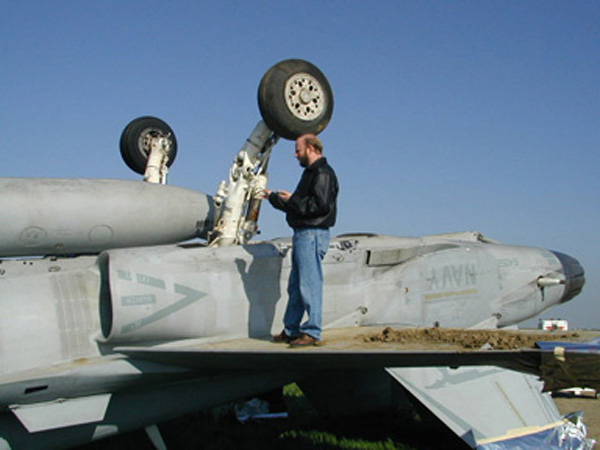
Chrys Starr ascertains the center of gravity on the inverted Hornet.
Lemoore 3
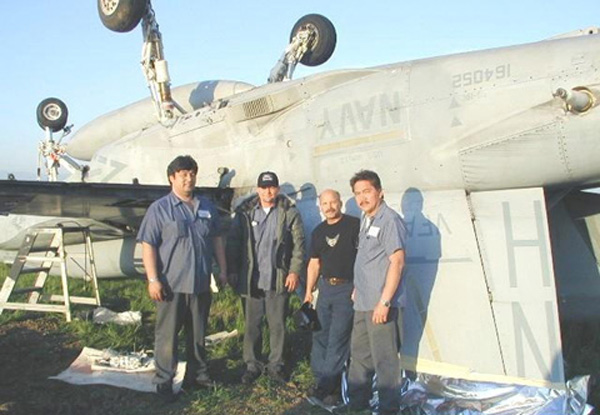
The Field Modification team: from left Tom Moore, Mike Bolt, Luis Morales, and Estelito Buyson.
Lemoore 5
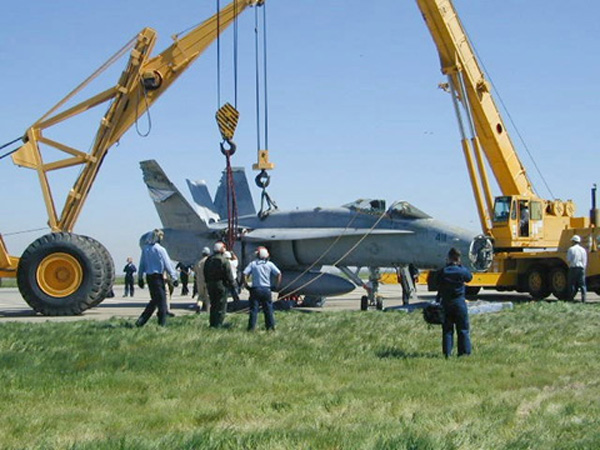
The stricken Hornet is inverted with the help of two cranes and lots of ingenuity
NAVAIR Field Service Team Lemoore flip flops a Hornet
Story, photos by Jamie Montgomery
NAVAIR Depot North Island
NAS LEMOORE, Calif. – What began as an ordinary day for the NAVAIR Depot North Island Field Service Team at Naval Air Station Lemoore, Calif., ended as an extraordinary day. The team reversed a wrong by “righting” a Hornet. During landing, an F/A-18C came to rest in the inverted position.
The recovery of an inverted aircraft is rare, and I believe it has never been attempted on a Hornet.
Someone asked, “How do we recover the stricken aircraft without incurring any additional damage?”
Lt. Bart Nadolny and Senior Chief Aviation Structural Mechanic William Marker, both assigned to Commander, Strike Fighter Wing Pacific at Lemoore asked Tony Araiza (a Depot production supervisor) and me how to right the Hornet. We concluded that the best course of action would be to remove the wings, which I believe had never been attempted before.
Araiza selected a small group of highly skilled artisans – Luis Morales, Estelito Buyson, Michael Bolt, and Tommy Moore – from his onsite Field Modification Team and immediately went to work.
Working in the dirt with a minimum amount of tools and support equipment, the team had the inner and outer port and starboard wings off and on trailers in record time so that the Hornet would not sustain any additional damage.
With the planning and estimating teams’ portion of the job complete, it was time to call in the Field Support and Rigging crew. Engineers Peter Chan and Chrys Starr, Code 4.3, Lt. Eugene Tillery with Lemoore’s Field Service, Araiza and I held a meeting to formulate the plan that would put the aircraft on its wheels. While Tillery had a lot of experience in this area, he still had a few questions.
He needed to know the center of gravity, how much the aircraft weighed and which parts of the Hornet were its strongest points. When he got his answers, he knew what to do with one exception.
How would the sling be attached to the aircraft to turn it upright? Moore answered the all-important question. He would manufacture steel sleeve bushings for a custom fit with Tillery’s shackles. These custom fit parts would allow the lifting sling to be attached to the wing attach lugs.
Tillery and his team went to work and used two cranes simultaneously.
The first crane used the modified shackles and sling attached to the inner wing attach lugs on the port and starboard sides and was used as the main lifting force. Once the Hornet was suspended in the air, the second crane was attached by the sling to the starboard side.
At this time, both cranes operated in opposite directions.
The second crane raised the port side while the first crane lowered the starboard side effectively rotating the aircraft in mid air.
It was a sight to behold as the Hornet came to rest right side up on its landing gear without any additional damage. The evolution took two hours once the cranes were in place.
The cause of the accident is being investigated.
Montgomery, is a planner with the Depot and assigned to Field Service at Lemoore.