
Cherry Point artisans take first steps to get Lean
By Mike Barton
Public Affairs Specialist
When David Smith first heard about Lean, he thought “it was just another tool that they were going to shove down my throat.” Now Smith, who runs the depot’s Shaft Shop, is a true believer. Smith’s shop was the first one here to begin being “leaned out” through Lean methodology and processes. Lean is a type of production system designed to eliminate waste, increase speed, reduce variation, reduce cost, simplify the process and consistently meet warfighter requirements – a system that will lead to big changes here at NADEP Cherry Point.
The new Lean production strategy is designed to eliminate wasteful steps in the way artisans do business. By looking at the “eight deadly wastes” – Overproduction, Inventory, Waiting, Non Value Added elements (something the customer is not willing to pay for), Defects, Excess Motion, Transportation and Underutilized People – the shop is able to address these issues and work toward increased speed, reduced cost and simplified work processes. This, in turn, will lead to increased production and quality. Smith’s shop was among the first in a full-scale plan to apply Lean principles to the entire production force here. Another apparently successful Lean event was conducted by General Electric in the T64 Assembly Shop.
Smith has already seen the benefits in his shop. “We had a lot of stuff in here that we didn’t need,” he said, referring to excess parts that littered every nook and cranny in the shop space. “We had parts that we thought we needed, but we didn’t.” Smith admits that he wasn’t very enthusiastic about the whole idea of Lean at first. “But my mechanics took right to it.” Smith explained that even his production controllers, quality assurance and the examiner/evaluators pitched right in to work with the program. Like many, Smith was not immediately ready for the cultural change that is part of Lean, but is now convinced that Lean has real benefits. He sees the broader view of how the depot has to change to compete with outside businesses. “They might be Lean too,” said Smith, who now embraces the basic Lean principle: Why are we doing it this way and can we do it better?
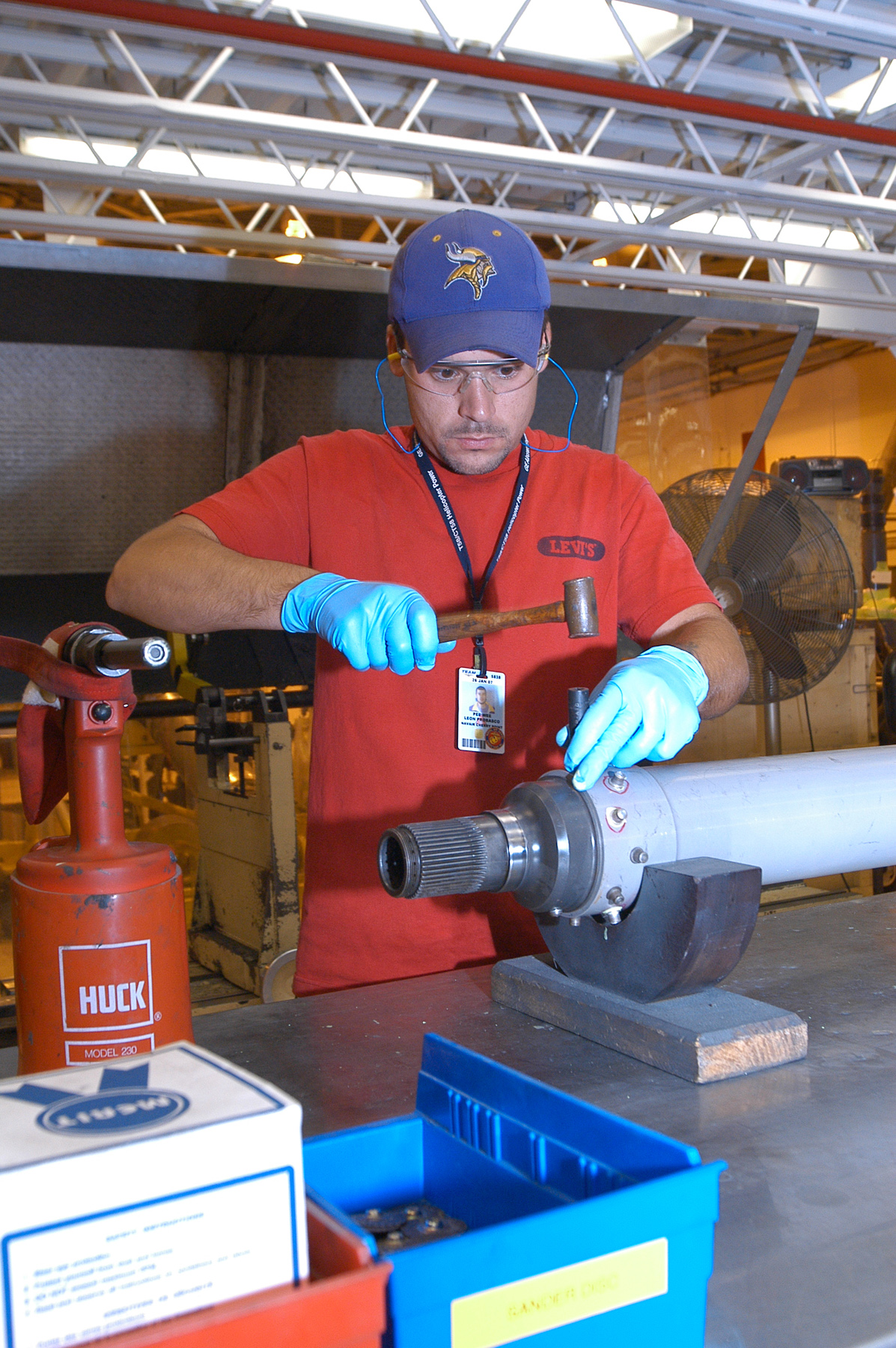
Smith also admits that he didn’t know why they hadn’t thought of these changes before on their own. “Maybe we thought we were already doing it the best way,” he explained with a shrug. Leon “Pee Wee” Probasco, a mechanic in the shaft shop, said he can see the benefits, but believes it will be much better when the rest of the depot gets on board. “If nothing else, it (the organizing) is allowing us more time for production,” said Probasco.
What exactly is Lean? Well, it isn’t a new computer program. And artisans won’t be sent to classes to learn some pie-in-the-sky business concept that looks good on paper but has no real usefulness in the real world. Instead, Lean facilitators will come to the artisans in their work places. They will measure the processes that artisans use to complete their mission every day and provide time- and work-trimming steps to those processes.
From a broader perspective, Lean is one of several initiatives under the AIRSpeed umbrella. AIRSpeed incorporates Lean, Theory of Constraints and Six Sigma (which all work hand-in-hand) as well as Drum Buffer Rope and Enterprise Resource Planning. All of these industry-proven initiatives are being tied together here to clean up and fine-tune the depot’s production processes to help the depot better support the warfighter. Col. J. Mark Reed, the depot’s executive officer, is closely watching this process. He sees how the combination of Lean and Theory of Constraints will help artisans to identify and remove bottlenecks in the production process, while the entire process is fine-tuned. “We will work with the artisans to determine why does this or that makes sense or doesn’t make sense,” said Reed. “We will then look for ways to reduce the steps to the next process.”
Michael Bogdahn, ERP and Lean/Six Sigma site lead, will lead the depot efforts in this initiative. Cherry Point has also awarded a contract to NC State Industrial Extended Services to assist Bogdahn in the training of core team members as well as the initial facilitation of Lean activities. All production areas of the depot are scheduled for Lean implementation. A steady process that is currently slated to run through July 2005 will bring visibility and some impact of Lean to all areas of the depot. “Lean stresses continuous improvement,” says Bogdahn. “You can count on the Lean team to always come back and assist you with all the sustainment and continuous improvement efforts that will be needed to make our workplace even better.”
He explains that it is a process that will encourage artisans to use their own improvement ideas based on their experience, while providing them with other tested means of improving their production procedures. In some cases, this may mean adjusting to changes in the way artisans do business here – something that often seems harder to accept than it is to do the actual changes.
Our first hurdle, says Bogdahn, will be to convince people to abandon fixed ideas – the old “we’ve always done it that way” attitude. “We don’t go into a shop and dictate changes, the artisans design the changes for us,” said Bogdahn. “We’re hoping that artisans here will not only be open to this process, but that they will already have ideas and will have begun the cleanup process by the time we get to their shops.”
-30-
Cutline: One rivet at a time...
Leon “Pee Wee” Probasco, metalsmith, sets a rivet on an H-53 aft input shaft in the depot shaft shop. His shop was the first here to undergo Lean implementation, which will affect all production areas by mid next year. (Photo by Mike Barton)