Components is a Lean(er) fighting team at NAVAIR North Island
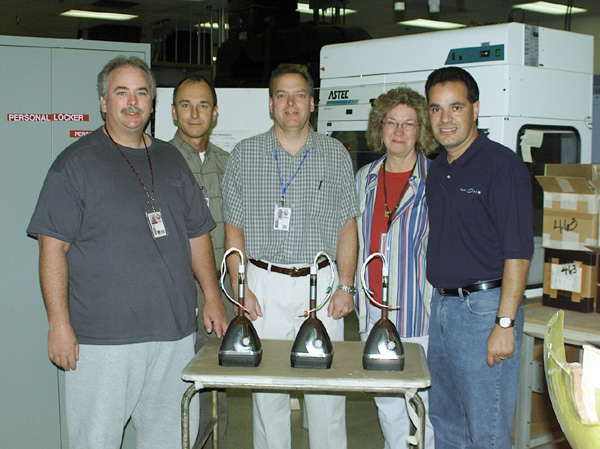
William Thayer, Randall Heath, David Giesenschlag, Theresa Cappello and Carlos Normandia (left to right) work on cathode ray tubes for F/A-18 heads up display in Building 463, a Lean area. Kevin Okerman is their team leader. Lead artisan Gilbert Araujo was not available for the photo. Photo by Joe Feliciano
AIRSpeed
Components is now a Lean(er) fighting team at NAVAIR Depot North Island
By Kevin Okerman
NAVAIR Depot North Island
CORONADO, Calif – To stay competitive in naval aviation, there is a challenge affecting how management conducts business. In the last few years, there have been changes that have affected the way the Depot’s Components program performs its workload. One of these changes is a drive towards partnering with private industry, or Performance Based Logistics (PBL). Depot management signed a PBL with the Boeing Co. for the F/A-18E/F Integrated Readiness Support Teaming (FIRST), and most recently with Kaiser Electronics to support the F/A-18A/D heads up display, digital display indicator, and digital repeater indicator.
When the Depot signs a contract with the private industry, it must abide by the parameters in the contract, otherwise the work will go to another provider. With the Kaiser contract, the Depot has 30 days to produce the display unit after it is inducted. After reviewing historical data on the display, Dustan Sandoval, Components program manager, said the program was going to have to improve its processes to meet the goal of the 30 days’ turnaround time. The average turnaround time was 137 days.
Organizational improvement requires the development of certain strategies that can streamline processes that are needed to get the work done. The entire Depot Corporation has embarked on implementation of this business process under the AIRSpeed program, which includes Lean, Six Sigma, and Theory of Constraints methodologies. The Component program has embraced one of these strategies with the “Lean” manufacturing methodology, to reduce waste and eliminate non-value added processing time.
Sandoval assembled an integrated team to “Lean” out this process. During the first week, the team reviewed and mapped out the current process and identified any possible waste. They walked wherever this display could be routed throughout the Depot, from when it was received from the distribution Depot until it was sold back to the supply system.
After documenting all the steps, the team created a “spaghetti chart” that showed the movement of the display within the process. The team uncovered some interesting facts: the display changed custody 22 times and traveled 14,164 feet, or almost three miles through three different buildings.
The team realized that to be competitive and reach the goal of 30 days, they needed to reduce the travel distances and custody exchanges, and at the same time ensure that the required quality repairs were performed.
To do this, the team had to consolidate the processes into one centralized area that would accommodate all the equipment. By negotiating with Avionics supervisors, Sandoval’s team obtained a new location for the production cell. The area had been a staging area for excess equipment in the avionics sector. Terry Cappello and Carlos Normandia, helped to inventory and remove the excess equipment from the shop’s custody. The team moved approximately 225 pieces of obsolete, broken, and/or excess equipment in three days.
With a proper area available, it was time to design the new production cell with the necessary equipment. The need for an industrial oven was the driving factor for moving the display. All surfaces shared the existing oven in Building 250. With the help of Jack Braun and Greg Kerr, a sufficient oven – that was identified as excess in previous “Lean” events – was moved to the new production cell in Avionics. The Depot’s Facilities competency hooked up the oven, and the rest of the equipment in support of production was moved from Building 250.
With the new location of the cell and the oven, 70 percent of all workload can be performed within the Avionics building. The travel distance was drastically reduced to 2,028 feet, and custody exchanges were lowered to only nine. The team estimates they will be able to process and produce these items in about half of the 30 days required in the contract. Until the rest of the point-of use equipment is delivered and installed in Building 463, the other 30 percent of the workload will continue to be routed to Building 472 for processing. The team will continue pursuing the equipment until 100 percent of all the work performed is contained in the Avionics building.
Through this process, the Depot is able to function more effectively without wasting time, energy and resources and maximize performance.
To be successful, many management strategies designed to increase profitability and throughput require employees’ participation. Such programs rely on the experience and performance of knowledgeable employees to achieve significant improvements in operations. This is a good example of how cross-functional experience provides a desired result that will help the Depot to stay competitive in the future.
NAVAIR provides cost-wise readiness and dominant maritime combat power to make a great Navy and Marine Corps team better.
Editor’s note: Okerman led the team that incorporated the Lean changes.