Oceana AIMD Sailors work smarter not harder
By Elizabeth Poe
Editor, Jet Observer
Note to Editors: Please see the sidebar below referencing a description of AIRSpeed.
How many times have you tried to suggest a different way of doing things only to hear one of the following answers?
“We’ve always done it that way.”
“That won’t fly around here.”
“We tried that before and it didn’t work.”
In any organization there will always be some people who resist any kind of change, even for the better.
Still, amazing changes can occur and that is exactly what’s happening at Oceana Aircraft Intermediate Maintenance Detachment. By implementing AIRSpeed tools, Sailors in the AIMD Electronic Countermeasures Center have reduced their working hours by 45 percent while increasing productivity by 30 percent, by implementing LEAN and the Basic Theory of Constraints (BTOC).
“LEAN and BTOC are processes in improvement. It’s a way of weeding out the things that inhibit your ability to perform your job,” said ATC(AW/SW) James Prince, the leading chief petty officer and security manager for Electronic Countermeasures Center, or Workcenter 640. “A LEAN process would make it simpler for you to perform something you do on a regular basis.”
LEAN can be applied to everyday life.
Just think about how much time you spend getting dressed.
“Most people think about what they’re going to wear when they get up in the morning. In that thought process they’re trying match the colors of the clothes they’re going to wear that day. So there’s time wasted. LEAN would suggest setting up a schedule for what you’re going to wear to work Monday through Friday. So you always know what you’re going to wear. Instead of spending two hours to get ready in the morning, you can get ready for work in 45 minutes. You’ve saved an hour and 15 minutes.
“In the military that’s cost. If I can complete a process faster, using less time, I’m working more efficiently,” said Prince, who supervises about 45 Sailors.
AT2(AW) Eddie Meharg has been at Workcenter 640 since December 2002. At that time there was an extremely high backlog.
“We didn’t get as much production done as we possibly could. It was pretty rough,” Meharg said.
The Sailors in the shop worked nine-hour days during the week. “On duty weekends, we put in about 10 hours a day on Saturdays and six hours a day on Sundays,” Meharg said.
It wasn’t any fun.
“When I first got here, morale was so bad that people on shore duty were volunteering to go on sea deployments,” Meharg said.
“The entire philosophy of how we approach production and maintenance of gear has changed,” he said. “When Chief Prince reported, he gave all the technicians in the shop the opportunity to tell him what they thought was wrong and what they thought would fix it,” Meharg said.
Meharg was surprised that the Sailors’ input was requested. “It was a big shock. My time in the Navy has never been that way. How ever management told you to do things, if you didn’t do them that way you got in trouble,” Meharg said.
Changing the way Workcenter 640 did business began with the reconfiguration of the workbenches and toolboxes to make everything more accessible to the technicians. It eliminated a lot of unnecessary steps, which saved time.
“The fact is that now we’re working smarter, not harder,” Meharg said.
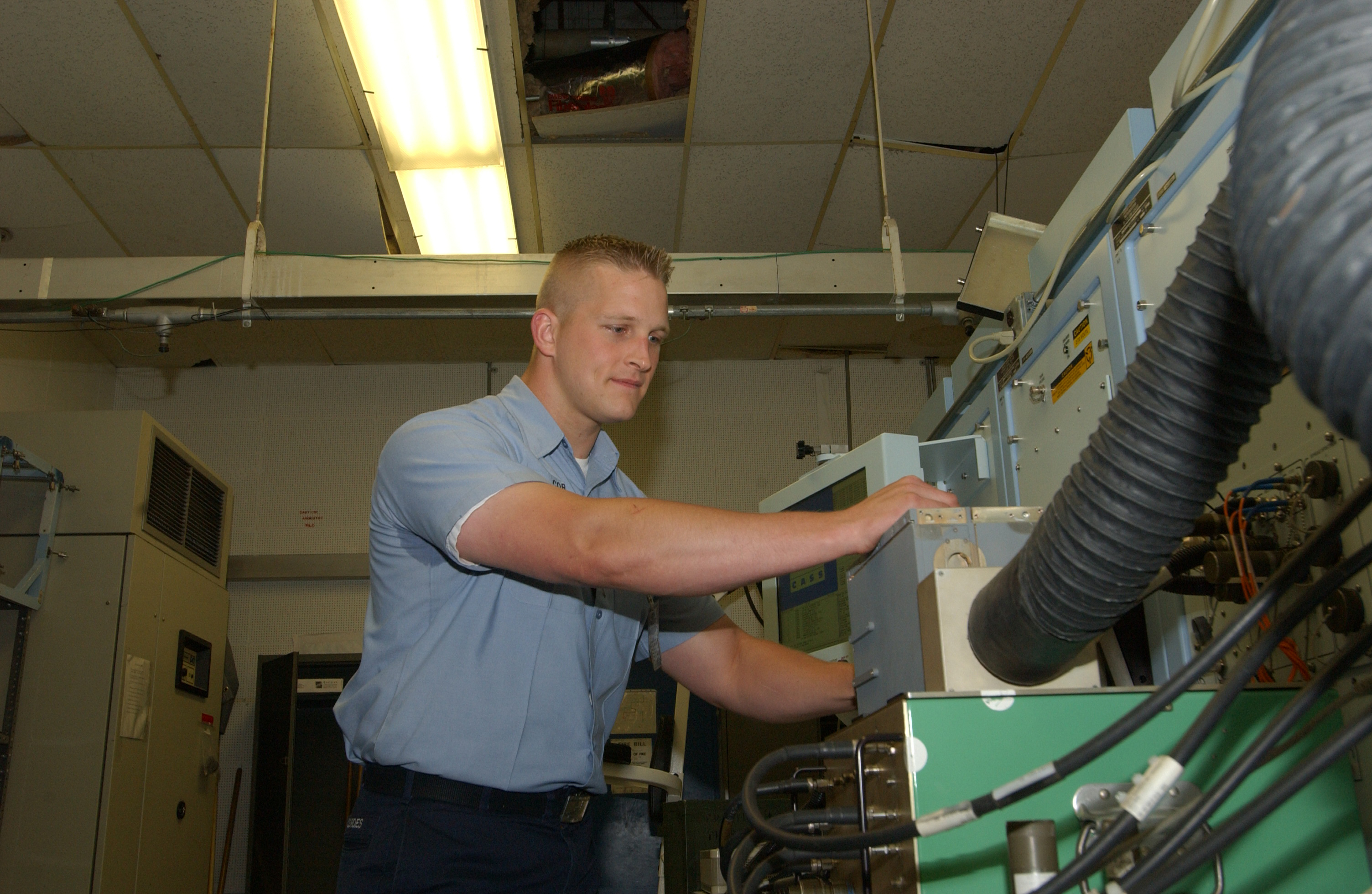
“We’re doing less work, but accomplishing more,” said AT2(AW/SW) Paul Cordes, who is TAD from AIMD Norfolk. Cordes is an E-2C Hawkeye aircraft technician.
Another important change was redistributing experience.
“We were very thin on experience. We had a lot of people rotating in and rotating out,” Meharg explained.
When Meharg reported, the shop was running three full shifts. The experienced Sailors had to run production and perform administrative duties just to try to keep up with the backlog. So the senior Sailors weren’t able to supervise the junior Sailors working at the benches.
“The main problem was lack of training,” said AT1(AW) Daniel Blaylock, who joined the shop in October.
By focusing on training – not the backlog – and how to do the work properly, the shop became more efficient. Previously when the shop received gear, the technicians would troubleshoot the gear and determine which parts needed to be fixed or replaced.
“But they’d get the parts in, put them in and it would still be broken. So they’d have to troubleshoot it again,” Blaylock said. It wasted man-hours and money. Last year the shop reordered $300,000 worth of parts because of cannibalization.
Blaylock said that once the shop began focusing on proper troubleshooting procedures in order to get the job done right the first time, the attitude within the shop changed dramatically.
“We consolidated and got rid of a complete shift and brought our experience back to the junior Sailors so we can train on a daily basis. It created an ability to eliminate mistakes before they happen and to raise the entire quality of all the technicians,” said Meharg, who is a collateral duty inspector.
Meharg says it’s made an enormous difference in the shop. “We came together and created a team concept. Each section has a team leader and it gives the junior Sailors a person to go to when they see something they haven’t seen before. The senior guy has seen it before or knows a way to figure it out. Electronics are funny. They can do different things every time they fail,” Meharg said.
“One thing that I’ve been impressed with – and hadn’t encountered yet in the Navy – is our ability to take a relativity small group of people and accomplish such a large amount of work in a very effective and efficient manner. And it’s showing in the numbers,” said Cordes, who is the day shift production supervisor.
The benefit to the Sailors is tremendous. Whereas weekend duty used to be simply par for the course, Sailors now have their weekends free, unless they are standing a watch or assisting Reserve unit training.
Best of all, by empowering the Sailors in their everyday activities, Blaylock says, they empower themselves in their own career development.
“It gives them something to strive for on a daily basis, which ultimately results in advancement and added responsibilities, and makes for a stronger Navy,” he said, because “when I can do the job of three or four people or an airman can do the job of two or three people, we’ve just met the requirements of what the Navy is shooting for.”
Positions in the shop are well defined. By establishing a direct area of concern for every individual within a workcenter, the machine that seems overwhelming at times is broken down into its basic components, Blaylock said.
On the day shift, Cordes assigns tasks as necessary to the team leaders, who in turn assign tasks to their team members. “It ends up being a real smooth transition without a lot of confusion,” he said.
Morale has gone through the roof in Workcenter 640. “The entire shop morale has gone up. Everybody looks forward to getting in here and getting the job done. We have hardly any personnel issues anymore,” Meharg said.
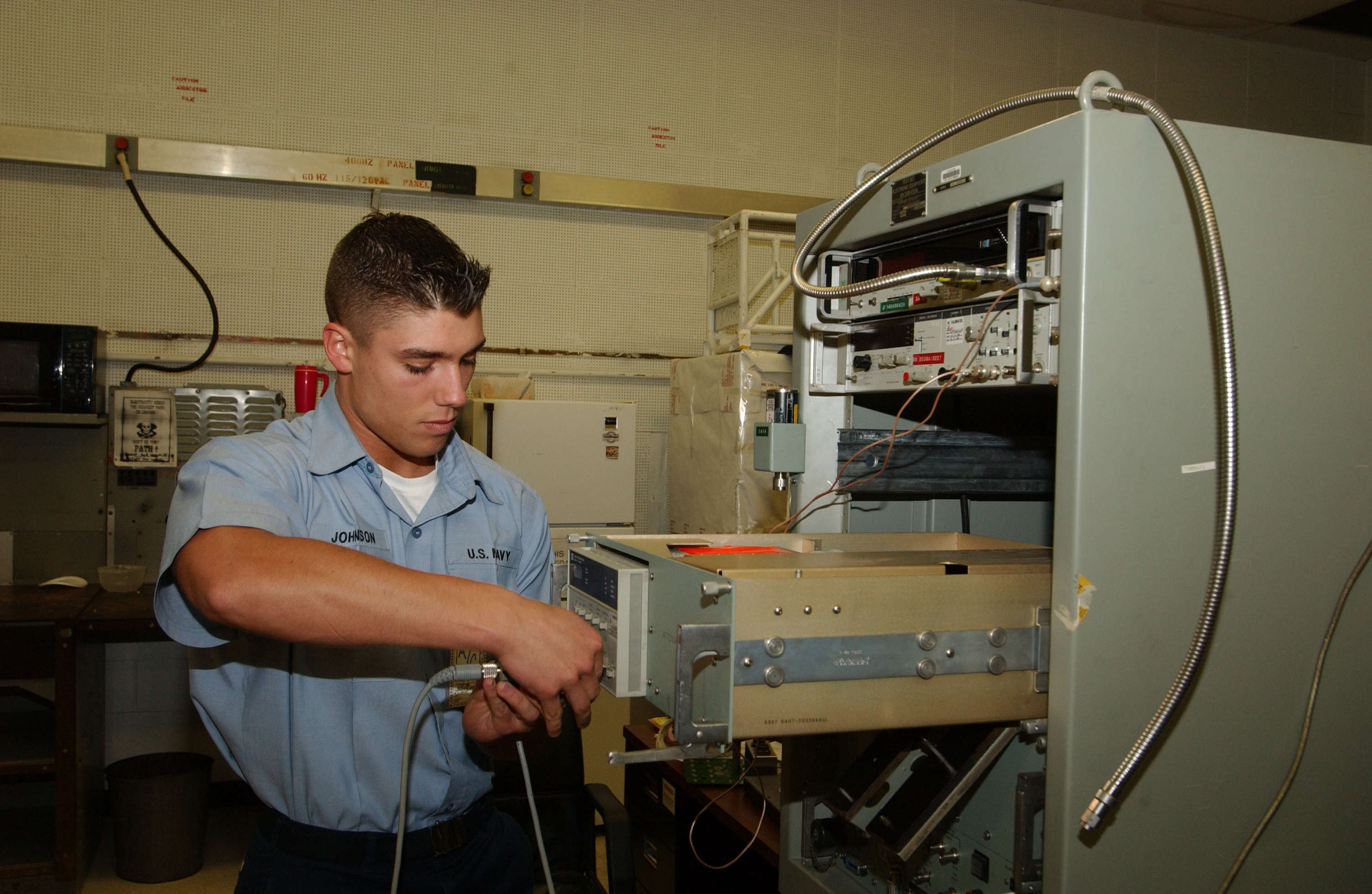
AIMD 640 is ATAN William Johnson’s first command, and he said the atmosphere is fairly relaxed.
“Everybody has their stressful moments, but I’m getting a lot of good training in this shop,” Johnson said.
As shop management is receptive to new ideas, Johnson is able to use his own ingenuity to develop a piece of gear that will ultimately save the shop more money and man-hours. He’s creating a box to test cables on test benches that will indicate if the cables are working by simply flipping a switch. At present, the cables must be checked individually pin by pin.
“When I first got here, everyone was being driven to work toward the numbers, the backlog. That was their whole focus – getting gear out the door,” Blaylock said. “Nobody liked that. Now all anybody has to worry about is getting trained to troubleshoot effectively.
AWP (awaiting parts) and the backlog have dropping steadily and significantly.
“As that came down the stress level of the workcenter came down as well. Now everybody comes to work to be trained, not to get beat up about the backlog,” Blaylock said.
Other benefits to Sailors include being able to workout more frequently on shop time in the morning as long as the backlog doesn’t go above 80. When Blaylock reported to the shop the backlog was well over 100 items needing repair. Now the backlog averages about 65.
Blaylock credits the team environment with empowering the techs. “It’s strengthened the chain of command and streamlined accountability. Training time has been cut in half,” he said.
Additionally, the team concept allows Sailors to complete tasks effectively in the absence of the team leader. Team members are rotated periodically so that everyone has the chance to learn how to operate various workbenches in the workcenter.
“Within the next six months every person in the shop will have the chance to learn how to do every job in the shop,” Blaylock said.
“The only thing that holds anyone back is themselves. Now everyone has to opportunity to excel if they take advantage of it,” Blaylock said. “No matter who you are – a supervisor, a chief, a division officer – you need to understand that there is always room for improvement,” Blaylock said. He also said that he was certain that the Sailors in Workcenter 640 would have to opportunity to advance in the Navy.
“Their future is laid out for them if they want to take it,” he said.
SIDEBAR
What is AIRSpeed?
“Naval Aviation has changed its focus to costwise readiness,” said Lt. Cmdr. Mark Nieto, who is attached to Naval Air Systems Command, NAS Patuxent River.
“In order to make that happen, AIRSpeed takes industry innovations and tools proven in the commercial sector and other parts of the military and implements them at maintenance and supply activities,” he said.
AIRSpeed will result in significant savings for the Navy, by achieving higher levels of readiness without incurring significantly more cost.
AIRSpeed tools are Lean Maintenance, Six Sigma and Theory of Constraints, and they are implemented by different teams.
Theory of Constraints is based on the belief that any organization has at least one constraint and that any improvements on non-constraints may not yield as significant a return on investment as working on the constraint.
LEAN focuses on the removal of waste-defined as anything not necessary (no value added) to produce the product or service.
Six Sigma is based on the assumption that the outcome of the entire process will be improved by reducing the variation of multiple elements.
LEAN at AIMD Oceana
•Eliminated 30 Bare Fire Walls and now have 22 spares for the F-404 Engine
•Decreased F-404 Rail usage from 18 to 6
•Reduced F-404 Engine Turn Around Time from 78 to 27 days while maintaining a 15 percent increase in module builds
•Reduced F/A-18 hydraulic actuator cycle time by 47 percent
•BRU-32 bomb rack reliability increased 40 percent due to improved build quality.
Aircraft Intermediate Maintenance Detachment Oceana is the first command Navywide to implement all AIRSpeed tools.
“This workcenter (AIMD 640) was considered a Constraint workcenter, because there were not enough hours in the day for us to meet the demands placed on us by the squadrons,“ said ATC(AW/SW) James Prince. “We looked at getting more Sailors, more test benches, we looked at everything.”
Nothing worked until they tried the AIRSpeed tools.
“Change is good if it’s change for the right reason,” Prince said. “LEAN, Six Sigma and the Theory of Constraints allows us to make change based upon the statistical data.
“You just have to honestly look at the way you’re doing business, and say there is a better way to do it,” he said.
For more information on AIRSpeed, link to https://logistics.navair.navy.mil/airspeed/, or 301.757.1487.
Photos by PH3 Mark Gleason
Caption 1:
AT2(AW/SW) Paul Cordes aligns a weapons replaceable assembly on CASS. CASS is Consolidated Automated Support System. "It's the latest and greatest in avionics test benches. Ideally it's supposed to be the one test set the Navy utilizes," he said. CASS allows AIMD to take on increasingly more intermediate level avionics maintenance."A lot of things that have traditionally gone to depot are being supported by CASS," Cordes said.
Caption 2:
ATAN William Johnson hooks up a power meter to be calibrated for the sweep cart.