Paint shop cleans up environmental act
By Michelle Burroughs
Industrial Environmental Program Division
and Mark Meno
Research and Engineering Group
Artisans here at the Cherry Point depot can breathe easier these days thanks to the depot’s continual efforts to improve its industrial methods and chemical use, efforts that directly support the depot’s environmental policy -- “Supporting Naval Aviation Through Proactive Environmental Stewardship and Compliance.”
The National Emission Standards for Hazardous Air Pollutants regulations were enacted by the United States Environmental
Protection Agency for the purpose of lowering air pollution from aerospace manufacturing and rework facilities. Among other impacts, this limited the use of paint removers containing what is considered a hazardous air pollutant (HAP). All three depots are subject to these regulations, and compliance is mandatory.
Fines levied can total up to $25,000 per day, per incident of
noncompliance.
Due to its unique ability to penetrate and lift most types of finishes, methylene chloride has been the paint removal solvent of choice in industry and DOD for years. Unfortunately, some of the chemicals used most frequently in industry and DOD turn out to be the most harmful to our health and the environment. Methylene chloride, a volatile HAP, is one such chemical.
Why take off paint? Paint is removed from aircraft and components to facilitate corrosion work, inspections for cracks and other damage, and because of overall paint condition.
At the naval air depots, paint is removed from an aircraft or component before reworking or repainting either by chemical stripping or abrasive blasting. In order to chemically strip paint from an aircraft or component, solvent is applied to the aircraft or component by spraying, wiping or dipping and the paint is then steamed or scrapped off. Before steaming or scraping occurs, the solvent must remain in contact with the painted surface for a period of two to eight hours, depending on the paint stripping system being used.
Paint is removed from most aircraft and large components using plastic media blasting. However, there are instances when abrasive blasting cannot be used effectively, such as “flight ready aircraft” and blast damage sensitive components. These cases warrant paint removal using chemical stripping.
All three depots have worked hard to achieve a high level of compliance with the Aerospace NESHAP. In a move to reduce the amount of HAP stripper used at the depots, the materials engineering division – comprised of chemists, material engineers and engineering technicians – led the way to the three depots’ success. As is often the case, these benefits are pushed out to fleet maintainers where applicable, when facilities and conditions allow, and once the processes have a prototype, are fine tuned and written into applicable maintenance manuals.
The following headway has been made at NADEP Cherry Point:
n The primary paint removal method for aircraft and aircraft components is plastic media blasting.
n There have been additional reductions in methylene chloride based paint removers with the implementation of MIL-R-83936 heated tank paint removers and TT-R-2918 aircraft surface paint removers.
n Methylene chloride based paint removers are only used for dress-out work around previously masked areas and some minor component paint removal when the heated tank process is fully loaded or is otherwise unavailable.
At Cherry Point, Supporting Naval Aviation Through Proactive Environmental Stewardship and Compliance is more than just a nine-word phrase. It is a rule that we can all live by.
-30-
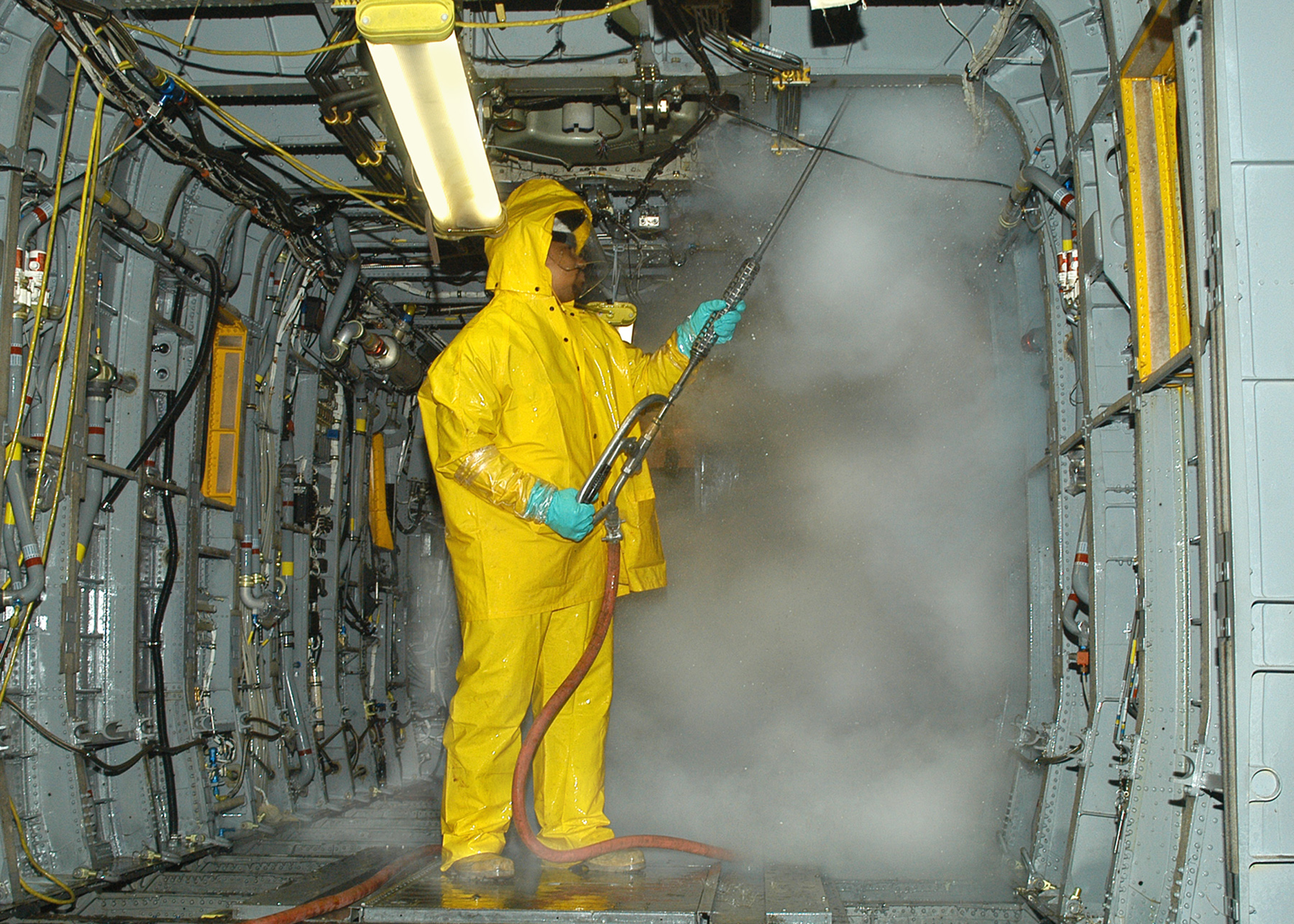
Clad head-to-toe in waterproof clothing, Albert George, a blaster/cleaner in the strip barn, steam-cleans the inside of an H-53 helicopter. Steam cleaning is one of several methods used at the depot to reduce the use of hazardous chemicals. (Photo by Mike Barton)