
Training to Assess the Threat: NAVAIRSYSCOM Det. 0474 Personnel Support Joint Combat Assessment Team Readiness
By Lt. Mike Neaves, NAVAIRSYSCOM Det. 0474, and Lt. Mike Randazzo, NAVAIR Air Systems Program Public Affairs Officer
Mission planners rely on real-time combat data to immediately establish the threat environment and improve planning of ongoing operations. As an integral part of a joint service combat assessment team, Naval Air Systems Command (NAVAIR) Air Systems Program (ASP) personnel aggressively train to add value to this effort and contribute to current and future Naval aircraft combat readiness.
Sponsored by the Joint Technical Coordinating Group on Aircraft Survivability (JTCG/AS), the Joint Combat Assessment Team (JCAT) is comprised of reservists from the Army, Navy and Air Force. JCAT's primary mission is to collect data on aircraft combat damage and losses.
During recent conflicts, the lack of a permanent combat damage reporting system resulted in the loss of valuable combat damage data. In 1999, JCAT was established as a reserve unit ready to rapidly deploy and collect combat data anywhere in the world.
Lcdr. James Bogden and Lt. Mike Neaves joined JCAT from NAVAIRSYSCOM Det. 0474, which supports NAVAIR's Naval Aviation Depot at Naval Air Station Jacksonville, Fla. Det. 0474 is aligned with NAVAIR's Industrial Capabilities unit which delivers the people, skills, knowledge, facilities, and equipment required to perform depot-level maintenance and repair of aircraft, engines, components, and other aeronautical equipment, and performs manufacturing and prototyping operations.
The JCAT unit also provides threat training to aviators and battle damage repair personnel. "An important part of this mission is to ensure that we continually train for the mission to ensure that we are ready to be deployed when ever and where ever we are needed," Lcdr. Bogden said.
Bogden and Neaves recently participated in a two-phase training session geared toward raising awareness of threat assessment and combat data collection.
The first phase of the training was the 2003 Threat Warheads and Effects Seminar at Hurlburt and Eglin Air Force Bases, Ft Walton Beach, Fla. The annual threat seminar covers the entire spectrum of threat weapons including small arms, AAA, rocket propelled grenades (RPGs), manned portable air defense systems, and the latest Russian surface-to-air missile systems. Threat exploitation hardware displays and live fire demonstrations of small arms, RPG’s, and a Stinger missile serve to reinforce the classroom material.
The second phase of JCAT training consisted of hands-on combat data collection training hosted by the NAVAIR Weapons Survivability Laboratory at China Lake, Calif.
“We received valuable training on the effects of hydrodynamic ram from armor piercing and high explosive AAA, conventional metal versus composite structural damage, and warhead fragment and pattern identification. The combat data collection training provided us with the techniques and abilities needed to collect damage information in the fluid combat environment while minimizing the impact on the maintenance personnel trying to get the aircraft back into action," Neaves said of his recent training experience.
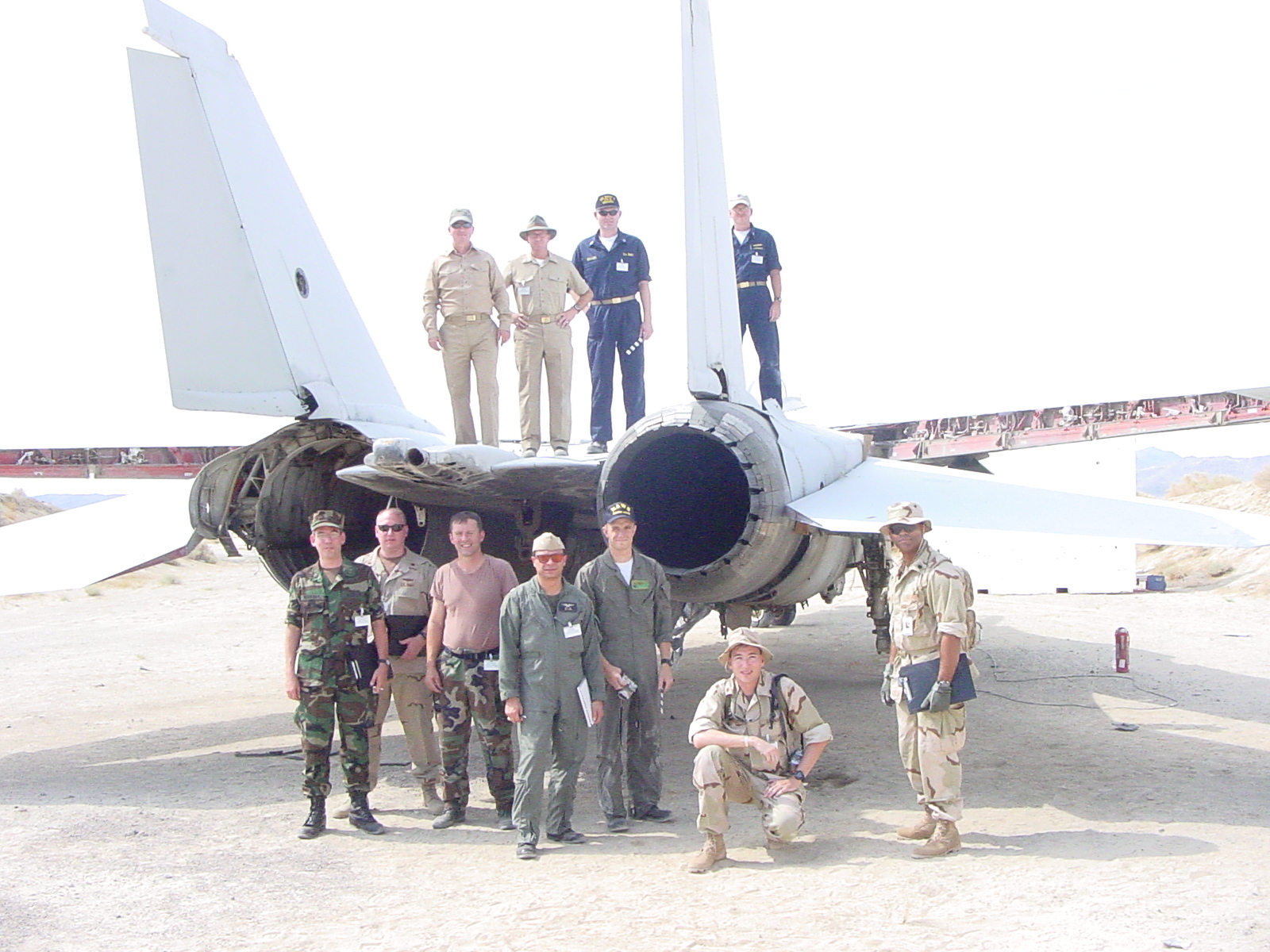
Participants observed an F-14 live-fire demonstration and collected damage data on a variety of aircraft including an F/A-18 Super Hornet, V-22 Osprey, Harrier, and C-130. Each complete training assessment consisted of data collection (measurements, photographs, interviews, etc.), preparing a presentation, briefing the findings, and an instructor critique of student performance. Emphasis was placed on proper damage documentation for future reference and briefing operational commands.
"Projecting ASP technology and operations support at the depot level, even in a joint operating environment such as JCAT, is key to the ASP strategic planning process: to create a more ready and responsive Naval Air Systems Reserve Force," said Rear Admiral Mark Hazara, Director, Naval Reserve Air Systems Program"
"Harvesting combat data to improve survivability and provide a database of lessons learned for future aircraft designers supports our effort to provide NAVAIR with readily deployable assets to provide optimum current and future material readiness," Rear Adm. Hazara added.
The Air Systems Program (ASP) provides qualified and diverse civilian and military experience in operational support of Naval Air Systems Command (NAVAIR) research and development, engineering, program management, logistics, and industrial capability activities. The 600 Naval Reserve officer and enlisted men and women of the ASP train constantly to respond to evolving NAVAIR missions enabling the organization to harvest tangible cost savings for fleet recapitalization. The ASP is comprised of 32 commands that are headquartered in 14 states.
For more information about ASP please contact Lt. Mike Randazzo, ASP Public Affairs Officer via e-mail at [email protected].
NAVAIR (www.navair.navy.mil) provides advanced warfare technologies through the efforts of a seamless, integrated, worldwide network of aviation technology experts. From aircraft and weapons development to carrier launch and recovery; from sensors to real-time communications to precision targeting; from aircraft and weapons sustainment to state-of-the-art training; NAVAIR provides dominant combat effects and matchless capabilities to the American warfighter.
Photo 1: JCAT Team with live fire testing F-14: As an integral part of a joint service combat assessment team, Naval Air Systems Command (NAVAIR) Air Systems Program (ASP) personnel from NAVAIRSYSCOM Det. 0474aggressively train to contribute to current and future Naval aircraft combat readiness. (Lcdr. James Bogden is second from left on top, and Lt. Mike Neaves is third from left on top.)