
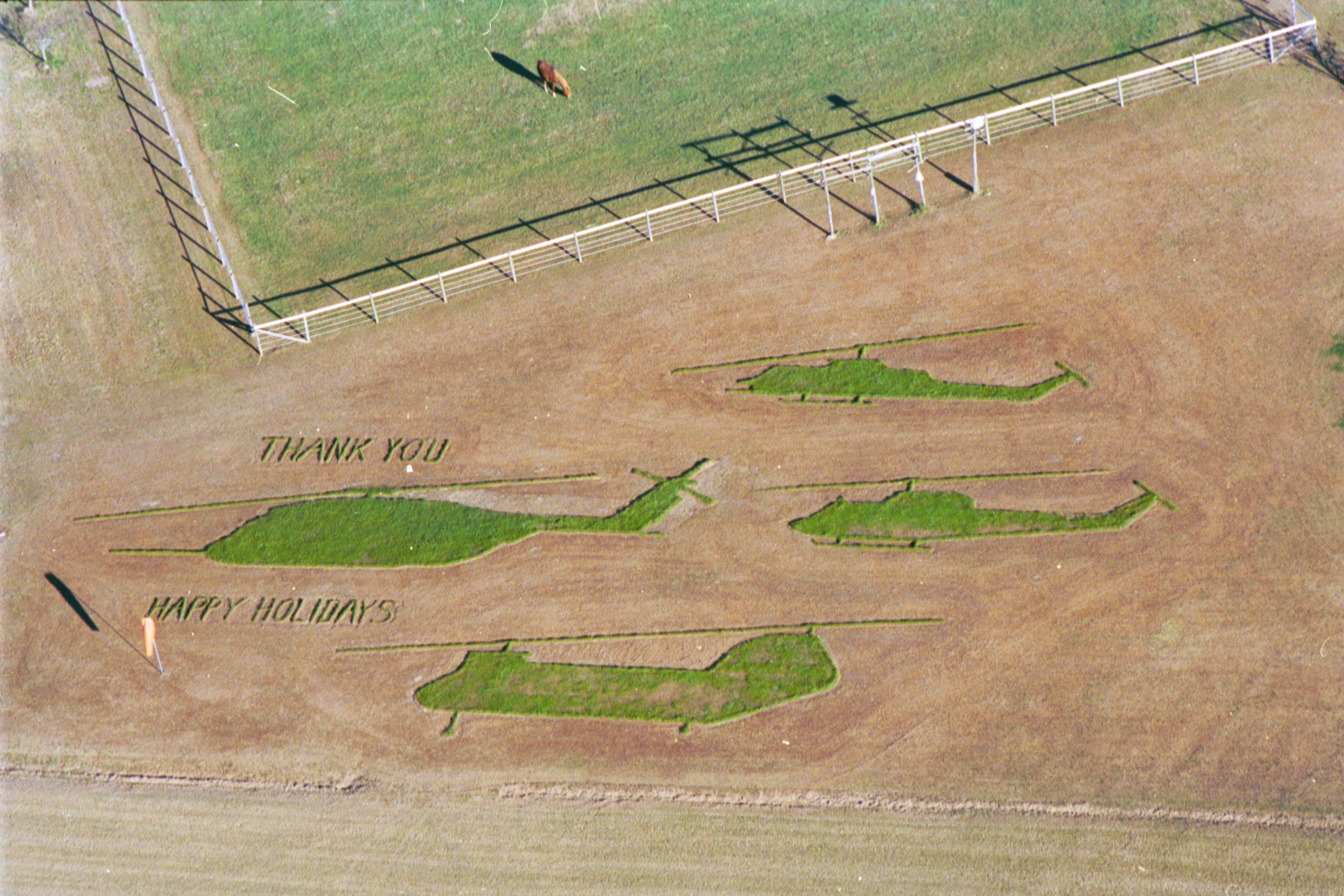
Grassy greeting for local Marine helicopters
By Mike Barton
Public Affairs Specialist
NAVAIR DEPOT, MCAS Cherry Point, N.C. -- Tom McFalls has a thing for aircraft. He works on them, he flies them, and unlike probably anyone else in the world … he grows them in his front yard.
The 61-year-old aeronautical engineer for the H-53 helicopter program here at NAVAIR Depot Cherry Point has had his hands on one type of aircraft or another for 43 years. He began as an enlisted crewman in the Navy and later became a bombardier/navigator in the Navy’s premier attack jet, the A6-E Intruder. After 22 years in the Navy, he retired and moved into civil service, where he has spent the last 19 years working on the H-53.
Like many former service members, if you ask him where he is from, he will answer, “All over.” But when he transferred to Cherry Point several years ago, something happened – he began to put down roots.
OK, here’s where we get to the “growing” part. You see, it was only five or six years ago that McFalls began constructing helicopters from grass and dirt on his property near Maysville, N.C. No, this isn’t one of those X-File sort of things. It’s just his way of giving a holiday greeting to the local Marine helicopter crews out of MCAS New River, or anybody else who happens to be flying by.
In the past, says McFalls, it was only designs of lone H-53s that climbed up through the dirt and brown summer grass. But this year, in honor of all of the service members who are serving in the Middle East, you can also see a Cobra, a Huey and an H-46 springing to life from the winter rye. The message – Thank You, Happy Holidays – appears beside them in five-foot letters. “I just want (the young Marines) to know that we appreciate what they do,” says McFalls, a man who has quietly spent his own life in support of his country. “I get my thrill or payback when a Marine aircraft circles around, obviously looking over the greeting.”
When you look at this small squadron, laid out in bright green against the surrounding winter stubble, you can get an idea of the kind of guy McFalls is – patriotic, thoughtful, precise. The engineer in him shows in his designs, drawn carefully from official profiles, staked out in grids, outlined in the grass and fill-planted over the course of several days. And if you see them from the right angle, they just might appear to be landing near the faded orange windsock beside the narrow grass landing strip that stretches through his yard.
McFalls built that strip so that whenever the mood strikes him, he can easily take to the air in his small Piper Cub, which he has flown for more than a quarter of a century. Sure, it’s a huge difference from tooling around in a multi-million dollar jet war bird, but according to this old pilot, “It’s good for what ails you.” His 1,000-foot private strip – flanked by his home, a horse pasture, and by power cables at one end – doesn’t attract much landing traffic. In McFalls wry words, “It keeps the riffraff out. A lot could probably get in, but they’d have to be catapulted out.”
But he is quick to point out that he doesn’t mind aerial visitors, because that’s what his helicopters were “grown” for. They can only be seen from the air, appearing in late October and lasting – with regular care and trimming – until the surrounding grass greens in the spring. To most civilian aviators, his place would be just an interesting sight about two miles west of Maysville, halfway between New River and Oak Grove. At coordinates N 34 54.4, W 77 16.1, it doesn’t even appear on pilot sectional charts. But to a passing Marine aviator who has brethren out in a combat zone, it is a symbol of respect from a man who has always been with them in spirit. And to Tom McFalls, it is the one place where he has finally been able to put down roots, without giving up his love for the sky.
-30-
Photo cutline: Seen only from the air from late fall through spring, Tom McFalls’ squadron of helicopters greet Marine and civilian aircrews who pass over his private airstrip near MCAS New River. The NADEP Cherry Point aeronautical engineer increased the display from one to four birds this year in honor of service members stationed on foreign soil. (Photo by Tom McFalls)