USS Truman Kicks-off Lean Program
By Journalist Seaman Jennifer Carl
USS Truman (CVN 75) PAO
NORFOLK, Va. – Increased productivity is important to achieving maximum operational effectiveness. With this in mind, the Department of the Navy is testing a variety of programs called continuous process improvement methodologies, such as Theories of Constraints, Six Sigma and Lean, in an effort to make the most of its assets and streamline production.
USS Harry S. Truman (CVN 75) kicked off its first such program, on a carrier March 10. The program is called Lean-Pathways and the Navy’s first implementation of AIRSpeed aboard a carrier. Lean means exactly what the name implies – trimming the “fat” from inventtory and cycle time. AIRSpeed originated in the three Naval Aviation depots as a part of NAVRIIP.
The program is designed to minimize waste within the production process. It focuses on giving the customer what they need, when they need it, without defects and at the lowest possible cost. HST is implementing this program in an effort to improve maintenance and supply flow.
Lean is one of three methodologies the Navy is looking at using to sustain cost-wise readiness and to re-capitalize within its $115 billion annual budget, according to Nick Kunesh, deputy assistant secretary of the Navy (Logistics). The other two programs are Theory of Constraints (TOC) and Six Sigma. TOC focuses on system improvement through the removal of any constraint in the proces. Six Sigma aims to reduce variations by identifying any problems within the process and working to eliminate them.
“The efficiency methodologies can help to improve readiness and increase velocity in the repair cycle,” said Kunesh. “They can increase capabilities while cutting labor and material costs.”
A Lean team spent 11 days aboard USS George Washington (CVN 73) gathering and analyzing data concerning maintenance, supply and the repair cycle. The analysis resulted in a number of observations that will help in determining how Lean will be implemented on HST.
For HST, the implementation of Lean could mean rearranging some workstations and shops, according to Ralph Day, one of the team members who visited GW. Among the areas most profoundly affected by changes made through Lean are the aviation support division (S-6) within the supply department and the aircraft intermediate maintenance department (AIMD).
A five-day Accelerated Improvement Workshop (AIW) began March 29 on board HST. The purpose of this workshop is to evaluate the changes that need to be made and to train future Lean leaders from HST. Once Lean certification is earned, a Sailor will be responsible for leading any future training workshops and encouraging sustainment of the program.
During the kick-off, Kunesh’s presentation included quotes from President George W. Bush, the Secretary of the Navy and the Chief of Naval Operations. All of these leaders are calling for transformation in the military.
Efficiency methodologies are just the beginning of the transformations the Navy is considering. Other transformation ideas include the concept of sea-basing and the design of CVN 21, the next-generation aircraft carrier. The focus of all of these concepts is to support speed, agility, flexibility and sustainment.
Sea-basing is designed to give the Navy staying power, self-sufficiency and the ability to get to a fight quickly, according to Kunesh. Sea-basing would also put 80 percent of the world’s population within range of naval forces.
CVN 21, which is planned to be available around 2011, calls for reduced manning, improved survivability and more efficient flight operations. The new design will reflect any improvements made on HST through the implementation of Lean, according to Rear Adm. Michael Bachmann, Assistant Commander for Logistics, NAVAIR. Bachmann also noted that while the design for CVN 21 aims to reduce the manning by 750 and 1,000 people, plans for increased manning in future air wings will present an extra challenge.
“We will have to change ship design to make this work on a carrier,” said Bachmann.
By implementing Lean, on the HST is helping to make the transformations and improvements that will make the Navy more efficient. “This is the right time and the right place to start this off,” said Kunesh. “We’re really looking forward to doing this on Truman.”
For related news, visit the USS Harry S. Truman, Navy NewsStand page at www.news.navy.mil/local/cvn75. For information on the AIRSpeed program, contact the program office at 301.757.2649
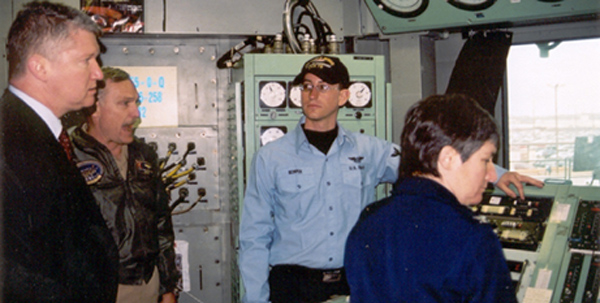
Photo Caption: Nick Kunesh, deputy assistant secretary of the Navy (Logistics) and Air Force Col. Sarah Smith, representative from Department of Defense for Maintenance, Policy, Programs and Resources, receive a brief from the Commanding Officer Capt. Michael Groothousen, and AE2(AW) Michael Kemper, test cell electrician, in the engine test cell on the Truman. (Photo by Eddie Riley, NAVAIR Public Affairs)